Union Budget Biopharma Push Versus Grassroots Public Health Funding
Source:The Hindu ↗
Why It Matters
Provides a critical analysis of India's health sector budgeting, exposing the gap between ambitious industrial/biopharma policies and the persistent underfunding of grassroots public health infrastructure. Crucial for GS2 answers on social justice, healthcare targets, and human resource development.
Summary
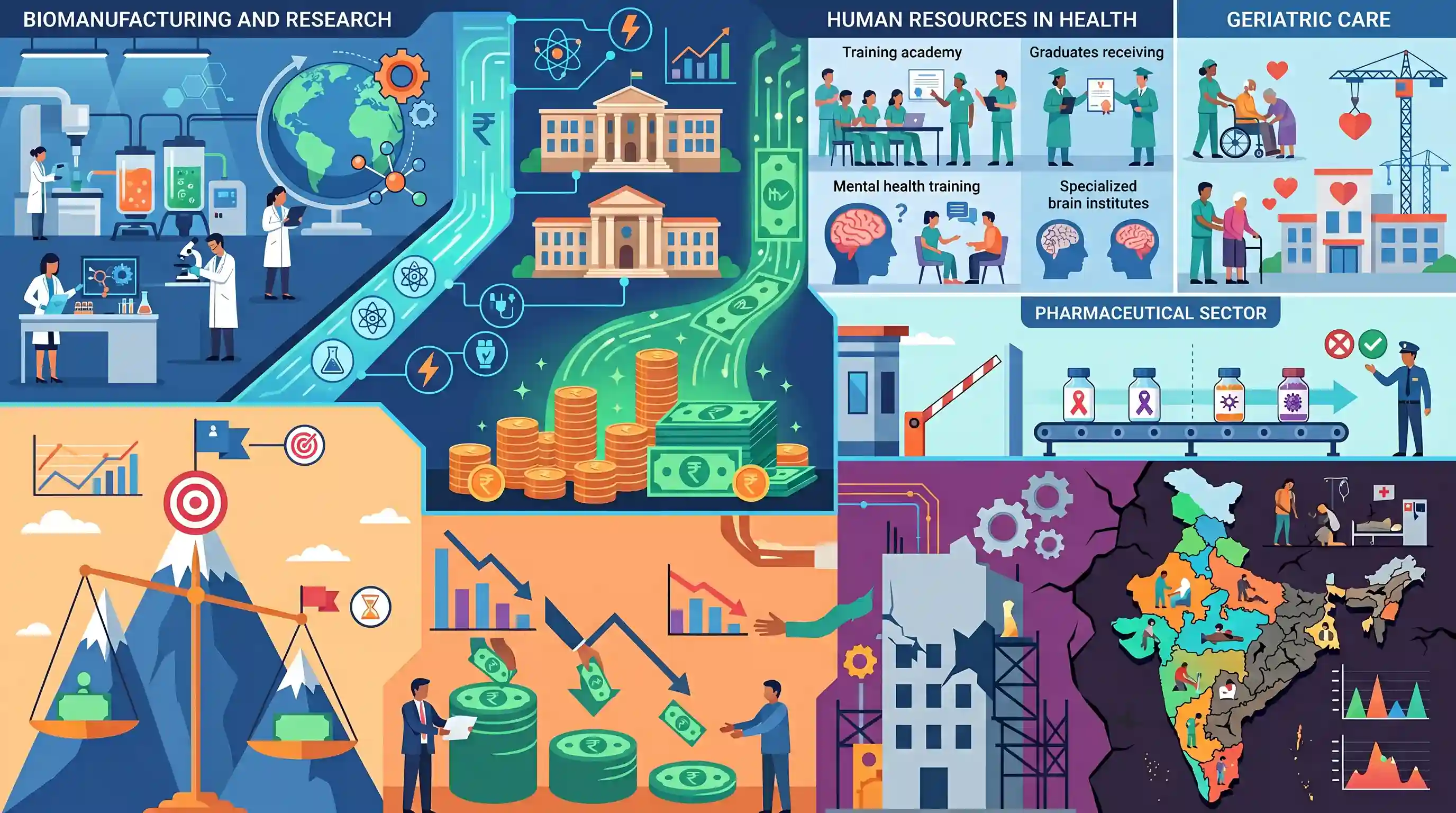
The Union Budget 2026 allocates over ₹1.05 lakh crore to the health sector, prioritizing biomanufacturing, research, and human resource development, while simultaneously missing broader public health funding targets. New initiatives like the ₹10,000 crore Biopharma SHAKTI scheme aim to position India as a global hub for biologics and clinical trials. Additional focus includes training allied health professionals and elderly care workers, establishing new NIPERs and NIMHANS campuses, and providing customs duty exemptions for crucial cancer and rare disease medications. However, the budget fails to meet the National Health Policy 2017 goal of spending 2.5% of GDP on health by 2025, instead hovering at 0.26% of GDP for central allocations. The steady decline in the Centre’s share of health expenditure raises concerns about the effective implementation of the National Health Mission and the persistence of patchy health outcomes nationwide.
Key Points
- The 2026 Union Budget allocates over ₹1.05 lakh crore to the health sector, which is a 10% increase from the previous year's revised estimates but remains a mere 0.26% of GDP.
- The new Biopharma SHAKTI scheme, with a ₹10,000 crore outlay, aims to establish India as a major manufacturing hub for biologics and biosimilars, supported by a pan-India clinical trial infrastructure.
- To bolster healthcare human resources, the budget proposes training 1 lakh allied health professionals over five years and 1.5 lakh care workers dedicated to the elderly.
- Seventeen cancer medicines and various rare disease treatments have been exempted from customs and import duties to improve affordability.
- The editorial highlights the Centre's failure to meet the National Health Policy 2017 target of increasing public health spending to 2.5% of GDP by 2025, noting a worrying reduction in funding for the National Health Mission.
Important Terms
Biopharma SHAKTI

A ₹10,000 crore initiative (Strategy for Healthcare Advancement through Knowledge, Technology, and Innovation) launched in Budget 2026 to transition India from generic drug leadership to a global hub for biologics and biosimilars.
UPSC context
GS-III: Economy/S&T; tests awareness of R&D funding, biomanufacturing goals, and pharmaceutical value-chain upgrades in India's industrial strategy.
National Health Policy 2017
A comprehensive policy aiming to achieve Universal Health Coverage (UHC) by increasing public health spending to 2.5% of GDP by 2025 and shifting from a curative to a preventive healthcare model.
UPSC context
GS-II: Governance (Health); tests understanding of primary health policy frameworks, financing targets, and preventive healthcare models.
National Institute of Pharmaceutical Education and Research (NIPER)
A group of autonomous universities declared 'Institutes of National Importance' under the Department of Pharmaceuticals. They specialize in high-level pharmaceutical education, research, and fostering industry-academia collaboration for drug development.
UPSC context
GS-III: Science and Technology; tests knowledge of institutional frameworks for pharmaceutical innovation and human resource development in high-value manufacturing.
National Institute of Mental Health and Neurosciences (NIMHANS)
The apex medical institution for mental health and neurosciences in India. As an Institute of National Importance, it leads specialized patient care, policy formulation, and the National Tele-Mental Health Programme.
UPSC context
GS-II: Social Sector/Health; tests knowledge of specialized medical institutional capacity, mental health governance, and public health missions.
National Health Mission
A flagship central program launched in 2013 by merging the National Rural Health Mission (NRHM) and National Urban Health Mission (NUHM) to provide universal, affordable, and quality primary healthcare.
UPSC context
GS-II: Government Schemes; tests knowledge of public health delivery systems, maternal-child indicators, and rural-urban healthcare integration.
Prelims Trap
"The National Health Policy 2017 mandates the Union Government to spend 2.5% of GDP on healthcare."
The 2.5% GDP target in the National Health Policy 2017 applies to total public health expenditure (Centre + States combined), not the Union Budget alone. Health remains a State subject.
Static Concepts Connected
How do Biologics and Biosimilars differ from traditional chemical drugs?
- Origin: Biologics are manufactured in living systems (microorganisms, plant/animal cells), unlike traditional drugs which are chemically synthesized.
- Complexity: They are typically large, complex molecules highly sensitive to environmental changes and require specialized cold-chain logistics.
- Biosimilars: Generics for biologics are called biosimilars; they are highly similar but not exact replicas due to the inherent complexities of living cell manufacturing.
What are the key macro-level targets of the National Health Policy 2017?
- Public Funding: Increase total public health expenditure (Centre and States combined) to 2.5% of GDP by 2025.
- State Budgets: Increase State sector health spending to more than 8% of their respective state budgets by 2020.
- Life Expectancy: Increase Life Expectancy at birth from 67.5 to 70 by 2025.
Cross-Topic Patterns
From APIs to complex Biologics
India’s shift from PLI schemes for chemical APIs to the Biopharma SHAKTI scheme signals a strategic upgrade in global pharmaceutical value chains, moving beyond generics to complex, high-margin biosimilars.
Geriatric care and demographic transition
As India's fertility rate drops below replacement level, the budgetary push to train 1.5 lakh elderly care workers acknowledges the emerging demographic transition towards an aging population.

Expect a 2026 Prelims S&T question distinguishing biologics from generics, given the ₹10,000Cr Biopharma SHAKTI push for biosimilars.
Linked PYQs · 5
Linked PYQs · 5
- 2020MainsGS2
In order to enhance the prospects of social development, sound and adequate health care policies are needed particularly in the fields of geriatric and maternal health care. Discuss.
- 2024MainsGS2
In a crucial domain like the public healthcare system the Indian State should play a vital role to contain the adverse impact of marketisation of the system. Suggest some measures through which the State can enhance the reach of public healthcare at the grassroots level.
- 2023MainsGS2
Skill development programmes have succeeded in increasing human resources supply to various sectors. In the context of the statement analyse the linkages between education, skill and employment.
- 2023MainsGS2
The crucial aspect of development process has been the inadequate attention paid to Human Resource Development in India. Suggest measures that can address this inadequacy.
- 2023PrelimsGS1
Consider the following statements in relation to Janani Suraksha Yojana: 1. It is a safe motherhood intervention of the State Health Departments. 2. Its objective is to reduce maternal and neonatal mortality among poor pregnant women. 3. It aims to promote institutional delivery among poor pregnant women. 4. Its objective includes providing public health facilities to sick infants up to one year of age. How many of the statements given above are correct?
