Healthcare Sector Allocations and Financing in Union Budget
Source:The Hindu ↗
Why It Matters
Provides a critical analysis of India's healthcare financing, highlighting the gap between policy targets (NHP 2017) and budget reality, while framing the impact of fiscal federalism on social sector outcomes.
Summary
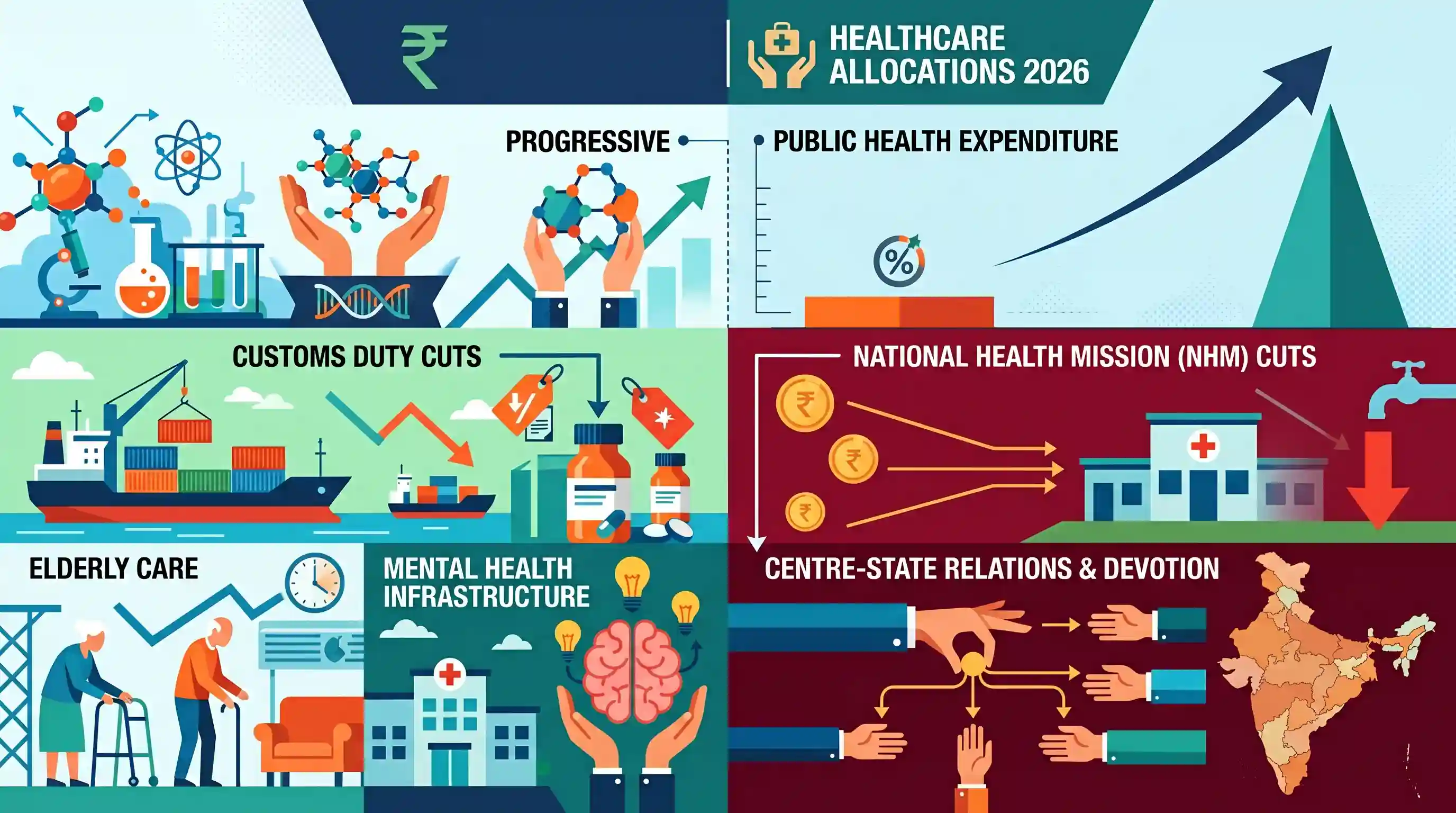
The editorial evaluates the 2026 Union Budget's healthcare allocations, highlighting a mix of progressive initiatives and persistent fiscal shortfalls. While praising the new 'Biopharma SHAKTI' scheme for biologics, customs duty cuts for life-saving medicines, and focus on elderly care and mental health infrastructure, the author heavily critiques the structural underfunding of the sector. The health budget remains stagnant at roughly 0.26% of GDP, far below the National Health Policy 2017 target of 2.5% by 2025. Additionally, funding cuts to the National Health Mission (NHM) and a reliance on state fiscal devolution threaten to cause uneven healthcare outcomes across India.
Key Points
- The 2026 Union health budget crossed ₹1.05 lakh crore (a 10% increase) but remains stagnant as a share of total expenditure (1.9%) and GDP (approx. 0.26%).
- The government missed the National Health Policy (2017) target to increase public health spending to 2.5% of GDP by 2025.
- Funding for the National Health Mission (NHM) has dropped despite good fund utilization, shifting the burden of primary healthcare development to States via fiscal devolution.
- The ₹10,000 crore 'Biopharma SHAKTI' scheme aims to make India a hub for biologics and biosimilars, alongside establishing 1,000 accredited clinical trial sites.
- Demographic transitions are addressed through initiatives to train allied health professionals and 1.5 lakh care workers for the elderly.
- Customs duty exemptions were provided for 17 cancer medicines and treatments for rare diseases, aiming to reduce out-of-pocket expenditure.
Important Terms
Biopharma SHAKTI scheme

A flagship 2026 initiative (Strategy for Healthcare Advancement through Knowledge, Technology, and Innovation) to boost domestic biologics and biosimilar production using non-animal technologies, targeting non-communicable diseases.
UPSC context
GS Paper 3 (S&T/Economy): Indigenous technology development and government policies for high-value biopharmaceutical manufacturing and industrial self-reliance.
National Health Policy 2017
The 2017 framework aiming for Universal Health Coverage and increasing public health expenditure to 2.5% of GDP by 2025 while urging states to spend 8% of their budgets on health.
UPSC context
GS Paper 2 (Health): Government policies for universal health coverage and the evaluation of long-term health expenditure targets.
National Health Mission (NHM)
India's primary health program providing accessible and quality healthcare through rural and urban sub-missions, focusing on maternal health, child health, and the management of communicable and non-communicable diseases.
UPSC context
GS Paper 2 (Health): Welfare schemes, health infrastructure development, and challenges in fiscal devolution and fund utilization between Centre and States.
National Institute of Pharmaceutical Education and Research (NIPER)
A network of autonomous 'Institutes of National Importance' specializing in advanced pharmaceutical education and research, with Budget 2026 proposing expansion into a biopharma-focused innovation network.
UPSC context
GS Paper 3 (Economy/S&T): Development of high-end human resources and R&D infrastructure to enhance India's global pharmaceutical competitiveness.
National Institute of Mental Health and Neurosciences (NIMHANS)
The apex 'Institute of National Importance' for mental health and neurosciences, acting as the nodal center for Tele-MANAS and expanding with a new northern campus (NIMHANS-2).
UPSC context
GS Paper 2 (Health): Institutional capacity building for mental health and addressing regional imbalances in access to specialized tertiary care.
Prelims Trap
"The Union Budget met the NHP 2017 target of allocating 2.5% of GDP to health."
The 2.5% of GDP target refers to 'Total Public Health Expenditure' (Centre + States combined). The Union budget alone contributes only around 0.25-0.3% of GDP.
Static Concepts Connected
How is healthcare jurisdiction divided between the Centre and States?
- State List: Public health, sanitation, hospitals, and dispensaries fall strictly under Entry 6 of the State List.
- Concurrent List: Population control, family planning, and medical education fall under the Concurrent List, allowing Central intervention.
- Fiscal Mechanism: The Centre supports state healthcare delivery primarily through Centrally Sponsored Schemes (like NHM) and Finance Commission devolution.
What are biologics and biosimilars in the pharmaceutical sector?
- Biologics: Complex medicines manufactured in or extracted from living systems (microorganisms, plant/animal cells) rather than chemically synthesized.
- Biosimilars: Highly similar, clinically equivalent versions of originally approved biologics, serving the same function as generic versions of chemical drugs.
- Clinical Use: They are highly effective, targeted therapies primarily used for treating cancers, autoimmune diseases, and rare genetic disorders.
Cross-Topic Patterns
Federalism & Centrally Sponsored Schemes
Cuts to the National Health Mission push the funding burden to States, testing the efficacy of the Finance Commission's untied tax devolution in maintaining primary healthcare outcomes.
Demographic Transition & Care Economy
Training 1.5 lakh geriatric care workers signals India's policy shift from maximizing the 'demographic dividend' to preparing for an imminent 'aging population' crisis.
Tariffs and Out-of-Pocket Expenditure
Exempting cancer and rare disease drugs from customs duty links macroeconomic trade policy directly to the social justice goal of reducing catastrophic Out-of-Pocket Expenditure (OOPE).

NHP 2017 targets, Biopharma SHAKTI scheme, and Constitutional jurisdiction over public health will likely form a composite 2026 Prelims MCQ.
Linked PYQs · 5
Linked PYQs · 5
- 2024MainsGS2
In a crucial domain like the public healthcare system the Indian State should play a vital role to contain the adverse impact of marketisation of the system. Suggest some measures through which the State can enhance the reach of public healthcare at the grassroots level.
- 2021MainsGS2
“Besides being a moral imperative of a Welfare State, primary health structure is a necessary precondition for sustainable development.” Analyze.
- 2020MainsGS2
In order to enhance the prospects of social development, sound and adequate health care policies are needed particularly in the fields of geriatric and maternal health care. Discuss.
- 2024MainsGS1
What is the concept of a 'demographic winter'? Is the world moving towards such a situation? Elaborate.
- 2025MainsGS2
Examine the evolving pattern of Centre-State financial relations in the context of planned development in India. How far have the recent reforms impacted the fiscal federalism in India?
