ISRO Long Term Lunar Mission Roadmap and Base Establishment
Source:The Hindu ↗
આ શા માટે મહત્વનું છે
India's space programme is a core component of the Science and Technology syllabus in GS3. ISRO's transition from satellite launches and cost-effective orbiters to developing a space station (BAS), manned lunar landings, and a permanent moon base reflects a massive leap in national capabilities, carrying immense geopolitical, scientific, and technological significance.
સારાંશ
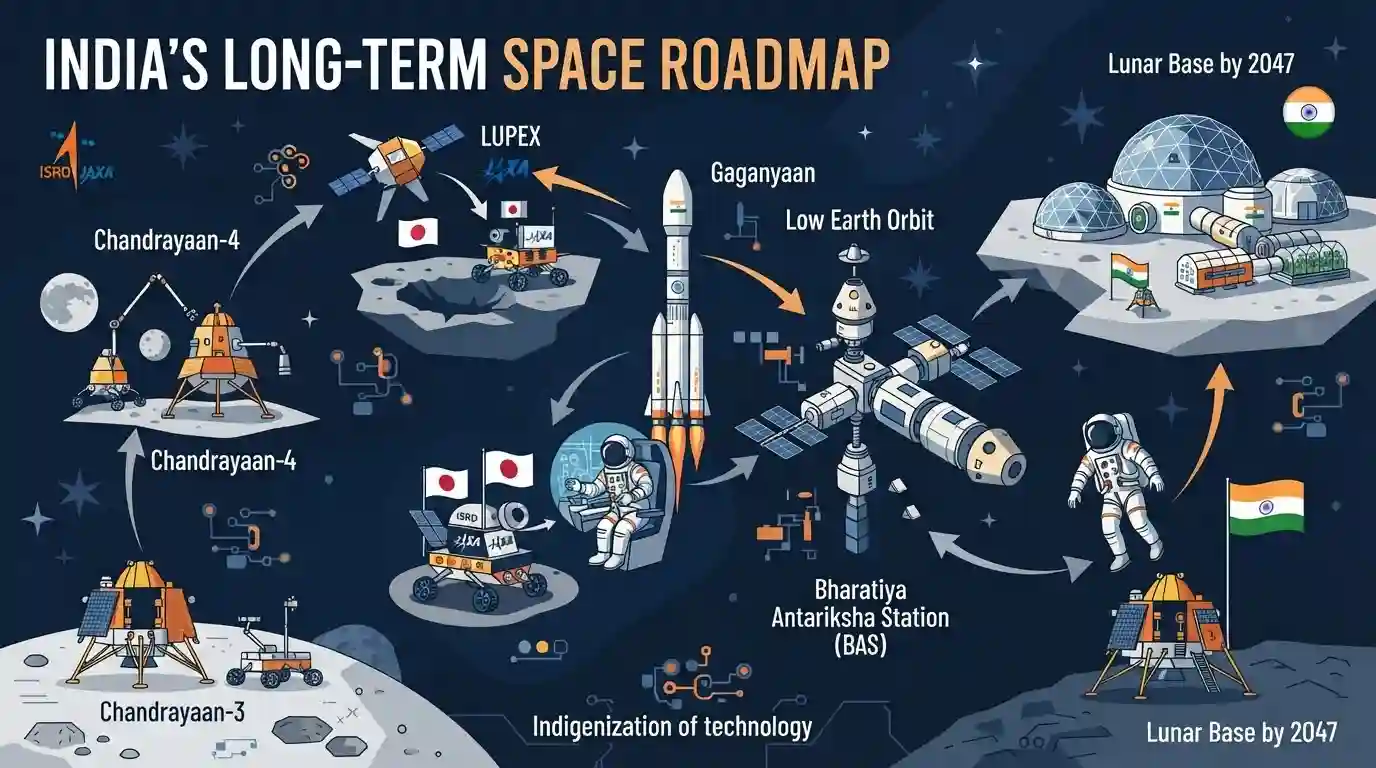
ISRO has outlined an ambitious, long-term roadmap for India's future in space, culminating in the establishment of a lunar base by 2047. Following the success of Chandrayaan-3, the space agency is preparing for Chandrayaan-4, which aims to return lunar samples, and the Lunar Polar Exploration Mission (LUPEX) in collaboration with Japan's JAXA. These robotic missions will build foundational technologies alongside the Gaganyaan human spaceflight programme. Together, they will pave the way for setting up the Bharatiya Antariksha Station (BAS) in Earth's orbit by 2035, serving as a stepping stone for the ultimate goal of landing an Indian astronaut on the Moon by 2040.
મુખ્ય મુદ્દા
- India has articulated a long-term lunar roadmap, targeting an Indian astronaut on the Moon by 2040 and the establishment of a lunar base by 2047.
- Intermediate technological milestones include the Bharatiya Antariksha Station (BAS) by 2035 and the Gaganyaan human spaceflight mission.
- Near-term lunar missions include Chandrayaan-4 (a sample return mission) and LUPEX (a joint mission with JAXA to explore the lunar south pole).
- The progression signifies ISRO's shift from standalone uncrewed missions to sustained human extraterrestrial presence.
મહત્વપૂર્ણ શબ્દો
Bharatiya Antariksha Station (BAS)

India's planned modular space station, developed by ISRO for low Earth orbit. Expected to be fully operational by 2035, BAS will support human spaceflight, microgravity research, and serve as a base for future lunar exploration.
UPSC context
GS Paper 3 (Space Technology). Highlights India's self-reliance in space infrastructure, showcasing advancements in long-duration human spaceflight and microgravity research.
Chandrayaan-4
An ISRO lunar sample-return mission targeting a 2028 launch. It aims to execute a precision landing, robotic sample collection, lunar ascent, deep space docking, and Earth re-entry, making India one of the few nations to retrieve lunar surface samples.
UPSC context
GS Paper 3 (Space Missions). Evaluates ISRO’s capabilities in sample retrieval, orbital docking, and planetary science, paving the way for future human lunar missions.
LUPEX (Lunar Polar Exploration Mission)
A joint ISRO-JAXA robotic mission to explore the Moon's south pole for water and resources. Launching around 2028, ISRO will provide the lunar lander while Japan’s JAXA supplies the launch vehicle and surface rover.
UPSC context
GS Paper 2 (International Relations) and GS 3 (Space). Demonstrates strategic Indo-Japanese cooperation in advanced space exploration and lunar resource mapping.
Gaganyaan
ISRO's flagship human spaceflight programme designed to launch a three-member crew into a 400 km low Earth orbit for three days. It aims to demonstrate indigenous capabilities in human-rated launch vehicles, life support systems, and safe Earth re-entry.
UPSC context
GS Paper 3 (Indigenization of Technology). Crucial for assessing India's self-reliance in aerospace technology, human safety protocols, and expanding its strategic space footprint.
પ્રિલિમ્સ ટ્રેપ
Chandrayaan-4 is a single-launch sample return mission utilizing the heavy-lift LVM3 rocket.
Chandrayaan-4 actually requires TWO separate launches of the LVM3 rocket due to its heavy 9,200 kg modular mass, followed by autonomous in-space docking.
સંલગ્ન સ્થિર ખ્યાલો
What is Low Earth Orbit (LEO) and why is it used for space stations?
- Altitude range: Typically 160-1,000 km above Earth's surface. India's BAS is planned for a 400-450 km orbit.
- Strategic advantages: Offers radiation protection (below Van Allen belts) and requires significantly less launch energy for frequent resupply missions.
- Station habitat: The standard domain for human spaceflight, housing the ISS, China's Tiangong, and the upcoming Bharatiya Antariksha Station.
What is space docking and why is it essential for advanced lunar missions?
- Mechanism: The autonomous or piloted physical joining of two independently launched spacecraft in orbit.
- Utility: Bypasses single-rocket payload limitations by enabling modular assembly in space, which is critical for heavy sample-return architecture.
- Indian capability: India demonstrated this via SpaDeX (2025), unlocking the ability to construct the BAS and execute Chandrayaan-4.
આંતર-વિષય પેટર્ન
Space diplomacy via joint missions
India's collaboration with JAXA for LUPEX aligns with broader technological convergence among Quad nations, echoing the strategic precedent set by the NASA-ISRO (NISAR) partnership.
Lunar South Pole resource race
The quest for water-ice in permanently shadowed regions by Chandrayaan-4 and LUPEX directly links to future extraterrestrial mining, space law (Artemis Accords), and lunar habitation viability.

Expect timeline matching for ISRO's Space Vision 2047 (BAS 2035, Moon 2040) or a multi-statement question on Chandrayaan-4's architecture.
સંલગ્ન PYQ · 3
સંલગ્ન PYQ · 3
- 2023MainsGS3
What is the main task of India's third moon mission which could not be achieved in its earlier mission? List the countries that have achieved this task. Introduce the subsystems in the spacecraft launched and explain the role of the Virtual Launch Control Centre' at the Vikram Sarabhai Space Centre which contributed to the successful launch from Sriharikota.
- 2017MainsGS3
India has achieved remarkable successes in unmanned space missions including the Chandrayaan and Mars Orbitter Mission, but has not ventured into manned space missions. What are the main obstacles to launching a manned space mission, both in terms of technology and logistics? Examine critically.
- 2025PrelimsGS1
Consider the following space missions : I. Axiom-4 II. SpaDeX III. Gaganyaan How many of the space missions given above encourage and support micro-gravity research?
