Moodys Projects India GDP Growth at 6.4 Percent for Financial Year 27
Source:The Hindu ↗
Why It Matters
GDP projections by major global credit rating agencies reflect the international perception of India's macroeconomic stability and policy effectiveness. Understanding the drivers of this growth—such as RBI's monetary easing, robust banking health, and GST reforms—is vital for questions on economic development and fiscal policy.
Summary
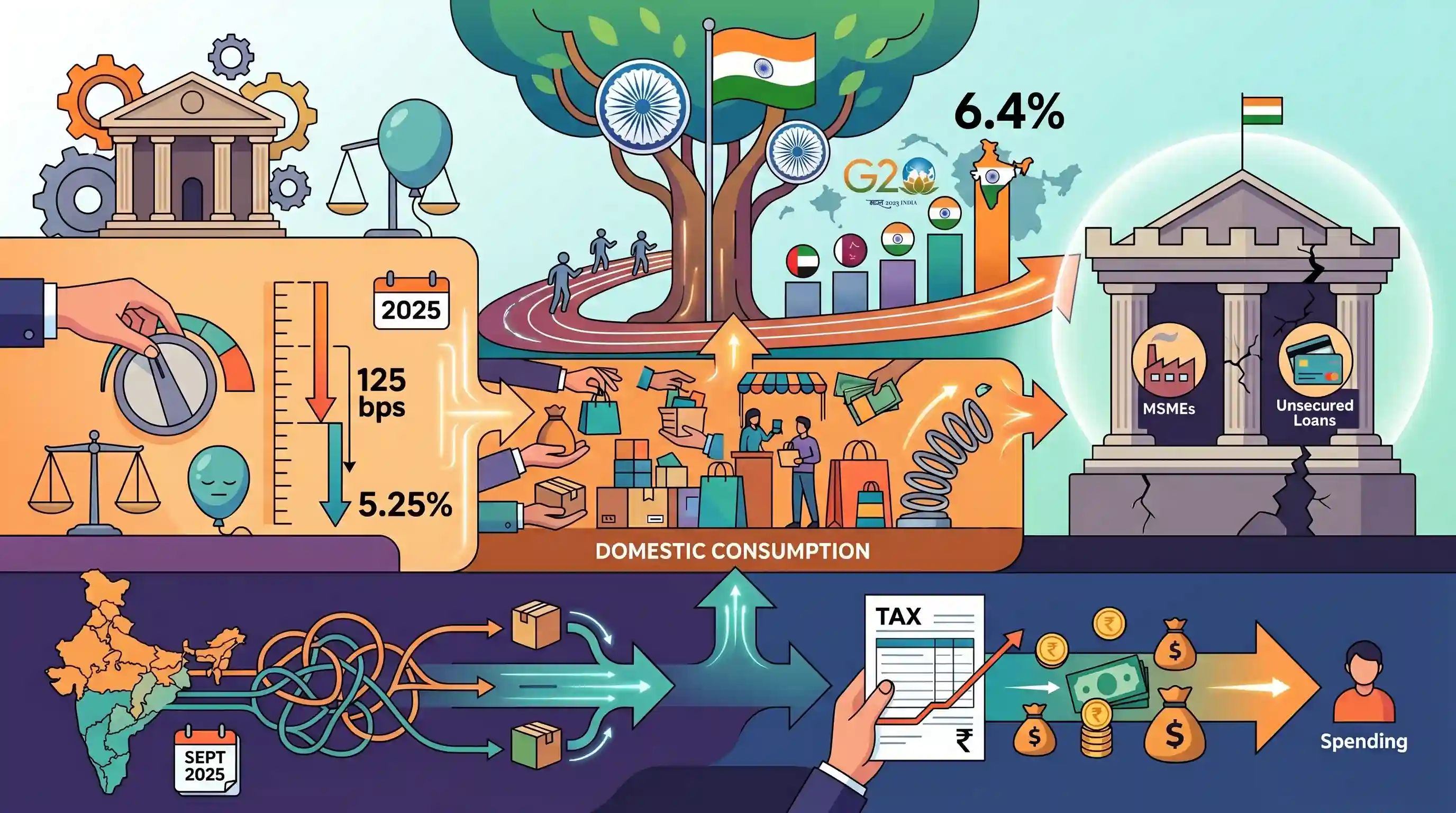
Moody's Ratings has projected India's real GDP to grow at 6.4% in the financial year 2026-27, marking it as the fastest-growing economy within the G20. The rating agency attributes this growth largely to a strong rebound in domestic consumption. Additionally, Moody's expects the Reserve Bank of India (RBI) to implement cumulative policy rate cuts of 125 basis points, bringing the rate down to 5.25% in 2025 as inflation remains under control. Despite minor anticipated stress in the MSME and unsecured retail loan segments, India's banking sector remains highly resilient with strong capital adequacy. Future policy tailwinds, such as the planned rationalisation of the Goods and Services Tax (GST) by September 2025 and earlier enhancements to income tax thresholds, will further fuel consumption-led expansion.
Key Points
- Moody's Ratings projects India's GDP to grow at 6.4% in FY26-27, maintaining its position as the fastest-growing G20 economy.
- Economic growth will be primarily driven by robust domestic consumption and a stable macroeconomic environment.
- The RBI is projected to lower its policy rate by 125 basis points to 5.25% in 2025, supported by controlled inflation.
- The banking sector displays resilient asset quality with sufficient reserves, although mild stress is expected in MSME and unsecured retail loans.
- Fiscal measures like the anticipated rationalisation of GST in September 2025 and increases in personal income tax thresholds are expected to further boost consumption.
Important Terms
Gross Domestic Product (GDP)

The total market value of all final goods and services produced within a country's borders during a specific period, reflecting its economic size and health.
UPSC context
GS Paper III: Indian Economy; tests comprehension of growth indicators, national income accounting, and macroeconomic stability.
GST Rationalisation
The process of simplifying the indirect tax structure by reducing tax slabs (e.g., to 5% and 18%) to improve compliance and minimize the cascading effect.
UPSC context
GS Paper III: Government Budgeting; tests knowledge of fiscal federalism, indirect tax reforms, and the GST Council.
Monetary Policy Committee (MPC)
A statutory body of the Reserve Bank of India (RBI) that determines benchmark interest rates to maintain price stability while supporting economic growth.
UPSC context
GS Paper III: Indian Economy; tests understanding of central bank functions, inflation targeting, and monetary transmission.
MSME (Micro, Small and Medium Enterprises)
Small-scale industrial and service units categorized by investment and turnover, crucial for India's employment generation, industrial output, and export contributions.
UPSC context
GS Paper III: Indian Economy; tests awareness of sectoral vulnerabilities, government support schemes, and socio-economic development.
G20 (Group of Twenty)
An intergovernmental forum of 19 countries, the European Union, and the African Union, addressing global economic stability and sustainable development.
UPSC context
GS Paper II: International Relations; tests knowledge of global governance, multilateral groupings, and India's economic diplomacy.
Sovereign Credit Rating
An assessment of a country's creditworthiness by agencies like Moody's, influencing its international borrowing costs and ability to attract foreign investment.
UPSC context
GS Paper III: Indian Economy; tests comprehension of global financial perceptions and their impact on capital flows.
Prelims Trap
"The RBI decreases risk weights on unsecured retail loans to boost domestic consumption."
Unsecured retail loans carry higher default risk. The RBI actually increases risk weights on them to force banks to maintain higher capital buffers (CAR), rather than decreasing them.
Static Concepts Connected
What is Capital Adequacy Ratio (CAR) and how do risk weights function?
- Definition: The ratio of a bank's capital to its risk-weighted assets (RWA), ensuring it can absorb a reasonable amount of unexpected loss.
- Risk Weights: Different asset classes are assigned percentages based on risk. Unsecured loans get higher weights, inflating the RWA denominator and requiring banks to set aside more capital.
- Basel III Norms: Global banking standards that mandate a minimum CAR (typically enforced by the RBI) to maintain financial stability and prevent systemic failures during credit shocks.
How do RBI policy rate cuts transmit to domestic consumption?
- Credit Cost: Lower repo rates reduce the cost of borrowing for retail loans, directly incentivizing durable goods consumption, vehicle purchases, and housing demand.
- Savings Yield: Reduced interest on fixed deposits structurally disincentivizes hoarding cash, nudging households towards immediate consumption or investments in capital markets.
- MSME Boost: Cheaper working capital allows MSMEs to scale operations more efficiently, indirectly generating employment and boosting downstream consumer spending power.
Cross-Topic Patterns
Consumption via Tax Rationalisation
Recent Economic Surveys emphasize transitioning from Capex-led to consumption-led growth. GST slab rationalisation and hiked income tax thresholds act as direct fiscal multipliers to achieve this.
Unsecured Credit vs Twin Balance Sheet
While the historical Twin Balance Sheet problem is largely resolved, the rapid growth in unsecured retail credit presents a new potential NPA risk vector being actively managed by the RBI.

Expect a Prelims 2026 multi-statement question combining RBI's risk weights on unsecured loans, CAR formulas, and domestic growth drivers.
Linked PYQs · 5
Linked PYQs · 5
- 2023MainsGS3
Faster economic growth requires increased share of the manufacturing sector in GDP, particularly of MSMEs. Comment on the present policies of the Government in this regard.
- 2021MainsGS3
Explain the difference between computing methodology of India's Gross Domestic Product (GDP) before the year 2015 and after the year 2015.
- 2020MainsGS3
Define potential GDP and explain its determinants. What are the factors that have been inhibiting India from realizing its potential GDP?
- 2024MainsGS3
What are the causes of persistent high food inflation in India? Comment on the effectiveness of the monetary policy of the RBI to control this type of inflation.
- 2019MainsGS3
Enumerate the indirect taxes which have been subsumed in the Goods and Services Tax (GST) in India. Also, comment on the revenue implications of the GST introduced in India since July 2017.
