Moodys projects India GDP growth at 6.4 percent for financial year 27
Source:The Hindu ↗
Why It Matters
Provides an external credit rating agency's perspective on India's macroeconomic fundamentals. Highlighting the balance between high GDP growth, robust domestic consumption, structural tax reforms, and a resilient banking sector, the article serves as an excellent case study or data point for GS-3 answers on economic growth, NPA management, and RBI monetary policy.
Summary
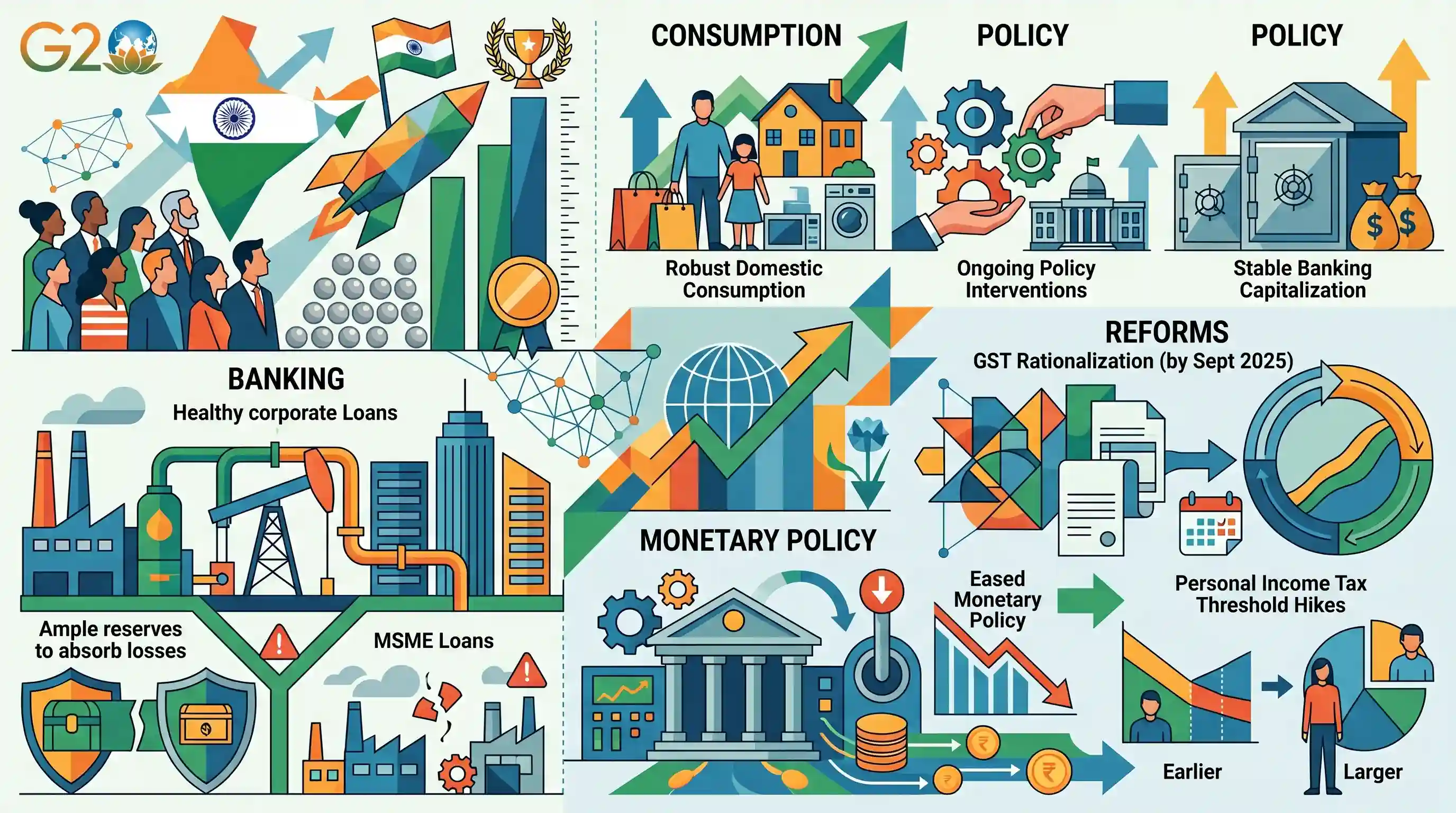
Moody's projects India to be the fastest-growing G20 economy, forecasting a 6.4% GDP growth for FY27. This growth is driven by robust domestic consumption, ongoing policy interventions, and stable banking capitalization. Although MSME loans exhibit some stress, overall corporate loan quality is healthy and banks maintain sufficient reserves to absorb losses. Structural reforms, such as the rationalization of the Goods and Services Tax (GST) by September 2025 and earlier hikes in personal income tax thresholds, are expected to provide long-term fiscal support. Meanwhile, the RBI is anticipated to ease its monetary policy, potentially lowering the policy rate to 5.25% in 2025.
Key Points
- Moody's projects India to achieve a 6.4% GDP growth in FY27, making it the fastest-growing economy in the G20, though lower than the Finance Ministry's estimates.
- Robust domestic consumption, driven partly by previous personal income tax threshold increases, remains the primary engine for economic growth.
- Structural fiscal reforms are anticipated, including a rationalization of the Goods and Services Tax (GST) structure by September 2025.
- The banking sector remains well-capitalized with healthy corporate loan quality, and despite some stress in MSME portfolios, banks have sufficient reserves.
- The RBI is expected to adopt an accommodative stance by easing monetary policy and lowering the policy rate to 5.25% by 2025.
Important Terms
Goods and Services Tax (GST)

A comprehensive, destination-based indirect tax levied on the supply of goods and services. Introduced via the 101st Constitutional Amendment in 2017, it replaced multiple central and state taxes to create a unified national market.
UPSC context
GS Paper III (Economy); tests knowledge of fiscal reforms, federalism (GST Council), and the impact of indirect taxation on economic growth.
MSME (Micro, Small, and Medium Enterprises)
Businesses categorized by specific investment and turnover thresholds under the MSMED Act, 2006. They are vital for employment, contributing approximately 30% to India's GDP and nearly 45% of total exports.
UPSC context
GS Paper III (Economy/Industry); focuses on inclusive growth, job creation, and sectoral challenges like credit access and formalization.
Reserve Bank of India (RBI)
India's central bank and monetary authority. It regulates the money supply, manages foreign exchange, supervises the banking sector, and sets the policy rate to maintain price stability while supporting economic growth.
UPSC context
GS Paper III (Economy); crucial for understanding monetary policy, inflation targeting (CPI), banking regulation, and financial stability.
G20 (Group of Twenty)
A premier international forum for economic cooperation representing 19 countries, the European Union, and the African Union. Collectively, members account for 85% of global GDP and 75% of international trade.
UPSC context
GS Paper II (International Relations); evaluates India’s role in global governance, international economic stability, and leadership of the Global South.
Credit Rating Agencies (CRAs)
Independent firms, like Moody’s, that assess the creditworthiness of borrowers (corporations or sovereign governments). Their ratings influence interest rates on loans and a country's ability to attract foreign investment.
UPSC context
GS Paper III (Economy); important for understanding sovereign credit ratings, external debt management, and their influence on global investor sentiment.
Prelims Trap
"Credit Rating Agencies operating in India are regulated by the Reserve Bank of India (RBI)."
While CRAs rate bank loans and corporate debt, domestic CRAs (like CRISIL and ICRA) are regulated by SEBI under the 1999 CRA Regulations, not the RBI.
Static Concepts Connected
What does an 'Accommodative' monetary policy stance signify?
- Core Meaning: The central bank is willing to lower interest rates to stimulate economic growth and boost consumption.
- Money Supply: It actively aims to increase the money supply within the banking system to make borrowing cheaper.
- Inflation Context: This stance is typically adopted when inflation is well within the central bank's target tolerance band.
What is the Capital Adequacy Ratio (CAR) in banking?
- Definition: The ratio of a bank's capital to its risk-weighted assets and current liabilities.
- Primary Purpose: It acts as a financial cushion, ensuring banks can absorb a reasonable amount of losses before becoming insolvent.
- Basel Framework: Dictated by Basel Norms, it comprises Tier 1 (core capital like equity) and Tier 2 (supplementary capital) reserves.
Cross-Topic Patterns
Monetary easing vs. Fiscal prudence
As the RBI shifts to an accommodative stance to spur growth, the government's parallel fiscal reforms (GST rationalization) create a classic monetary-fiscal balancing act often tested in Prelims.
MSME stress & Priority Sector Lending
Continued stress in MSME loans ties into Priority Sector Lending (PSL) requirements, forcing banks to constantly balance mandated credit targets with systemic asset quality risks.

Expect a multi-statement prelims question contrasting SEBI's regulation of Credit Rating Agencies with RBI's mandate on capital adequacy.
Linked PYQs · 4
Linked PYQs · 4
- 2019MainsGS3
Do you agree with the view that steady GDP growth and low inflation have left the Indian economy in good shape? Give reasons in support of your arguments.
- 2023MainsGS3
Faster economic growth requires increased share of the manufacturing sector in GDP, particularly of MSMEs. Comment on the present policies of the Government in this regard.
- 2022PrelimsGS1
With reference to the Indian economy, consider the following statements: 1. If the inflation is too high, Reserve Bank of India (RBI) is likely to buy government securities. 2. If the rupee is rapidly depreciating, RBI is likely to sell dollars in the market. 3. If interest rates in the USA or European Union were to fall, that is likely to induce RBI to buy dollars. Which of the statements given above are correct?
- 2020MainsGS3
Explain the rationale behind the Goods and Services Tax (Compensation to States) Act of 2017. How has COVID-19 impacted the GST compensation fund and created new federal tensions?
