Moodys Downgrades India GDP Growth Forecast Amid Geopolitics
Source:The Hindu ↗
Why It Matters
This article illustrates the direct transmission mechanism of international geopolitical crises to domestic macroeconomic stability. It highlights the vulnerability of India's growth, inflation, CAD, and fiscal deficit to West Asian instability, highly relevant for GS3 Economy and GS2 International Relations (India's West Asia policy and energy security).
Summary
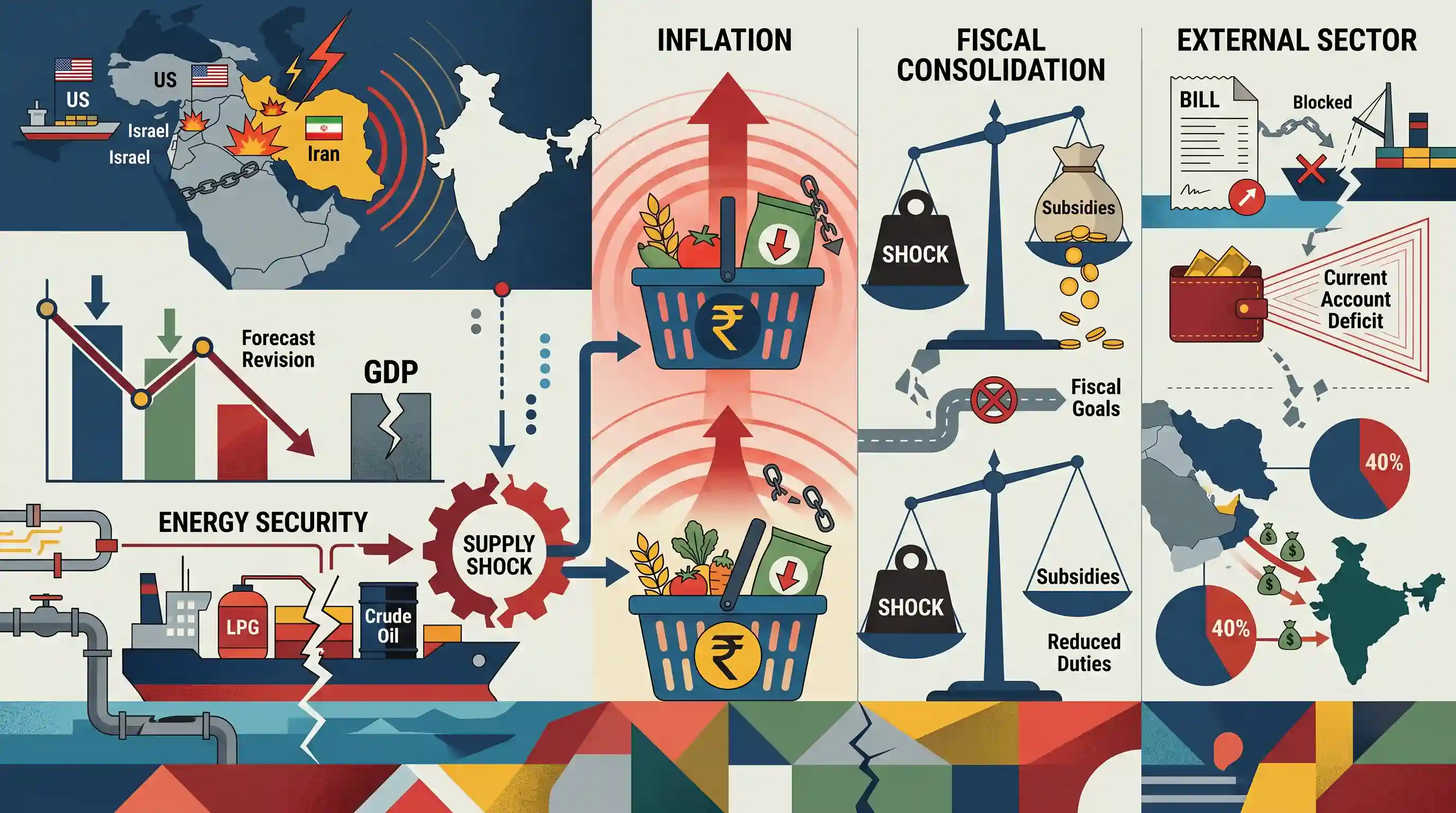
Moody's has revised India's GDP growth forecast for FY27 downwards from 6.8% to 6%, citing the escalating West Asia conflict involving Israel, the US, and Iran. The geopolitical crisis presents multiple macroeconomic risks for India, primarily through potential disruptions to crucial energy shipments like LPG and crude oil. This supply shock is expected to fuel broader inflation, including higher food costs driven by expensive imported fertilisers. Additionally, the government's fiscal consolidation efforts may stall as it absorbs the shock through prolonged subsidies or reduced excise duties on fuel. India's external sector faces dual vulnerabilities: widened Current Account Deficits due to inflated import bills and trade disruptions, alongside potential impacts on remittances, as the Gulf region accounts for nearly 40% of India's total remittance inflows.
Key Points
- Moody's has lowered India's FY27 GDP growth estimate to 6% from 6.8% in response to geopolitical uncertainties arising from the Israel-US-Iran conflict.
- Supply chain disruptions in West Asia threaten India's energy security, particularly concerning shipments of LPG and crude oil.
- Inflationary pressures are expected to rise due to higher fuel prices and increased costs of imported fertilisers, directly impacting food inflation.
- The government's fiscal consolidation path may be derailed if elevated commodity prices force sustained targeted subsidies or cuts in excise duties on petrol and diesel.
- The Current Account Deficit (CAD) and external sector remain vulnerable, given higher import costs and the fact that 40% of India's remittance inflows originate from the Gulf region.
Important Terms
Fiscal Consolidation

A reduction in the government's fiscal deficit and debt accumulation through increased revenue and disciplined spending, ensuring long-term financial stability and macroeconomic health.
UPSC context
GS Paper III (Indian Economy); tests knowledge of the FRBM Act and fiscal prudence measures.
Current Account Deficit (CAD)
A measurement of a country's trade where the value of goods and services it imports exceeds the value of its exports, including net income and transfers.
UPSC context
GS Paper III (External Sector); tests understanding of Balance of Payments and currency stability.
Remittances
Non-commercial money transfers sent by foreign workers to their home countries; India is globally the largest recipient, using these to finance its trade deficit.
UPSC context
GS Paper III (Economy) and GS Paper II (Diaspora); tests role in external sector stability.
Credit Rating Agency (CRA)
Independent agencies that evaluate the creditworthiness of debt issuers, including sovereign governments; their ratings influence international capital flows and a nation's borrowing costs.
UPSC context
GS Paper III (Economy); tests knowledge of investment models and global financial governance.
Energy Security
The uninterrupted availability of energy sources at an affordable price, encompassing accessibility, reliability, and sustainability to fuel economic development and national safety.
UPSC context
GS Paper III (Infrastructure and Energy); tests strategies to reduce import dependency and geopolitical risks.
Supply-side Inflation
Inflation driven by increased costs of production, such as rising global crude oil or fertilizer prices, rather than by excessive consumer demand.
UPSC context
GS Paper III (Economy); tests ability to distinguish between cost-push and demand-pull inflationary pressures.
Prelims Trap
"A Gulf nation (like UAE or Saudi Arabia) is the largest single-country source of inward remittances to India."
While the Gulf region contributes roughly 40% combined, the USA recently overtook the UAE as the largest single-country source of remittances to India.
Static Concepts Connected
How does a Middle East crisis impact India's Balance of Payments?
- Trade Deficit: Inelastic demand for crude oil and fertilizers inflates the import bill, sharply widening the merchandise trade deficit.
- Net Invisibles: Potential job losses or economic slowdown in the Gulf reduces crucial private remittance transfers to India.
- Capital Flight: Resulting domestic inflation and currency depreciation risks often trigger Foreign Portfolio Investment (FPI) outflows.
How does imported inflation derail the FRBM fiscal consolidation path?
- Subsidy Burden: Elevated global fertilizer and fuel prices force the government to increase revenue expenditure to shield consumers.
- Revenue Foregone: Cutting excise duties and VAT on petroleum products to curb inflation directly reduces crucial indirect tax collections.
- Borrowing Costs: RBI tightening policy rates to combat inflation inadvertently raises the interest burden on government market borrowings.
Cross-Topic Patterns
Food Security + Energy Geopolitics
India's heavy reliance on imported LNG for domestic urea production intricately links Middle East stability directly to Indian agricultural output and food inflation.
IR Mapping of Trade Chokepoints
Red Sea, Bab-el-Mandeb, and Strait of Hormuz supply disruptions are frequently tested as IR map locations alongside their economic impacts on trade flows.

Expect a 2026 prelims question linking crude volatility directly to CAD widening, imported inflation, and FRBM glide path deviations.
Linked PYQs · 5
Linked PYQs · 5
- 2025MainsGS2
"Energy security constitutes the dominant kingpin of India's foreign policy, and is linked with India's overarching influence in Middle Eastern countries.” How would you integrate energy security with India's foreign policy trajectories in the coming years?
- 2017MainsGS2
The question of India's Energy Security constitutes the most important part of India's economic progress. Analyze India's energy policy cooperation with West Asian countries.
- 2019MainsGS3
Do you agree with the view that steady GDP growth and low inflation have left the Indian economy in good shape? Give reasons in support of your arguments.
- 2024MainsGS3
What are the causes of persistent high food inflation in India? Comment on the effectiveness of the monetary policy of the RBI to control this type of inflation.
- 2021PrelimsGS1
Which one of the following is likely to be the most inflationary in its effects?
