IMD Monsoon Forecast and July Below-Normal Rainfall Risks
Source:The Hindu ↗
Why It Matters
This article highlights the critical vulnerabilities of India's rain-fed agriculture and water reservoirs to global climate patterns. It demonstrates the direct linkage between physical geography (ENSO, IOD, Bay of Bengal meteorology) and macro-economic stability (food security, inflation, and water resources), which are core topics under GS1 Physical Geography and GS3 Agriculture and Environment.
Summary
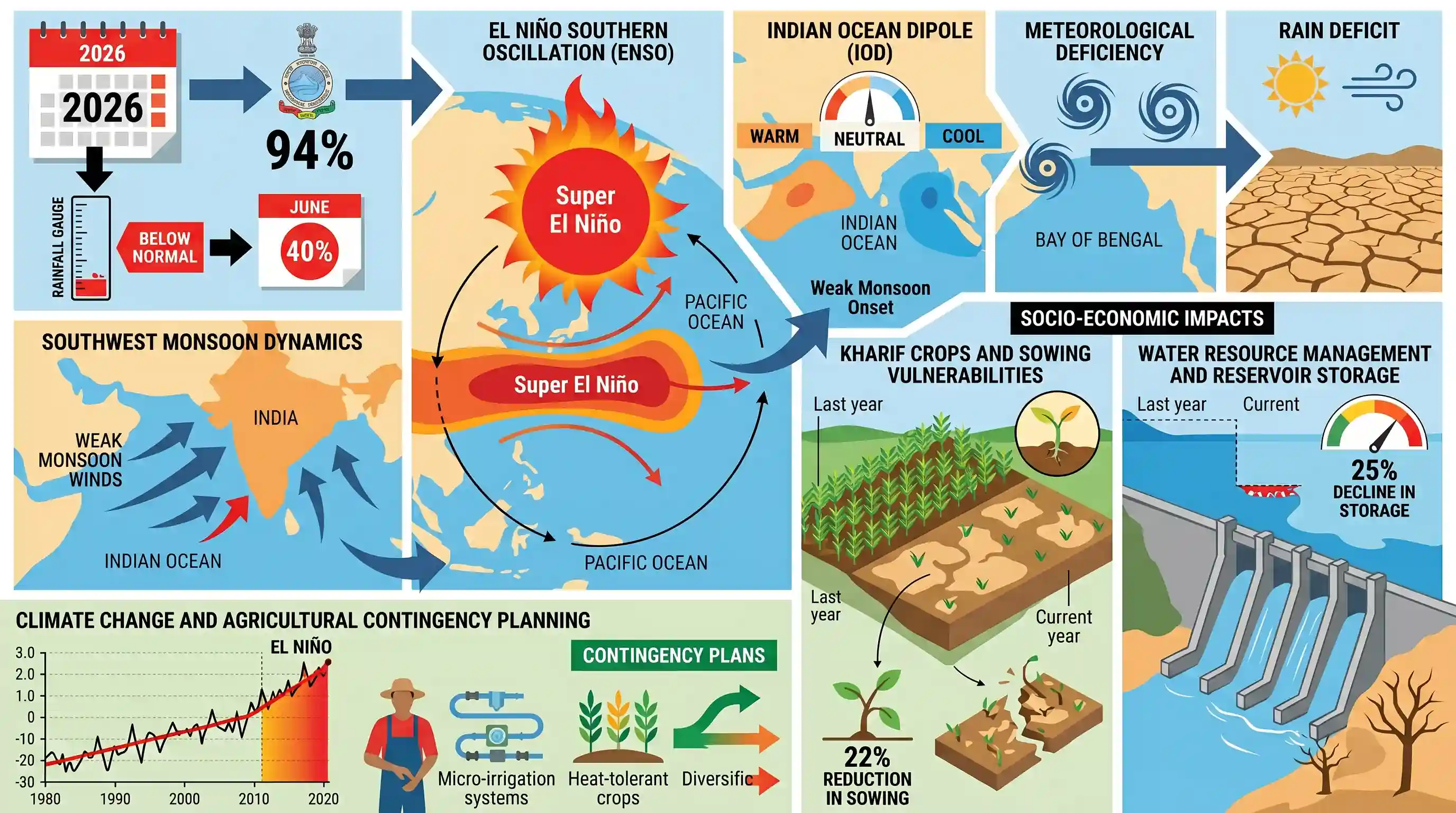
The India Meteorological Department (IMD) has forecasted below-normal rainfall (under 94% of the long-period average) for July 2026, compounding a severe 40% rainfall deficit in June. The weak monsoon onset is driven by a developing 'Super El Niño' and the absence of low-pressure systems in the Bay of Bengal, with a neutral Indian Ocean Dipole (IOD) expected to offer no relief. This meteorological deficit has immediate socio-economic impacts, leading to a 22% reduction in Kharif crop sowing and a 25% decline in water reservoir levels compared to last year, threatening India's agricultural output and water security.
Key Points
- Below-Normal July Forecast: The India Meteorological Department (IMD) has projected below-normal rainfall (<94% of the long-period average) for July 2026, the critical month for India's southwest monsoon.
- Historic June Deficit: This prediction follows a weak June, which recorded a massive 40% rainfall deficit (99.5 mm). This was the fifth lowest June rainfall since 1901 and the lowest since 2014.
- Key Climatic Drivers: The deficit is primarily attributed to a developing 'Super El Niño' in the Central Pacific and the complete absence of low-pressure systems (which usually bring rain from the Bay of Bengal) during June.
- Neutral Indian Ocean Dipole (IOD): Weather models suggest that the IOD will remain neutral during the second half of the monsoon season, making it unable to offset or compensate for the negative impacts of El Niño.
- Severe Agricultural Impact: Sowing of Kharif crops, particularly paddy, has declined by 22% compared to last year, as farmers delay activities in anticipation of better rain.
- Water Resource Stress: Water levels in major Indian reservoirs are 25% lower than June last year, posing significant threats to irrigation, drinking water, and hydropower generation, with risks of faster depletion due to higher evaporation.
Important Terms
India Meteorological Department (IMD)

India's apex government agency for meteorological observations, weather forecasting, and seismology. Established in 1875, it operates under the Ministry of Earth Sciences, predicting monsoons, cyclones, and extreme weather events.
UPSC context
GS Paper I (Monsoon dynamics) & GS Paper III (Disaster Management); tests institutional weather forecasting and climate risk preparedness.
Central Water Commission (CWC)
A premier technical organization in India functioning under the Ministry of Jal Shakti. It initiates, coordinates, and furthers schemes for water resource conservation, control, flood management, and reservoir monitoring.
UPSC context
GS Paper III (Water Resource Management); tests understanding of technical bodies managing river basin planning, reservoir storage, and flood safety.
Indian Ocean Dipole (IOD)
An ocean-atmosphere phenomenon in the Indian Ocean, defined by the sea-surface temperature difference between its western and eastern parts, which significantly affects monsoon rainfall over India.
UPSC context
GS Paper I (Climatology); tests understanding of physical geography, ocean-atmosphere interactions, and their influence on the Indian monsoon.
Kharif Crops
Monsoon-season agricultural crops sown during the onset of the southwest monsoon (June-July) and harvested in autumn. Major examples include rice, maize, cotton, and soybean.
UPSC context
GS Paper I & III (Agriculture & Cropping Patterns); tests knowledge of climate dependencies, seasonal farming, and food security.
Ministry of Agriculture and Farmers Welfare
The apex administrative body of the Government of India responsible for formulating and administering rules, laws, and schemes related to agriculture, food security, and farmer welfare.
UPSC context
GS Paper III (Government Policies and Interventions); tests understanding of administrative frameworks for agricultural sustainability and socio-economic support.
Australian Bureau of Meteorology
Australia's national meteorological, climate, and water information agency. It plays an important role in monitoring global ocean-atmospheric climate indicators like ENSO and IOD.
UPSC context
GS Paper I (Climatology); tests awareness of major international meteorology bodies tracking atmospheric-oceanic phenomena affecting global weather.
Prelims Trap
Normal rainfall is defined by IMD as any precipitation falling between 90% and 110% of the Long Period Average (LPA).
Aspirants confuse the broad normal range with IMD's strict 'Normal' classification (96%-104%). Rainfall below 96% is 'Below Normal' (90%-95%) or 'Deficient' (<90%).
Static Concepts Connected
How do El Niño and the Indian Ocean Dipole (IOD) interact to affect the Indian Monsoon?
- El Niño mechanism: Warming of the central Pacific shifts Walker Circulation convective rainfall eastward, suppressing India's southwest monsoon rains.
- Positive IOD buffer: Warmer western Indian Ocean sea temperatures enhance monsoon winds, acting as a buffer that can offset El Niño's drying effects.
- Neutral/Negative IOD impact: A neutral or negative IOD fails to provide this moisture buffer, leaving India highly vulnerable to severe Pacific-driven rainfall deficits.
What is the Long Period Average (LPA) used by the IMD?
- Definition: The average rainfall recorded over a historical 50-year interval, used as a benchmark to classify seasonal performance.
- Current baseline: The current southwest monsoon LPA is 87 cm, calculated using historical data from the 1971–2020 period.
- Classification bands: IMD categorizes seasonal rainfall as 'Normal' at 96%–104% of LPA, 'Below Normal' at 90%–95%, and 'Deficient' under 90%.
Cross-Topic Patterns
Monsoon variability + Food inflation dynamics
Delayed Kharif sowing of pulses and oilseeds triggers supply-side agricultural shocks, directly pushing up CPI food inflation and complicating RBI's monetary policy stance.
Hydrological drought + Energy security
Low reservoir levels cripple peaking-load hydropower generation, forcing grid operators to increase reliance on coal-fired thermal power plants during dry spells.

2026 Prelims may test the exact quantitative bands of IMD's LPA categories alongside the physical mechanism of IOD-El Niño cancellation.
Linked PYQs · 3
Linked PYQs · 3
- 2017PrelimsGS1
With reference to 'Indian Ocean Dipole (IOD)' sometimes mentioned in the news while forecasting Indian monsoon, which of the following statements is/are correct? 1. IOD phenomenon is characterised by a difference in sea surface temperature between tropical Western Indian Ocean and tropical Eastern Pacific Ocean. 2. An IOD phenomenon can influence an El Nino's impact on the monsoon. Select the correct answer using the code given below:
- 2014MainsGS1
Most of the unusual climatic happenings are explained as an outcome of the El-Nino effect. Do you agree?
- 2020MainsGS3
Suggest measures to improve water storage and irrigation system to make its judicious use under depleting scenario.
