Indian Current Account Deficit and Foreign Direct Investment Flows
Source:Indian Express ↗
Why It Matters
Ahluwalia's analysis provides a holistic view of the contemporary Indian economy, linking external sector vulnerabilities (CAD, Rupee depreciation) with trade policy (FTAs, protectionism) and internal reforms (DBT, taxation). This is highly useful for GS-3 Mains answers on trade strategies, subsidy rationalisation, and foreign investment policies.
Summary
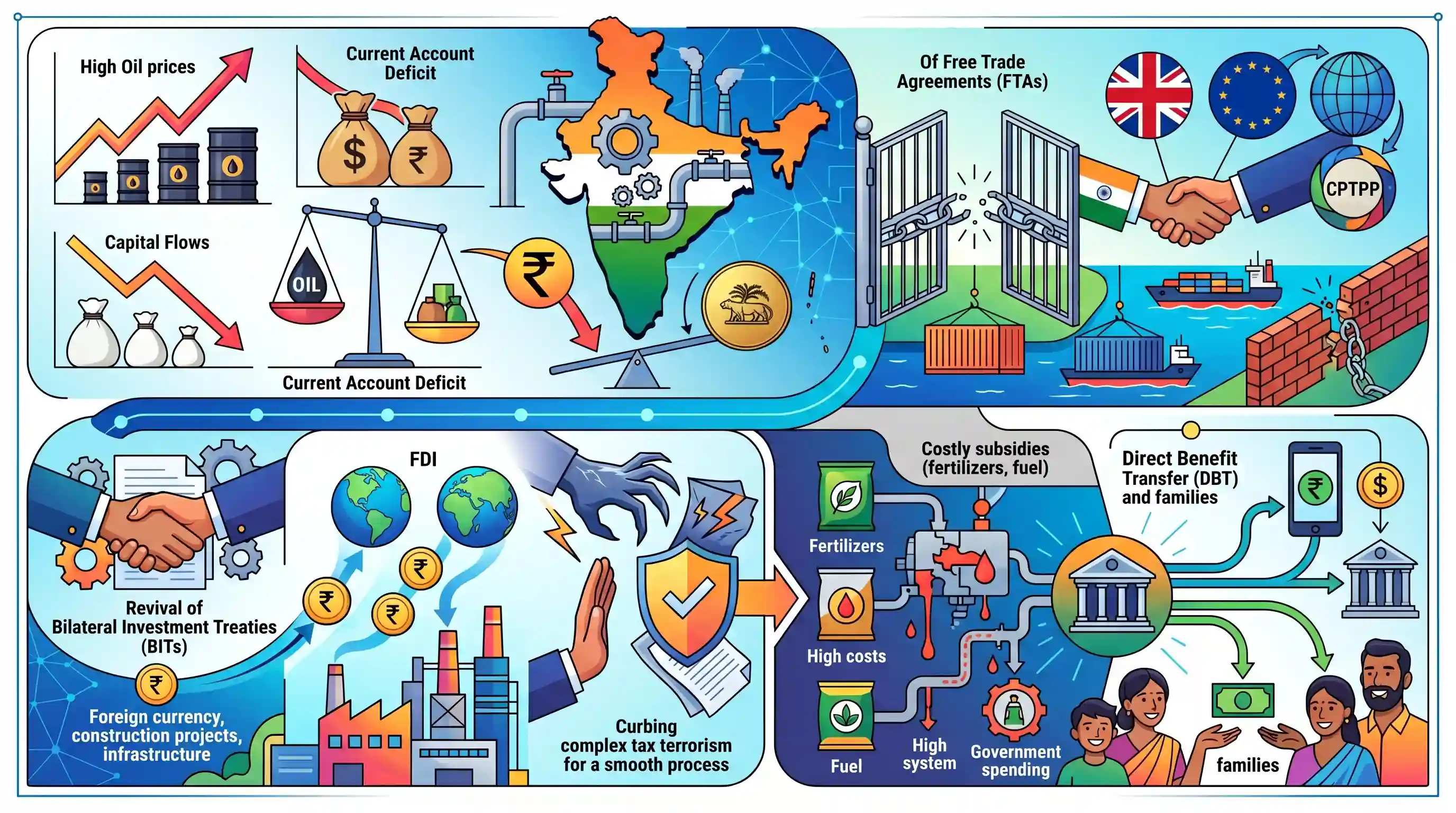
In an interview, former Deputy Chairman of the Planning Commission Montek Singh Ahluwalia outlines India's pressing macroeconomic challenges, including a widening Current Account Deficit driven by high oil prices and declining capital flows. He supports the RBI's strategy of allowing the Rupee to depreciate to manage external imbalances. Ahluwalia strongly advocates for concluding Free Trade Agreements (FTAs) with the UK and Europe and joining the CPTPP, warning against domestic protectionist pressures. He also emphasizes the need to revive Bilateral Investment Treaties to attract FDI, curb tax terrorism, and shift from price subsidies (like fuel and fertilisers) to Direct Benefit Transfers (DBT) to reduce economic distortions.
Key Points
- Current Account Deficit (CAD) is widening primarily due to high global oil prices, compounded by a decline in capital account surplus (lower net FDI and negative FPI).
- RBI allowing the Rupee to depreciate is a practical adjustment to correct external imbalances, as long as it avoids expectations of continuous depreciation.
- India should resist protectionist pressures from domestic industries during FTA negotiations with the UK and Europe, and should actively consider joining the CPTPP.
- The 2015 cancellation of Bilateral Investment Treaties negatively impacted FDI inflows; finalizing new treaties is crucial to restore investor confidence.
- Prices of administered goods like fuel, electricity, and fertilisers should be market-determined to reduce distortions, with targeted relief provided through Direct Benefit Transfers (DBT).
- Excessive Quality Control Orders (QCOs), which act as disguised import licensing, and arbitrary taxation (like retrospective taxes) must be curbed to improve the ease of doing business.
Important Terms
Free Trade Agreements (FTAs)

Treaties between countries to reduce or eliminate tariffs, quotas, and non-tariff barriers, facilitating the free flow of goods and services across borders.
UPSC context
GS-III (Economy/Trade Policy); tests knowledge of export competitiveness and India's ongoing negotiations with the UK and EU.
Bilateral Investment Treaties (BITs)
Reciprocal agreements between two countries to promote and protect foreign private investments, providing legal guarantees against non-discriminatory treatment and arbitrary expropriation.
UPSC context
GS-III (Investment Models); crucial for understanding FDI protection and the controversial 2016 Indian Model BIT framework.
Comprehensive and Progressive Agreement for Trans-Pacific Partnership (CPTPP)
A high-standard free trade bloc of 11 Pacific Rim nations (and the UK) setting rules for labor, environment, and digital trade.
UPSC context
GS-II (International Relations); relevant for plurilateral trade dynamics and India's strategic 'Act East' policy alternatives.
Direct Benefit Transfer (DBT)
A governance reform transferring government subsidies directly into beneficiaries' Aadhaar-linked bank accounts to eliminate middlemen, reduce leakages, and improve efficiency.
UPSC context
GS-III (Subsidies/E-technology); fundamental to understanding public finance management and digital service delivery in India.
Current Account Deficit (CAD)
A macroeconomic indicator where the total value of a country's imports of goods, services, and transfers exceeds the value of its exports.
UPSC context
GS-III (Economy/BoP); core concept for currency stability, Rupee depreciation, and external sector vulnerability.
Tax Terrorism
A term for aggressive, unpredictable, or arbitrary tax enforcement by authorities that creates fear and hinders the ease of doing business.
UPSC context
GS-III (Taxation/Economy); relates to retrospective taxation issues and reforms needed for a stable investment climate.
Prelims Trap
The RBI actively intervenes to prevent any depreciation of the Indian Rupee to control the Current Account Deficit.
Aspirants assume the RBI's mandate is to halt depreciation entirely. However, the RBI primarily intervenes to curb excessive volatility; it allows natural depreciation as a self-correcting mechanism for external imbalances.
Static Concepts Connected
How is a Current Account Deficit (CAD) financed within the Balance of Payments?
- Current Account: Records trade in goods (visibles), services (invisibles), remittances, and income transfers. A deficit means imports exceed exports.
- Capital Account: Records cross-border investments like Foreign Direct Investment (FDI), Foreign Portfolio Investment (FPI), and External Commercial Borrowings (ECBs).
- Financing Mechanism: A CAD is offset by a surplus in the capital account. If capital inflows are insufficient, the RBI draws down foreign exchange reserves to bridge the gap.
What are the core features of India's 2015 Model Bilateral Investment Treaty (BIT)?
- Exhaustion of Local Remedies: Requires foreign investors to litigate in domestic courts for at least five years before initiating international arbitration.
- Enterprise-based definition: Restricts treaty protection to actual operational enterprises, excluding standalone assets or pre-investment activities.
- Notable Exclusions: Government procurement, taxation measures, and compulsory licensing are explicitly kept outside the purview of the treaty to protect sovereign policy space.
Cross-Topic Patterns
Non-Tariff Barriers & GVC Integration
The use of Quality Control Orders (QCOs) as disguised import licensing contradicts the PLI scheme's goal of integrating India into Global Value Chains by making intermediate component imports too costly.
Subsidy Rationalization via DBT
Shifting from administered price mechanisms (like heavily subsidized fertilizers) to targeted Direct Benefit Transfers connects fiscal deficit consolidation directly to India's digital public infrastructure (JAM trinity).

Expect a multi-statement Prelims question linking India's 2015 Model BIT, 'exhaustion of local remedies', and the recent FDI slowdown.
Linked PYQs · 4
Linked PYQs · 4
- 2025MainsGS3
What are the challenges before the Indian economy when the world is moving away from free trade and multilateralism to protectionism and bilateralism? How can these challenges be met?
- 2015MainsGS3
In what way could replacement of price subsidy with Direct Benefit Transfer (DBT) change the scenario of subsidies in India ? Discuss.
- 2022PrelimsGS1
With reference to the Indian economy, consider the following statements: 1. If the inflation is too high, Reserve Bank of India (RBI) is likely to buy government securities. 2. If the rupee is rapidly depreciating, RBI is likely to sell dollars in the market. 3. If interest rates in the USA or European Union were to fall, that is likely to induce RBI to buy dollars. Which of the statements given above are correct?
- 2021PrelimsGS1
Consider the following : 1. Foreign currency convertible bonds 2. Foreign institutional investment with certain conditions 3. Global depository receipts 4. Non-resident external deposits Which of the above can be included in Foreign Direct Investments?
