Himachal hill terrain disaster relief norms restructuring appeal
Source:hindustantimes ↗
Why It Matters
Crucial for HPAS aspirants to understand the intersection of disaster management policies, financial frameworks like SDRF/NDRF, and geographical vulnerabilities unique to Himalayan states like Himachal Pradesh.
Summary
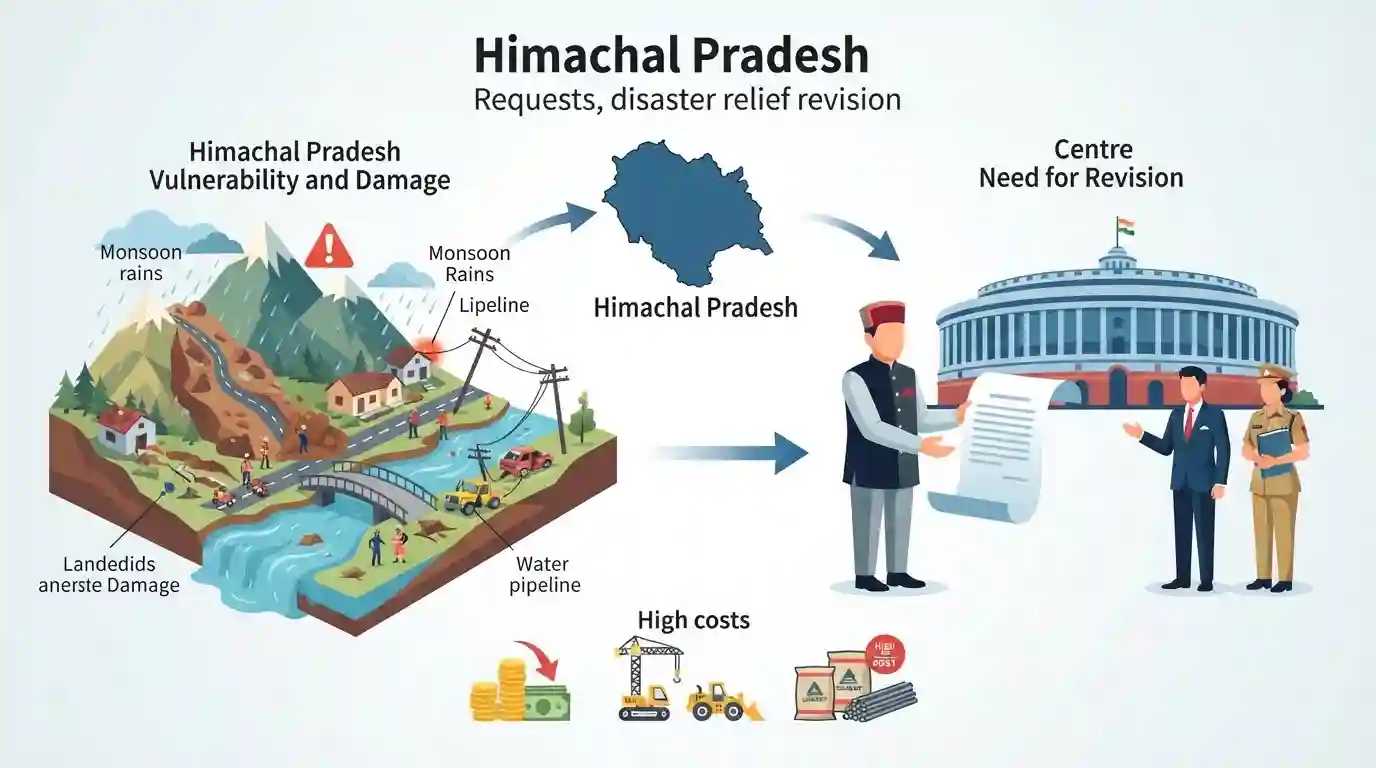
The Himachal Pradesh government has approached the Centre requesting a comprehensive revision of disaster relief norms, citing the unique vulnerabilities, heavy infrastructure damage, and higher restoration costs associated with hill terrain during monsoon calamities.
Key Points
- The Himachal Pradesh government has urged the Centre to revise disaster relief norms, explicitly taking into account the unique and fragile hill terrain.
- Monsoon-related losses in the state have caused extensive damage to infrastructure, lives, and livelihoods, prompting demands for customized financial assistance.
- Existing standard disaster relief criteria do not adequately reflect the higher costs of restoration and specialized engineering required in mountainous topography.
Important Terms
State Disaster Response Fund (SDRF)

A fund constituted under the Disaster Management Act, 2005, serving as the primary fund available with state governments for immediate relief during notified disasters.
UPSC context
Important for HPAS Paper II (Governance and Disaster Management) and GS-III (Disaster Management). Tests knowledge of financial mechanisms for disaster response.
National Disaster Response Fund (NDRF)
A national-level fund managed by the Central Government to provide additional financial assistance to states when a disaster of severe magnitude overwhelms the State Disaster Response Fund resources.
UPSC context
Crucial for HPAS Paper II and GS-III (Disaster Management). Tests understanding of centre-state fiscal coordination during calamities.
Prelims Trap
NDRF and SDRF funds serve as full compensation for actual infrastructure losses suffered by hill states.
SDRF and NDRF are designed to provide immediate relief and supplementary assistance, not full compensation for all actual economic losses or asset damages.
Static Concepts Connected
What are the funding pattern and allocation criteria for the State Disaster Response Fund (SDRF) and National Disaster Response Fund (NDRF)?
- Funding Ratio: SDRF funding is shared between the Centre and States in a 90:10 ratio for special category/northeastern and hill states, and 75:25 for general states.
- NDRF Nature: NDRF supplements SDRF when a calamity is of a severe nature and local funds are inadequate; it is 100% centrally funded.
- Governing Norms: Allocations are governed by recommendations of successive Finance Commissions and guidelines issued by the Ministry of Home Affairs.
Cross-Topic Patterns
Himalayan Disasters and State Fiscal Deficits
Monsoon destruction in fragile Himalayan ecosystems directly ties infrastructure engineering costs to state fiscal health and borrowing limits under the FRBM Act.
Climate Resilience vs. Plains-Centric Funding Norms
Hill states face severe challenges meeting climate resilience benchmarks under national funding schemes designed primarily for plains topography.

HPAS questions on disaster management will test SDRF/NDRF allocation criteria, Centre-state funding ratios, and hill state vulnerabilities.
Linked PYQs · 3
Linked PYQs · 3
- 2025HPAS_PRELIMSGS1
When was the National Centre for Disaster Management established in India ?
- 2024HPAS_PRELIMSGS1
Arrange the following climatic zones of Himachal Pradesh according to rainfall amount from lowest to highest : (1) Frigid aridic zone (2) Wet temperate zone (3) Humid sub-tropical zone (4) Sub-humid sub-tropical zone Choose the correct answer from the options given below :
- 2025HPAS_PRELIMSGS1
Mountain Soil Zone in Himachal Pradesh is found between :
