Monsoon session of Parliament likely to commence from July twentieth
Source:The Hindu ↗
Why It Matters
This article highlights multiple overlapping constitutional and parliamentary topics essential for UPSC GS-II: the functioning of the CCPA, parliamentary privileges (Article 105), the Speaker's role in the Anti-Defection Law (Tenth Schedule), and the interplay between women's reservation, delimitation, and federalism (representation of southern states).
Summary
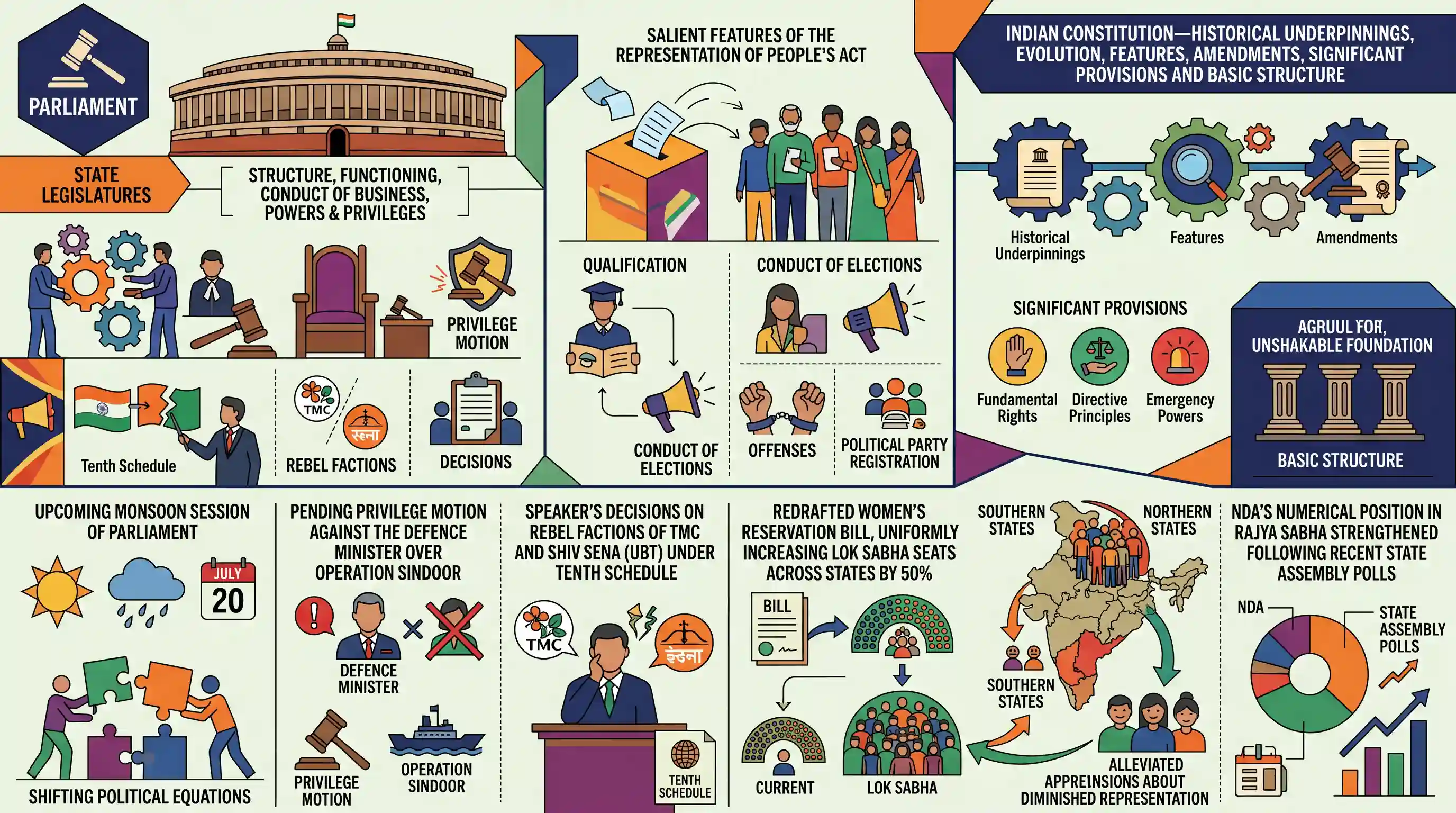
The upcoming Monsoon Session of Parliament, likely starting July 20, is set against a backdrop of shifting political equations and significant legislative agenda. Key procedural and constitutional issues include a pending privilege motion against the Defence Minister over 'Operation Sindoor', and the Speaker's impending decisions on recognizing rebel factions of the TMC and Shiv Sena (UBT) under the Tenth Schedule. Furthermore, the session may witness the introduction of a redrafted Women's Reservation Bill, which aims to uniformly increase Lok Sabha seats across states by 50%. This proposed measure intends to alleviate the long-standing apprehensions of southern states regarding their diminished representation in a population-based delimitation exercise. Meanwhile, the NDA's numerical position in the Rajya Sabha has strengthened following recent state assembly polls.
Key Points
- The Cabinet Committee on Parliamentary Affairs (CCPA) is likely to finalize the upcoming Parliament Monsoon session to begin around July 20.
- Congress member K.C. Venugopal moved a privilege motion against Defence Minister Rajnath Singh for allegedly misleading the Parliament concerning casualties in 'Operation Sindoor'.
- Splits in the Trinamool Congress and Shiv Sena (UBT) have led to rebel MPs seeking recognition as separate groups, which awaits a decision by Lok Sabha Speaker Om Birla under anti-defection provisions.
- Following recent state elections, the NDA's strength in the Rajya Sabha has increased, tilting the upper house's numerical balance in its favor.
- A redrafted Women's Reservation Bill is anticipated, which might uniformly increase Lok Sabha seats across all states by 50% to address southern states' concerns over population-linked delimitation disadvantages.
Important Terms
Women's Reservation Bill

A constitutional measure (106th Amendment) reserving 33% of seats for women in Lok Sabha and Assemblies. Recent proposals link its implementation to a 50% increase in total parliamentary seats to resolve delimitation concerns.
UPSC context
GS-II: Governance and Polity. Tests knowledge of electoral reforms, gender representation, and constitutional amendments.
Tenth Schedule
Inserted via the 52nd Amendment (1985), it provides for the disqualification of lawmakers on grounds of defection. The Speaker acts as the adjudicating authority to determine the 'real' political party during splits.
UPSC context
GS-II: Indian Constitution. Critical for questions on political stability, the Speaker's powers, and intra-party democracy.
Privilege Motion
A procedural motion moved by a member when a breach of parliamentary privilege or contempt of the House is alleged, such as a Minister providing misleading information. Admission is decided by the Presiding Officer.
UPSC context
GS-II: Parliament functioning. Tests understanding of legislative procedures, accountability of the executive, and parliamentary privileges.
Cabinet Committee on Parliamentary Affairs (CCPA)
An extra-constitutional committee (established under Transaction of Business Rules, 1961) responsible for scheduling parliamentary sessions, managing the government's legislative agenda, and reviewing state legislations. Usually chaired by the Defence Minister.
UPSC context
GS-II: Executive and Legislature. Tests knowledge of the Cabinet's role in coordinating parliamentary business and executive-legislative relations.
Delimitation
The process of redrawing boundaries of Lok Sabha and Assembly constituencies based on the latest census to ensure equal representation. Post-2026 delimitation remains a point of contention for southern states.
UPSC context
GS-II: Federalism and Representation. Relevant for issues regarding population-based seat distribution and federal balance of power.
Operation Sindoor
A military counter-terrorism operation (referenced in 2025-26 contexts) involving precision strikes across the Line of Control. In Parliament, it is currently the subject of a privilege motion regarding casualty disclosure.
UPSC context
GS-III: Internal Security. Used to test oversight mechanisms of military operations and executive accountability in security matters.
Prelims Trap
"The Cabinet Committee on Parliamentary Affairs (CCPA) is chaired by the Prime Minister."
While the Prime Minister heads most major cabinet committees (like Security or Economic Affairs), the CCPA is conventionally chaired by the Union Home Minister or Defence Minister.
Static Concepts Connected
How does the Tenth Schedule treat party splits and mergers?
- Merger Exception: Exempts disqualification if at least two-thirds of the legislature party's members agree to merge with another political party.
- Split Removal: The 91st Constitutional Amendment Act (2003) deleted the original provision that protected one-third of members defecting as a legally recognized 'split'.
- Adjudicating Authority: The Presiding Officer decides defection cases. Their decision is subject to judicial review, as established in the 1992 Kihoto Hollohan case.
What are the constitutional rules governing Delimitation and Lok Sabha seats?
- Current Freeze: The 84th Constitutional Amendment Act (2001) froze the total number of Lok Sabha seats allotted to each state until the first Census taken after 2026.
- Federal Balance: This freeze was enacted to prevent penalizing states (primarily in the South) that successfully implemented family planning and population control measures.
- Women's Quota Tie-in: Under the 106th Amendment, the 33% reservation for women in Parliament is constitutionally contingent upon the publication of the census and subsequent delimitation.
Cross-Topic Patterns
Delimitation vs. Demographic Federalism
The debate over expanding Lok Sabha seats directly mirrors southern states' grievances regarding the weightage given to the 2011 population data in Finance Commission tax devolution formulas.
Extra-Constitutional Bodies & Committees
UPSC frequently tests the composition of Cabinet Committees. While the PM heads core panels like Security and Economic Affairs, the CCPA's distinct leadership is a recurring structural anomaly.
Tenth Schedule & Judicial Review
The Speaker's delay in adjudicating defection petitions routinely invokes judicial intervention, referencing the Kihoto Hollohan (1992) and Keisham Meghachandra (2020) judgments on tribunalization of the Speaker's role.

The interplay of the 84th, 91st, and 106th Constitutional Amendments (Delimitation, Defection, Women's Quota) is prime for a 2026 Polity MCQ.
Linked PYQs · 5
Linked PYQs · 5
- 2014MainsGS2
The 'Powers, Privileges and Immunities of Parliament and its Members' as envisaged in Article 105 of the Constitution leave room for a large number of un-codified and un-enumerated privileges to continue. Assess the reasons for the absence of legal codification of the 'parliamentary privileges'. How can this problem be addressed ?
- 2014PrelimsGS1
Which one of the following Schedules of the Constitution of India contains provisions regarding anti-defection?
- 2020MainsGS2
Once a Speaker, Always a Speaker' ! Do you think this practice should be adopted to impart objectivity to the office of the Speaker of Lok Sabha ? What could be its implications for the robust functioning of parliamentary business in India?
- 2025PrelimsGS1
Consider the following statements : I. On the dissolution of the House of the People, the Speaker shall not vacate his/her office until immediately before the first meeting of the House of the People after the dissolution. II. According to the provisions of the Constitution of India, a Member of the House of the People on being elected as Speaker shall resign from his/her political party immediately. III. The Speaker of the House of the People may be removed from his/her office by a resolution of the House of the People passed by a majority of all the then Members of the House, provided that no resolution shall be moved unless at least fourteen days' notice has been given of the intention to move the resolution. Which of the statements given above are correct?
- 2023MainsGS2
Discuss the contribution of civil society groups for women's effective and meaningful participation and representation in state legislatures in India.
