Monsoon session of Parliament scheduled to commence on July twenty
Source:The Hindu ↗
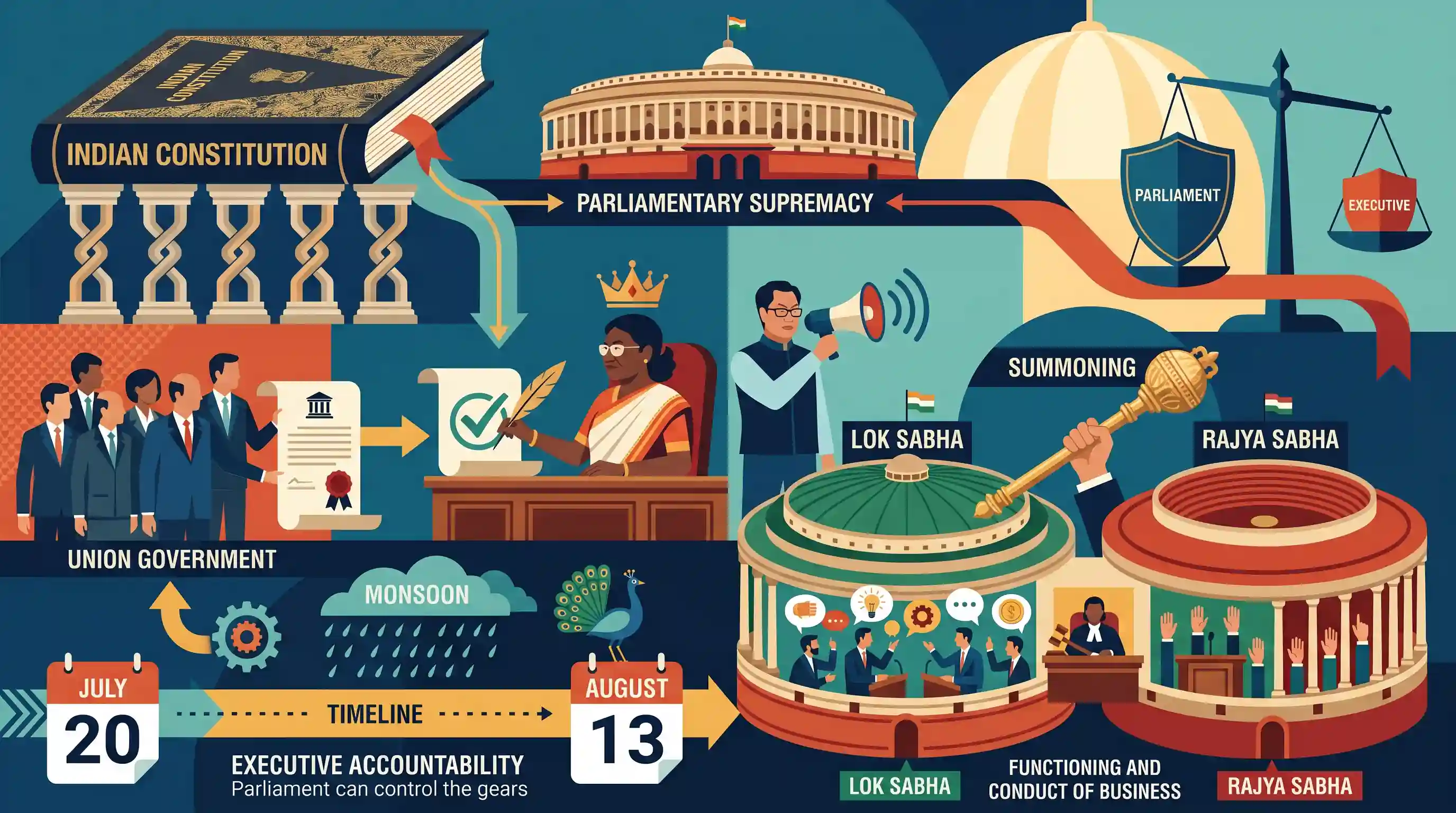
Why It Matters
The summoning of parliamentary sessions is a foundational constitutional process under Article 85. The announcement demonstrates the executive's role in determining the legislative timetable (reflecting debates on executive dominance and the decline in the quantity of parliamentary sittings), which is a key recurring theme in both the UPSC Prelims and Mains.
Summary
The Monsoon Session of Parliament is scheduled to take place from July 20 to August 13, 2026. Minister of Parliamentary Affairs Kiren Rijiju announced that President Droupadi Murmu approved the summoning of both the Lok Sabha and the Rajya Sabha based on the formal recommendation of the Union Government.
Key Points
- The Monsoon Session of Parliament for the year 2026 is scheduled to run from July 20 to August 13, 2026.
- The summoning of both Houses of Parliament was approved by President Droupadi Murmu on the official recommendation of the Union Government.
- Constitutionally, under Article 85(1), the President has the power to summon Parliament, provided that the gap between two consecutive sessions does not exceed six months.
- While India traditionally holds three annual sessions (Budget, Monsoon, and Winter), this is a matter of parliamentary convention; the Constitution does not mandate three sessions or specify a minimum number of sitting days in a year.
Important Terms
Parliament of India

The supreme bicameral legislative body of India, comprising the President, the Rajya Sabha (upper house), and the Lok Sabha (lower house), responsible for lawmaking and holding the executive accountable.
UPSC context
GS Paper II: Parliament and State Legislatures — structure, functioning, and conduct of business.
Article 85 of the Indian Constitution
A constitutional provision governing the sessions, prorogation, and dissolution of Parliament, mandating that the gap between two consecutive sessions must not exceed six months.
UPSC context
GS Paper II: Indian Constitution — significant provisions, executive accountability, and parliamentary control.
Cabinet Committee on Parliamentary Affairs
An extra-constitutional standing committee of the Union Cabinet responsible for coordinating government legislative business and recommending dates for summoning and proroguing Parliament.
UPSC context
GS Paper II: Executive, Cabinet Committees, and functioning of the Parliament.
Summoning of Parliament
The formal process of convening the members of both houses of Parliament to meet, officially declared by the President on the advice of the Union Cabinet.
UPSC context
GS Paper II: Parliament — functioning, legislative procedures, and the role of the President.
Union Cabinet
The core decision-making body of the executive, consisting of the Prime Minister and senior ministers of cabinet rank, collectively responsible to the Lok Sabha.
UPSC context
GS Paper II: Structure, organization, and functioning of the Executive.
Prelims Trap
The Cabinet Committee on Parliamentary Affairs, which decides the session schedule, is chaired by the Prime Minister.
Unlike other major Cabinet Committees, the CCPA is traditionally chaired by the Union Minister of Defence, not the Prime Minister.
Static Concepts Connected
What are the key constitutional distinctions between Prorogation and Adjournment?
- Authorized authority: Adjournment is done by the Presiding Officer (Speaker/Chairman), whereas prorogation is done by the President under Article 85(2)(a).
- Impact on business: Adjournment suspends a sitting for hours or days; prorogation terminates the entire session of the House.
- Lapsing of notices: Prorogation causes all pending notices (other than bills) to lapse; adjournment does not affect pending business or notices.
Does the Constitution mandate the frequency and duration of Parliament sessions?
- Maximum gap rule: Article 85(1) mandates that six months shall not intervene between the last sitting of one session and the first of the next.
- Convention-based sessions: The three-session annual calendar (Budget, Monsoon, Winter) is a convention, not a constitutional mandate.
- No sitting minimum: The Constitution does not prescribe a minimum number of sitting days per year for either House of Parliament.
Cross-Topic Patterns
Declining sittings and executive accountability
Fewer sitting days reduce legislative scrutiny, increasing the executive's dominance and undermining parliamentary oversight of policy and finance.
Ordinance route and parliamentary recess
Prorogation officially places Parliament in recess, satisfying the Article 123 requirement for the President to promulgate urgent ordinances.

Expect a multi-statement question contrasting President's power of prorogation with Speaker's adjournment sine die and their effect on bills.
Linked PYQs · 3
Linked PYQs · 3
- 2020PrelimsGS1
Consider the following statements: 1. The President of India can summon a session of the Parliament at such place as he/she thinks fit. 2. The Constitution of India provides for three sessions of the Parliament in a year, but it is not mandatory to conduct all three sessions. 3. There is no minimum number of days that the Parliament is required to meet in a year. Which of the statements given above is/are correct?
- 2024MainsGS2
“The growth of cabinet system has practically resulted in the marginalisation of the parliamentary supremacy.” Elucidate.
- 2021MainsGS2
To what extent, in your view, the Parliament is able to ensure accountability of the executive in India?
