Himachal Pradesh assembly passes higher education amendment bill
Source:Indian Express ↗
Why It Matters
Important for HPAS aspirants to track current legislative developments, functioning of the Himachal Pradesh Vidhan Sabha, and changes in state higher education frameworks.
Summary
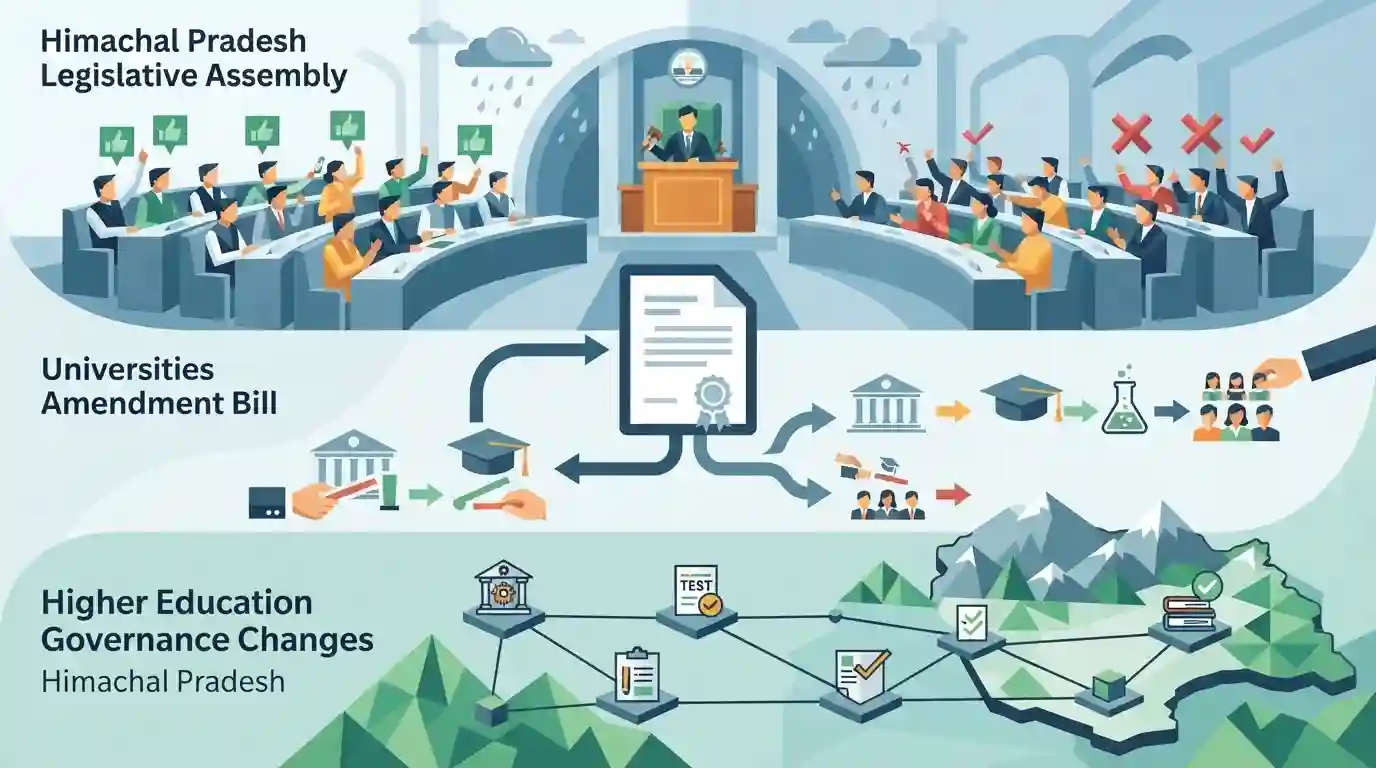
During the monsoon session of the Himachal Pradesh Legislative Assembly, the House passed the Universities Amendment Bill despite opposition resistance, highlighting key legislative business and higher education governance changes in the state.
Key Points
- The Himachal Pradesh Legislative Assembly passed the Universities Amendment Bill during its monsoon session amidst opposition protests.
- The legislative proceeding highlights the state government's efforts to reform or manage higher education structures and university regulations in Himachal Pradesh.
- Monsoon and budget/legislative sessions of the state assembly serve as crucial mechanisms for enacting state laws and discussing regional higher education policies.
Important Terms
Universities Amendment Bill

A legislative measure passed by the Himachal Pradesh Assembly modifying governance, recruitment procedures through public service commissions, and financial oversight of state universities.
UPSC context
HPAS GS-II (Polity & Governance): Tests understanding of state-level higher education policy, university autonomy, and legislative procedures in Himachal Pradesh.
Himachal Pradesh Legislative Assembly
The unicameral state legislature of Himachal Pradesh responsible for law-making, budgetary oversight, and discussing matters of public importance during assembly sessions.
UPSC context
HPAS GS-II (State Polity): Essential for questions regarding the functioning, legislative business, and executive accountability within the Himachal Pradesh state legislature.
Prelims Trap
The Universities Amendment Bill violates UGC norms and is therefore entirely unconstitutional and void without central assent.
Aspirants often assume university appointments are solely governed by UGC guidelines without state legislature interference, missing that states can legislate on public university governance under the Concurrent/State list, subject to repugnancy tests.
Static Concepts Connected
What are the constitutional provisions and legislative lists governing higher education in India?
- Constitutional Entry: Seventh Schedule allocation: Education, including technical education, medical education, and universities, is in the Concurrent List (Entry 25) of the Seventh Schedule, though coordination and determination of standards in institutions for higher education fall under Union List Entry 66.
- State Competence: Legislative competence: State legislatures possess the competence to enact laws regarding the establishment, incorporation, and regulation of state universities, provided they do not conflict with central standards.
- Autonomous Balance: Institutional autonomy: State-funded universities balance statutory oversight by state governments with academic and administrative autonomy protected under UGC regulations and university acts.
Cross-Topic Patterns
Higher Education Autonomy vs State Legislative Control
State-level legislation modifying university appointments intersects directly with UGC guidelines, testing the boundaries of federal control over higher education under Entry 66 of List I versus Entry 25 of List II.
Public Employment Reform & Centralized Recruitment Bodies
Shifting non-teaching and lower-tier recruitment to the HPPSC and Rajya Chayan Aayog impacts state public employment frameworks and administrative accountability.

Expect a statement-based question on state university governance changes, specifically financial oversight and recruitment routing via HPPSC.
Linked PYQs · 2
Linked PYQs · 2
- 2025HPAS_PRELIMSGS1
Consider the following statements regarding public finance of Himachal Pradesh : (1) According to Budget Estimate for the year 2024-25, share of revenue expenditure out of total expenditure is around 80 percent. (2) Debt as a percentage of GSDP reached 75.33 during the year 2022-23. (3) State's own tax revenue as a percentage of total revenue for the year 2024-25 (BE) increased to 27.4. (4) During FY 2024-25 (BE) education and health sector were allocated Rs. 9995 and Rs. 8575 crores respectively. Choose the correct answer from the options given below :
- 2017HPAS_PRELIMSGS1
When Himachal Pradesh got right to participate in the election for first time under the new Constitution ?
