Andhra Pradesh Legislature Monsoon Session and Infrastructure Agenda
Source:The Hindu ↗
ఇది ఎందుకు ముఖ్యం
This article encompasses multiple crucial intersections of state polity (Article 174 and legislative sessions), regional geography/infrastructure (Polavaram project and Amaravati), and climatology (El Niño's impact on agriculture). These topics are high-yield areas for APPSC Group 1 Prelims, as evidenced by recurring questions on national projects and monsoon patterns.
సారాంశం
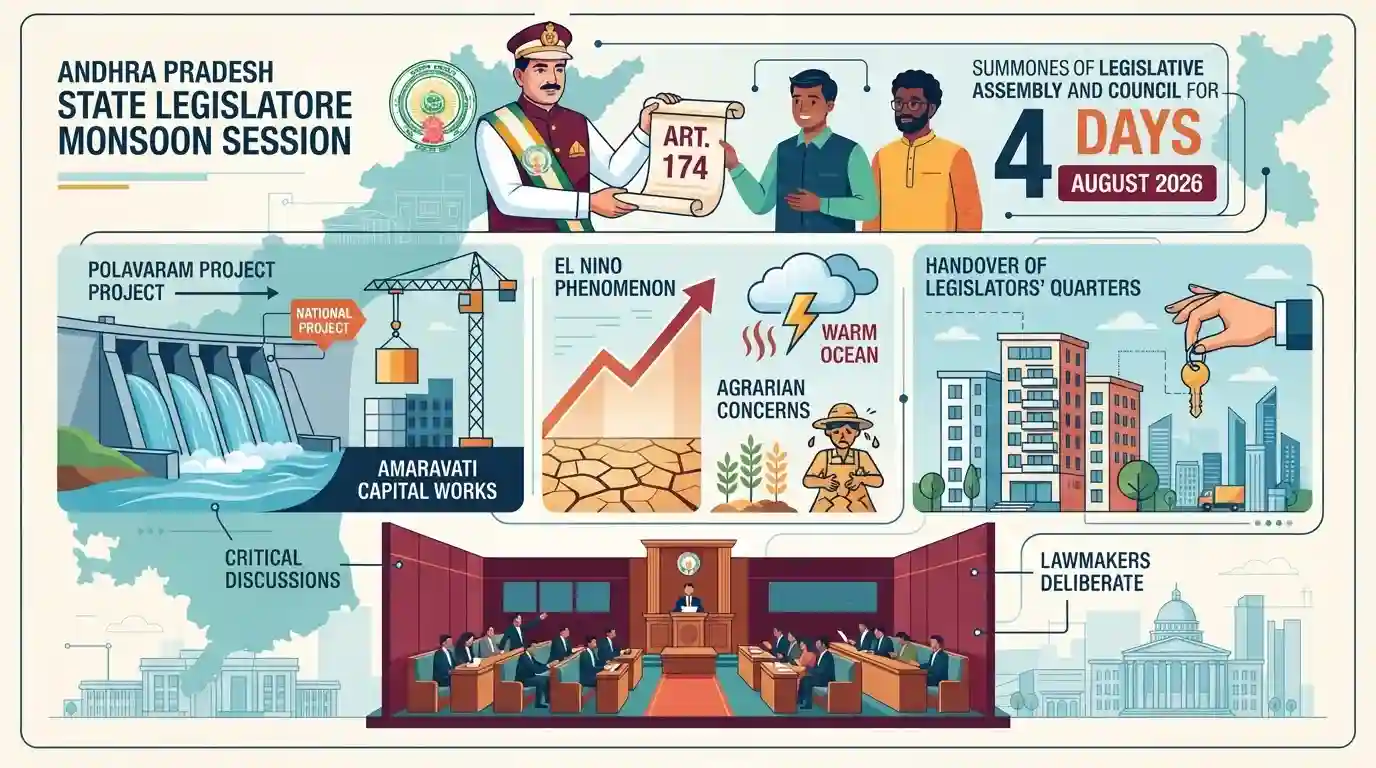
Andhra Pradesh Governor S. Abdul Nazeer has summoned both Houses of the State Legislature for a four-day Monsoon session commencing August 17, 2026, under Article 174 of the Constitution. The session is slated to feature critical discussions on state-centric infrastructural milestones, notably the Amaravati capital city works and the Polavaram national project. Furthermore, lawmakers will deliberate on agrarian concerns, emphasizing the potential climatic disruptions caused by the El Niño phenomenon on regional agriculture. Newly built legislators' quarters in Amaravati will also be officially handed over during this period.
ముఖ్య అంశాలు
- Andhra Pradesh Governor S. Abdul Nazeer summoned the State Legislature for a four-day Monsoon session starting August 17, 2026, invoking Article 174(1) of the Constitution.
- Chief Minister N. Chandrababu Naidu is expected to inaugurate newly constructed residential quarters for MLAs and MLCs in Amaravati.
- The legislative agenda includes debates on the ongoing progress of the Amaravati capital city construction and the Polavaram irrigation project.
- The session will also address agrarian challenges, focusing on farmers' issues and the potential impact of the El Niño phenomenon on the monsoon and agriculture.
ముఖ్యమైన పదాలు
Article 174 of the Constitution

Empowers the State Governor to summon, prorogue, and dissolve the state legislature. Usually exercised on the cabinet's aid and advice, it mandates that no more than six months elapse between legislative sessions.
UPSC context
GS Paper 2 (Polity); frequently tested in the context of the Governor's discretionary powers and executive-legislative relations.
Polavaram Project
A multi-purpose irrigation and hydropower project on the Godavari River in Andhra Pradesh. Declared a National Project under the AP Reorganisation Act, 2014, it involves inter-basin water transfer to the Krishna River.
UPSC context
GS Paper 1 (Geography) & GS Paper 3 (Infrastructure); relevant for inter-state water disputes, tribal displacement, and irrigation.
El Niño Phenomenon
A climate pattern involving the unusual warming of surface waters in the central and eastern equatorial Pacific Ocean. It often disrupts atmospheric circulation, typically weakening India's southwest monsoon and impacting agriculture.
UPSC context
GS Paper 1 (Geography) & GS Paper 3 (Economy/Agriculture); crucial for understanding monsoon variability, droughts, and food inflation.
Amaravati Capital City
The designated capital of Andhra Pradesh, built as a greenfield city on the banks of the Krishna River. It derives its name from a nearby historic site famous for its ancient Buddhist stupa.
UPSC context
GS Paper 1 (Urbanization/Art & Culture) & GS Paper 2 (Polity); relevant for state reorganization and ancient Buddhist history.
ప్రిలిమ్స్ ఉచ్చు
The Governor has absolute discretionary power to summon the state legislature under Article 174.
Summoning is bound by the aid and advice of the Council of Ministers, except in specific scenarios like a floor test (Nabam Rebia judgement).
అనుసంధానమైన స్థిర భావనలు
How is the Governor's power to summon a State Legislature exercised?
- Article 174: The Governor summons the House; the constitution mandates that the gap between two consecutive sessions cannot exceed six months.
- Nabam Rebia Rule: The power to summon is not normally discretionary and must be exercised on the aid and advice of the Council of Ministers.
- Discretionary Exception: The Governor can use discretion to summon the House for a floor test if the Chief Minister is suspected of having lost majority support.
What is the geographical significance of the Polavaram Project?
- River System: It is a major multi-purpose irrigation and hydro-electric project being constructed on the Godavari River in Andhra Pradesh.
- National Status: It was accorded 'National Project' status under the AP Reorganisation Act, 2014, making the Union government responsible for funding its irrigation component.
అంతర-అంశ నమూనాలు
ENSO + Agricultural Economy
El Niño's suppression of the Southwest monsoon directly links physical geography to macroeconomic challenges like food inflation, shifting cropping patterns, and RBI monetary policy responses.
Polavaram + Inter-basin Transfers
Debates on Polavaram often intersect with the Godavari-Krishna river interlinking project (Pattiseema lift irrigation) and broader inter-state water dispute resolution mechanisms (Article 262).

Expect a multi-statement question merging the Governor's summoning powers (Art 174) with Supreme Court constraints (Nabam Rebia case).
అనుసంధాన PYQలు · 2
అనుసంధాన PYQలు · 2
- 2023APPSC_PRELIMSGS1
Polavaram Project is a
- 2019APPSC_PRELIMSGS1
El-Nino is a complex weather system that appears once every three to seven years. Consider the following statements in this regard : A. The appearance of warm currents off the Coast of Peru in the Eastern Pacific. B. The word El-Nino means 'Christ Child' because the current appears around Christmas in December. C. El-Nino was one of the reasons for the deficit rainfall in India (2014). Which of the statements given above is/are correct ?
