Himachal To Adopt PPP Mode For Ropeway Projects Due To High Costs
Source:hindustantimes ↗
Why It Matters
Crucial for understanding infrastructure financing, alternative transport models in mountainous states, and the application of PPP frameworks in Himachal Pradesh's tourism and transit sectors.
Summary
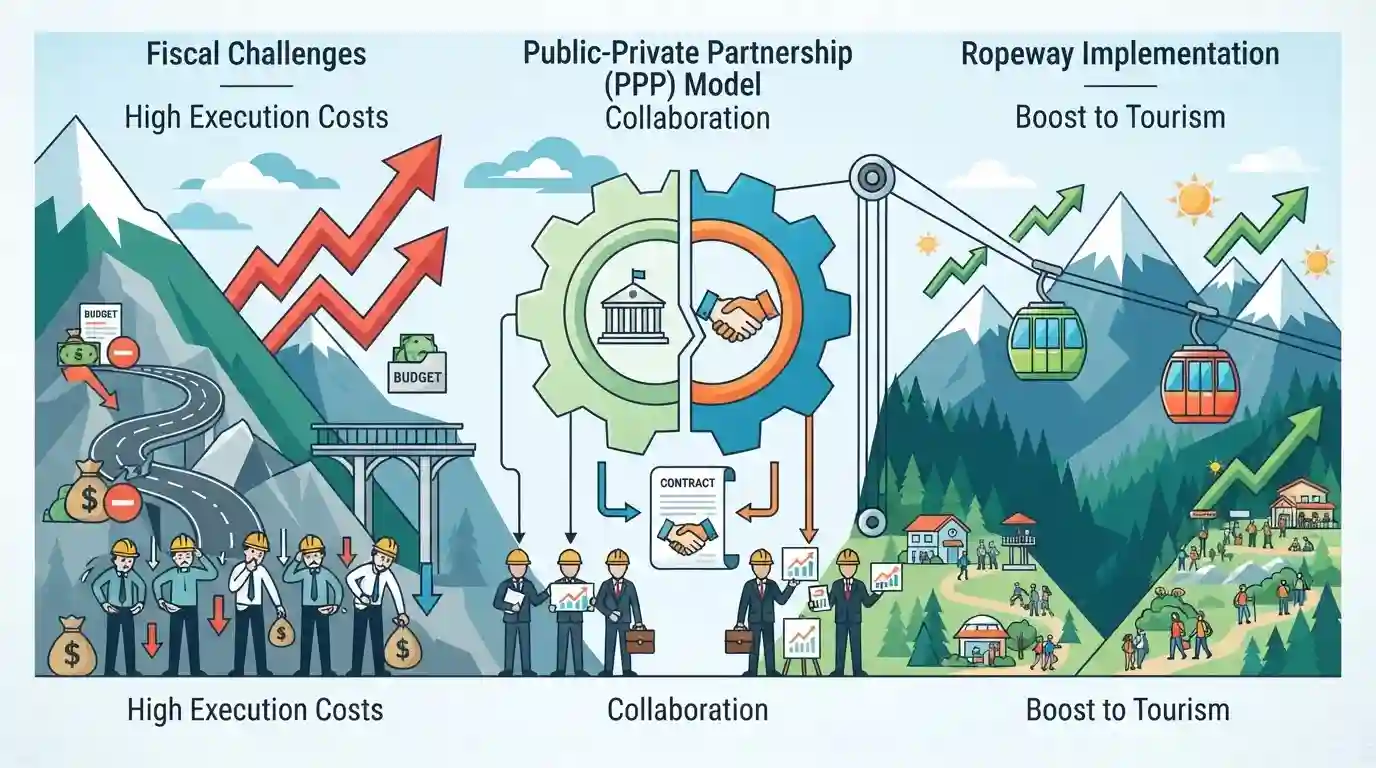
In response to high execution costs and fiscal constraints, the Himachal Pradesh government is shifting towards a Public-Private Partnership (PPP) model for implementing ropeway projects across the state to enhance hilly terrain transport and boost tourism infrastructure.
Key Points
- Himachal Pradesh is moving towards a Public-Private Partnership (PPP) model for ropeway projects due to high capital costs and fiscal constraints.
- The state government aims to improve urban and hilly transport infrastructure, boost tourism, and reduce traffic congestion through ropeway connectivity.
- High financial overheads associated with constructing ropeways in challenging Himalayan terrains necessitate private sector participation and investment.
Important Terms
Public-Private Partnership (PPP) framework for ropeways

A collaborative business arrangement between government agencies and private sector companies to fund, build, and operate infrastructure projects, mitigating state fiscal constraints.
UPSC context
HPAS Paper-II/III: Tests understanding of alternative financing mechanisms for infrastructure development in hilly terrains and tourism promotion.
Himachal Pradesh Government
The elected executive authority of Himachal Pradesh responsible for state policy formulation, fiscal management, and execution of public welfare and infrastructure projects.
UPSC context
HPAS Paper-II: Important for questions concerning state governance, regional administration, and policy shifts in response to fiscal challenges.
Prelims Trap
fully funded by the Central government under national infrastructure schemes
Aspirants often assume all ropeway projects in HP are fully funded by the Central government, ignoring state-level PPP shifts.
Static Concepts Connected
What are the various Public-Private Partnership (PPP) models commonly utilized in India's infrastructure sector?
- BOT (Build-Operate-Transfer):: BOT Model, where private partner builds, operates, and transfers the facility back to the government.
- DBFOT:: DBFOT Model, where design, build, finance, operate, and transfer responsibilities rest with the private concessionaire.
- HAM Model:: Hybrid Annuity Model (HAM), combining EPC and BOT where government pays a portion upfront and annuity during operation.
Cross-Topic Patterns
Ropeways & Fiscal Federalism in Hilly States
Himachal's fiscal constraints and high capex in fragile Himalayan ecosystems test the limits of pure state funding, necessitating blended finance and PPPs.
Urban Ropeways & National Parvatmala Scheme
Urban ropeway deployment in Shimla parallels national ropeway initiatives like Parvatmala, combining green transport with tourism monetization.

HPAS questions on HP infrastructure frequently test the financing mechanism (PPP vs. EAP) and concession period caps for ropeways.
Linked PYQs · 2
Linked PYQs · 2
- 2024HPAS_PRELIMSGS1
Arrange the following years based on the number of foreign tourist arrivals in Himachal Pradesh in descending order : (1) 2020 (2) 2021 (3) 2022 (4) 2023 (up to December 2023) Choose the correct option :
- 2025HPAS_PRELIMSGS1
According to PLFS 2023-24, share of secondary and tertiary sector in total employment in Himachal Pradesh respectively are :
