Himachal Pradesh shifts ropeway projects to public private partnership
Source:hindustantimes ↗
Why It Matters
Crucial for understanding infrastructure financing, alternative transport mechanisms in hilly terrain, and public-private partnership models in Himachal Pradesh.
Summary
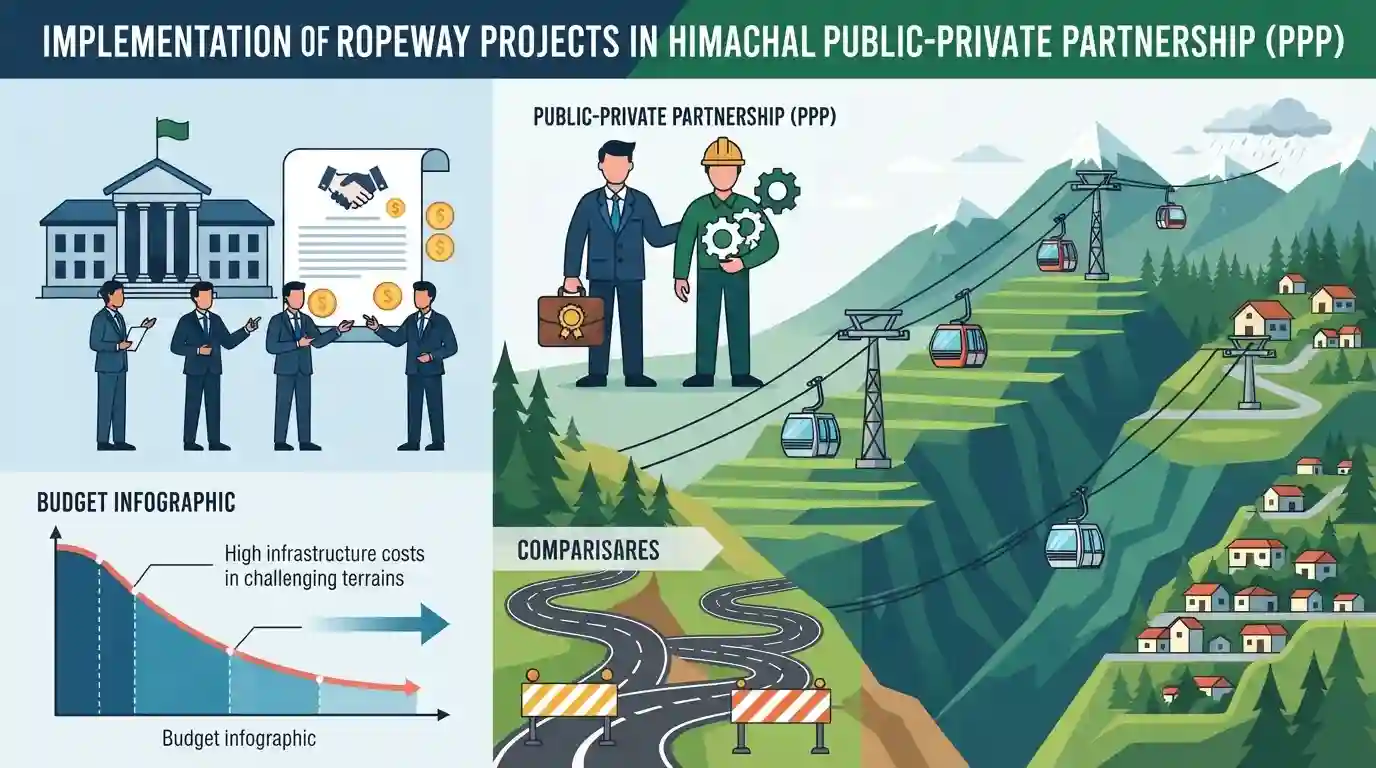
The Himachal Pradesh government has shifted towards implementing ropeway projects via Public-Private Partnership (PPP) mode to cope with high infrastructure costs in challenging hilly terrains, as discussed during the state's monsoon session.
Key Points
- The Himachal Pradesh government has decided to shift ropeway development projects to the Public-Private Partnership (PPP) mode due to high construction and operational costs.
- The decision comes amidst the monsoon session discussions addressing infrastructure financing and budgetary constraints in hilly terrains.
- Ropeways are crucial for enhancing green transport, reducing road congestion, and boosting tourism in remote hilly areas of Himachal Pradesh.
Important Terms
Public-Private Partnership (PPP) mode for ropeway projects

A collaborative funding and management model between government bodies and private enterprises used to build and operate large-scale public infrastructure projects like ropeways.
UPSC context
GS Paper III (Infrastructure & Economy): Tests understanding of alternative financing mechanisms for critical transport infrastructure in hilly regions.
Himachal Pradesh Government
The sub-national state government responsible for policy formulation, legislative business, and infrastructure development in Himachal Pradesh.
UPSC context
HPAS General Studies: Essential for questions concerning state administration, regional economic policies, and governance.
State Legislative Assembly
The unicameral legislative body of Himachal Pradesh where elected representatives discuss state legislation, budget allocations, and policy matters during sessions like the monsoon session.
UPSC context
HPAS Polity: Tests knowledge of state legislature functions, parliamentary procedures, and accountability mechanisms.
Static Concepts Connected
What are the standard Public-Private Partnership (PPP) models used in Indian infrastructure development?
- BOOT Model: The private partner builds, owns, operates, and transfers the facility after a concession period.
- BLT Model: Private partner builds, leases to the government, operates for a fee, and transfers ownership at the end of the term.
- BOT / OMT Model: Government builds and owns the asset, then leases operation and maintenance rights to a private entity for a fixed period.
Cross-Topic Patterns
Green Transport + Himalayan Ecology
Hilly terrain mobility solutions are increasingly linked to carbon credit mechanisms and National Action Plan on Climate Change (NAPCC) sub-missions for sustainable Himalayan development.

PPP concession models for hill infrastructure vs state budgetary constraints will feature in HPAS Mains Paper II/III.
Linked PYQs · 3
Linked PYQs · 3
- 2024HPAS_PRELIMSGS1
Arrange the following years based on the number of foreign tourist arrivals in Himachal Pradesh in descending order : (1) 2020 (2) 2021 (3) 2022 (4) 2023 (up to December 2023) Choose the correct option :
- 2024HPAS_PRELIMSGS1
For the year 2023-24, match the type/name of banks with their total number of branches in Himachal Pradesh : | List I (Type/Name of Bank) | List II (No. of Branches in HP) | |---|---| | (a) Public Sector Banks (PSBs) | (i) 267 | | (b) Private Sector Banks (PSBs) | (ii) 568 | | (c) Himachal Pradesh Gramin Bank (HPGB) | (iii) 1,170 | | (d) Himachal Pradesh Co-operative Sector Banks | (iv) 274 | Choose the correct option : Code: (a) (b) (c) (d)
- 2025HPAS_PRELIMSGS1
According to PLFS 2023-24, share of secondary and tertiary sector in total employment in Himachal Pradesh respectively are :
