Parliamentary Productivity Decline and Legislative Disruption Issues
Source:The Hindu ↗
কেন এটি গুরুত্বপূর্ণ
The persistent disruption of Parliament and the passage of bills without substantive debate undermine legislative scrutiny and executive accountability. Understanding parliamentary tools (like Starred Questions) and committees (like JPCs) is critical for UPSC aspirants studying the institutional health of Indian democracy.
সারসংক্ষেপ
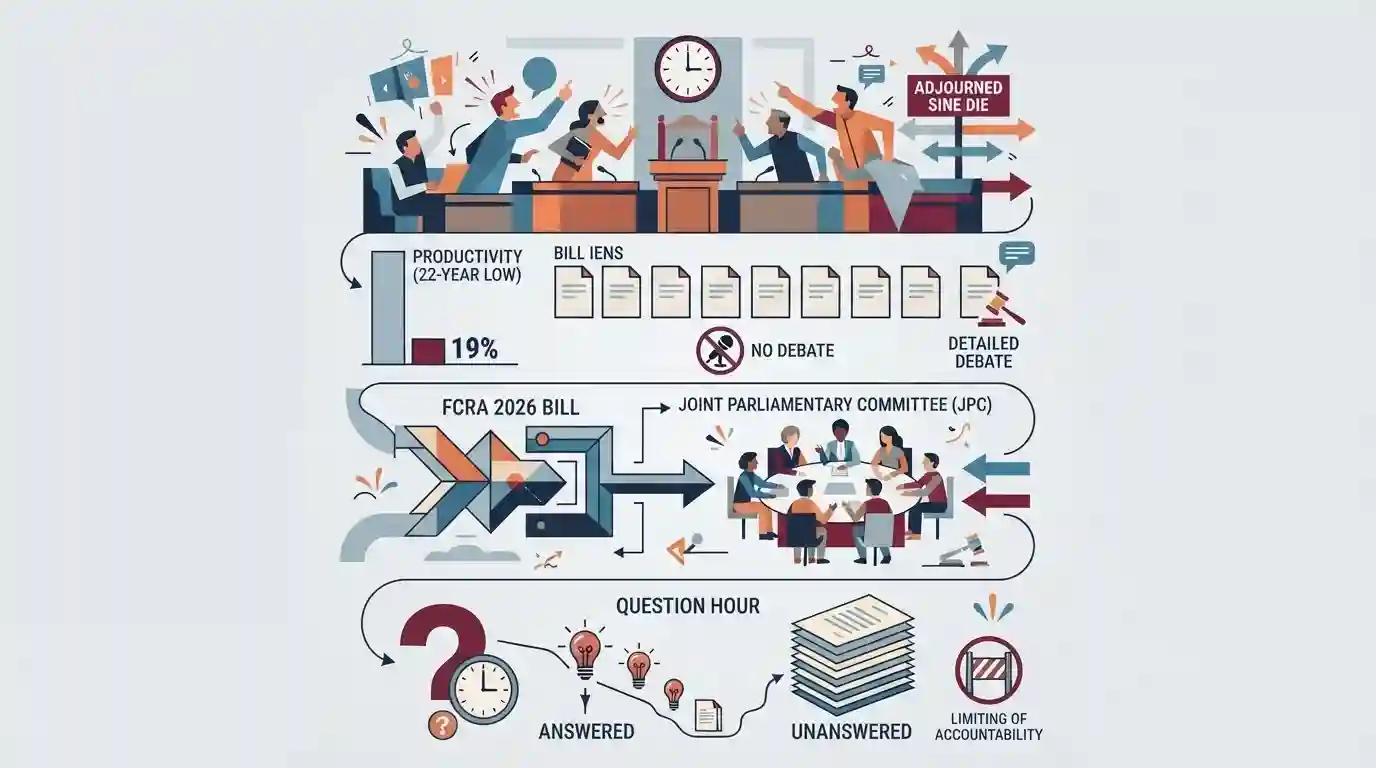
The Monsoon Session of Parliament concluded as a near washout, plagued by persistent disruptions and friction between the government and the Opposition over issues ranging from specific legislation to alleged scams. Both Houses were adjourned sine die ahead of schedule. While 12 Bills were passed, the legislative process suffered deeply; nine Bills were passed in the Lok Sabha without any MPs speaking, and only the Public Examination (Prevention of Unfair Means) Amendment Bill received a detailed debate. The session saw the Foreign Contribution (Regulation) Amendment Bill (FCRA) 2026 referred to a Joint Parliamentary Committee (JPC) due to Opposition pressure. PRS Legislative Research highlighted that Lok Sabha productivity hit a 22-year low of 19%, significantly limiting executive accountability tools like Question Hour, where only a fraction of starred questions were answered.
মূল বিষয়
- The Monsoon Session of Parliament was adjourned sine die ahead of schedule, with Lok Sabha productivity plummeting to 19% (a 22-year low for a non-election session) and Rajya Sabha to 39%.
- Despite the disruption, 12 Bills were passed, though only the anti-paper leak Bill saw detailed debate; nine Bills cleared the Lok Sabha without any MP participation.
- Under pressure from a united Opposition, the controversial Foreign Contribution (Regulation) Amendment Bill (FCRA) 2026 was referred to a Joint Parliamentary Committee (JPC).
- Parliamentary accountability mechanisms were severely curtailed, with only 16 out of 285 starred questions being answered in the Rajya Sabha.
গুরুত্বপূর্ণ শব্দ
Public Examination (Prevention of Unfair Means) Amendment Bill, 2026

A 2026 law tightening anti-paper leak measures, introducing 5-10 year jail terms and fines up to Rs 10 crore for organized exam fraud syndicates.
UPSC context
GS Paper 2 (Governance). Highlights government steps to ensure transparency and credibility in public recruitment and education.
Foreign Contribution (Regulation) Amendment Bill, 2026
A proposed legislation allowing a government-appointed Designated Authority to take over and manage the foreign-funded assets of NGOs if their FCRA registration ceases or is cancelled.
UPSC context
GS Paper 2 (NGOs/Governance). Tests knowledge of FCRA regulations, civil society funding, and the balance between security and fundamental rights.
Joint Parliamentary Committee (JPC)
An ad hoc committee comprising members from both the Lok Sabha and Rajya Sabha, formed to deeply scrutinize complex bills or investigate specific matters of national importance.
UPSC context
GS Paper 2 (Parliamentary Committees). Important for understanding legislative oversight, consensus building, and detailed bill scrutiny processes.
PRS Legislative Research
An independent Indian non-profit organization that analyzes legislative bills, tracks Parliament's functioning, and provides non-partisan data on legislative productivity.
UPSC context
GS Paper 2 (Parliament). Highly relevant for providing data-backed answers on parliamentary productivity, legislative reforms, and executive accountability.
Lok Sabha
The lower house of India's bicameral Parliament, composed of directly elected representatives. It passes legislation, controls national finances, and holds the Union executive accountable.
UPSC context
GS Paper 2 (Parliament). Core polity topic testing the powers, composition, and legislative processes of the House of the People.
প্রিলিমস ফাঁদ
The President of India has the power to adjourn the Parliament sine die when a session is washed out.
Adjournment sine die is declared by the Presiding Officer (Speaker/Chairman), terminating the sitting indefinitely. The President only prorogues the session under Article 85(2).
সংযুক্ত স্থির ধারণা
What are the primary categories of questions asked during Question Hour?
- Starred Questions: Requires an oral answer from the Minister and permits follow-up supplementary questions on the floor of the House.
- Unstarred Questions: Requires a written reply from the Ministry and does not allow any supplementary questioning by MPs.
- Short Notice Questions: Relates to matters of urgent public importance, asked with less than 10 days' notice, and answered orally.
What distinguishes a Joint Parliamentary Committee (JPC) in the Indian Parliament?
- Ad hoc Nature: JPCs are temporary (ad hoc) committees established to examine specific complex bills or investigate national issues, unlike permanent Standing Committees.
- Joint Composition: Membership is drawn from both Houses, traditionally following a 2:1 ratio between the Lok Sabha and the Rajya Sabha.
- Advisory Authority: JPC recommendations are advisory in nature and hold persuasive value, but they are not legally binding on the government.
আন্তঃবিষয় প্যাটার্ন
FCRA amendments & NGO regulation
The referral of the FCRA 2026 bill to a JPC highlights the continuous tension between internal security mandates and civil society freedom, a recurrent GS2/GS3 theme.
Anti-Defection Law stifling debates
The 19% productivity and lack of individual MP participation correlate with the Tenth Schedule, which enforces rigid party whips and reduces individual deliberative space.

Expect a 2026 Prelims question mapping parliamentary tools (Question Hour, JPC) directly to constitutional mechanisms of accountability.
সংযুক্ত PYQ · 4
সংযুক্ত PYQ · 4
- 2026PrelimsGS1
Consider the following statements in respect of questions asked by the Members in the Parliament of India : 1. Unstarred questions are those to which a Member desires an oral answer in the House. 2. Starred questions are those to which a Member desires a written answer. 3. No supplementary question can be asked on an unstarred question. Which one of the following conclusions based on the above statements is correct ?
- 2017PrelimsGS1
The Parliament of India exercises control over the functions of the Council of Ministers through 1. Adjournment motion 2. Question hour 3. Supplementary questions Select the correct answer using the code given below:
- 2019MainsGS2
Individual Parliamentarian's role as the national law maker is on a decline, which in turn, has adversely impacted the quality of debates and their outcome. Discuss.
- 2023MainsGS2
Explain the structure of the Parliamentary Committee system. How far have the financial committees helped in the institutionalisation of Indian Parliament?
