IMD Predicts Southwest Monsoon Revival and Northeast Rain
Source:Indian Express ↗
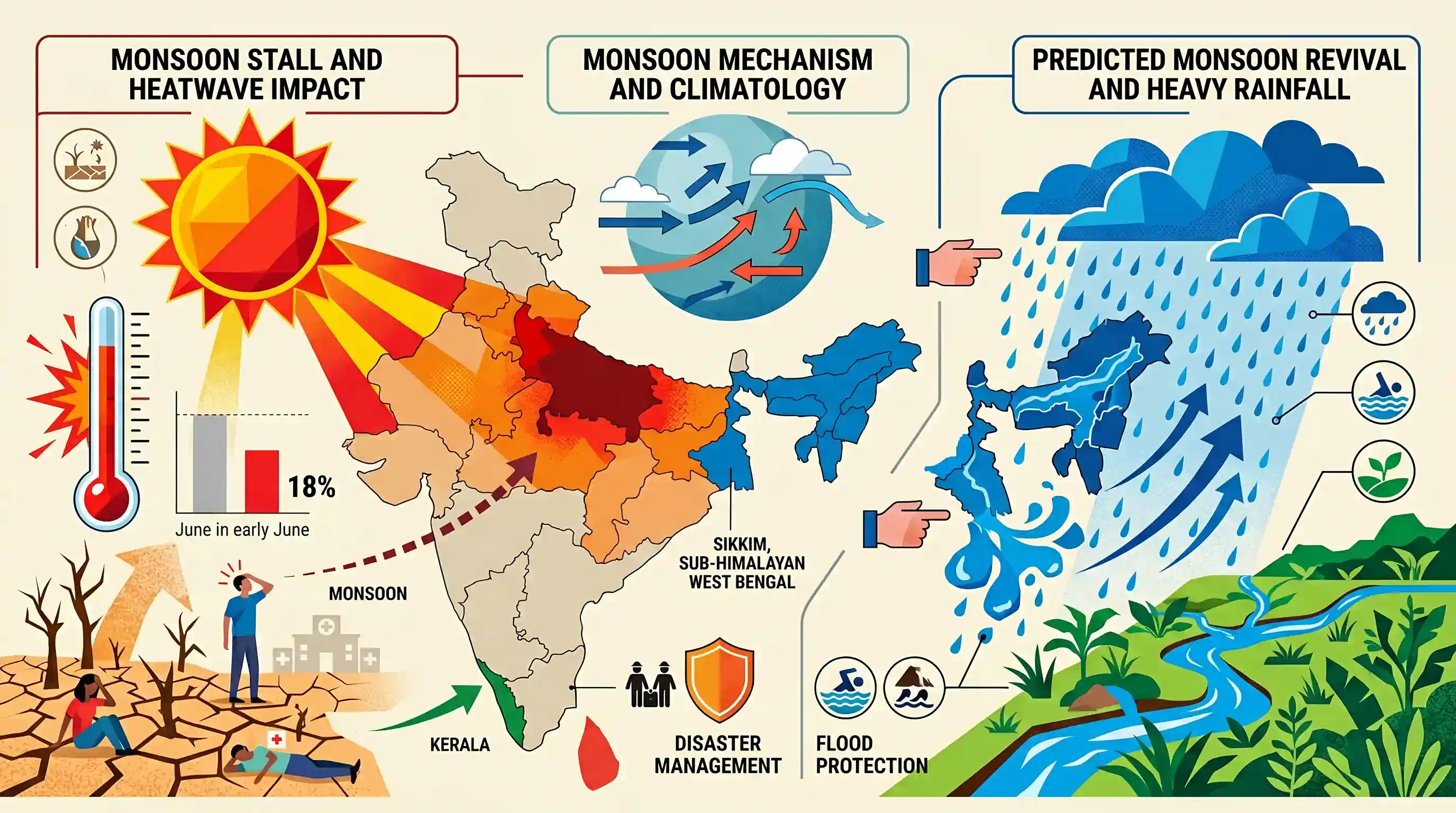
Why It Matters
The article highlights the dual climatic challenges faced by India—monsoon hiatuses leading to rainfall deficits in some regions and prolonged, fatal heatwaves in others. This spatial disparity is crucial for UPSC aspirants studying Indian Geography, Climatology, and Disaster Management.
Summary
The Southwest Monsoon is expected to revive after a significant hiatus, with the India Meteorological Department (IMD) predicting heavy rainfall over Sub-Himalayan West Bengal, Sikkim, and Northeast India. Despite a timely arrival in Kerala, the monsoon's stalled progression caused an 18% rainfall deficit in early June. This delay has simultaneously prolonged extreme heatwave conditions across central and northern India, especially in Uttar Pradesh, resulting in severe health impacts and multiple suspected heat-related deaths.
Key Points
- The IMD forecasts a revival of the southwest monsoon, expecting heavy to very heavy rainfall over Northeast India and Sub-Himalayan West Bengal over the next few days.
- The monsoon's progression stalled after a timely onset over Kerala, resulting in an 18% nationwide rainfall deficit between June 1 and 17.
- The hiatus in the monsoon's advance has prolonged severe heatwave conditions across northern, eastern, and central India, notably in Uttar Pradesh.
- The intense heatwave, coupled with warm night conditions, has led to numerous suspected heat-related fatalities and severe public health distress.
Important Terms
Southwest Monsoon

The primary moisture-laden wind system (June-September) providing ~75-80% of India's annual precipitation. Driven by differential heating between the Indian landmass and the ocean, it is the lifeline of Indian agriculture.
UPSC context
GS Paper I (Geography); critical for understanding climate mechanisms, monsoon distribution, and their impact on the agrarian economy.
India Meteorological Department (IMD)
The nodal agency under the Ministry of Earth Sciences for meteorological observations and forecasting. It issues early warnings for extreme weather events like cyclones, heatwaves, and monsoon variability.
UPSC context
GS Paper II & III; tests knowledge of institutional frameworks for disaster management and climate monitoring.
Heatwave
A period of abnormally high temperatures defined by the IMD when max temperatures reach ≥40°C (plains) or ≥30°C (hills), along with a 4.5°C+ departure from the normal.
UPSC context
GS Paper I & III; relevant for climate change, disaster management, and the public health impacts of "silent disasters."
Break in Monsoon
A temporary cessation of rainfall for one or more weeks during the monsoon season. This occurs when the monsoon trough shifts northward toward the Himalayan foothills, drying out the plains.
UPSC context
GS Paper I (Geography); tests understanding of intra-seasonal monsoon variability and its disruptive impact on crop cycles.
Rainfall Deficit
A situation where rainfall is significantly below the Long Period Average (LPA). IMD classifies it as 'deficient' if seasonal rainfall is less than 90% of the LPA.
UPSC context
GS Paper III (Economy/Agriculture); vital for assessing drought risks, food security, and impacts on rural consumption and inflation.
Prelims Trap
Heatwaves are a notified natural disaster under the NDMA, allowing states to access National Disaster Response Funds (NDRF) for relief.
Heatwaves are NOT centrally notified natural disasters. States cannot trigger NDRF for them, though they can use up to 10% of their State Disaster Response Fund (SDRF) for local relief under state-specific guidelines.
Static Concepts Connected
What causes a 'Break in Monsoon' and how does it affect Indian rainfall?
- Trough Shift: The monsoon trough (part of the ITCZ) shifts northward, moving close to the Himalayan foothills.
- Dry Plains: Rainfall sharply declines or ceases completely over the central and northern Indian plains.
- Northeast Deluge: Rainfall intensifies significantly over Northeast India, the Himalayan foothills, and parts of the southern peninsula.
What are the IMD's objective criteria for declaring a heatwave in India?
- Baseline Thresholds: Maximum temperature must reach at least 40°C in plains, 37°C in coastal areas, and 30°C in hilly regions.
- Normal Departure: A departure of 4.5°C to 6.4°C from normal triggers a heatwave. A departure >6.4°C triggers a severe heatwave.
- Absolute Rule: Regardless of normal departure, an absolute maximum temperature of 45°C triggers a heatwave, and 47°C triggers a severe heatwave.
Cross-Topic Patterns
Heatwaves vs. NDMA Funding Framework
The non-inclusion of heatwaves as centrally notified disasters limits NDRF allocation, forcing states to rely on their 10% SDRF quota and pushing urban local bodies to develop independent Heat Action Plans (HAPs).
Wet-bulb temperature & Urban Heat Islands
A stalled monsoon creates high heat combined with rising humidity (high wet-bulb temperature). This prevents nocturnal cooling ("warm nights"), drastically increasing heatstroke fatalities compared to dry heat.

Expect a multi-statement prelims question linking the monsoon trough's shift (Break in Monsoon) to IMD heatwave criteria and SDRF funding.
Linked PYQs · 5
Linked PYQs · 5
- 2023MainsGS1
Why is the South-West Monsoon called 'Purvaiya' (easterly) in Bhojpur Region? How has this directional seasonal wind system influenced the cultural ethos of the region?
- 2022MainsGS1
Discuss the meaning of colour-coded weather warnings for cyclone prone areas given by India Meteorological Department.
- 2017PrelimsGS1
With reference to 'Indian Ocean Dipole (IOD)' sometimes mentioned in the news while forecasting Indian monsoon, which of the following statements is/are correct? 1. IOD phenomenon is characterised by a difference in sea surface temperature between tropical Western Indian Ocean and tropical Eastern Pacific Ocean. 2. An IOD phenomenon can influence an El Nino's impact on the monsoon. Select the correct answer using the code given below:
- 2020PrelimsGS1
With reference to Ocean Mean Temperature (OMT), which of the following statements is/are correct? 1. OMT is measured up to a depth of 26°C isotherm which is 129 meters in the south-western Indian Ocean during January - March. 2. OMT collected during January - March can be used in assessing whether the amount of rainfall in monsoon will be less or more than a certain long-term mean. Select the correct answer using the code given below:
- 2025PrelimsGS1
The World Bank warned that India could become one of the first places where wet-bulb temperatures routinely exceed 35 °C. Which of the following statements best reflect(s) the implication of the above-said report? I. Peninsular India will most likely suffer from flooding, tropical cyclones and droughts. II. The survival of animals including humans will be affected as shedding of their body heat through perspiration becomes difficult. Select the correct answer using the code given below.
