Shifting Monsoonal Trends and Early Onset Dynamics
Source:The Hindu ↗
Why It Matters
Understanding the shifting dynamics of the Indian monsoon is crucial for geographic and environmental studies, directly impacting water security, agriculture, and disaster management. It provides a real-world example of how global warming alters local weather systems and necessitates adaptive policy frameworks.
Summary
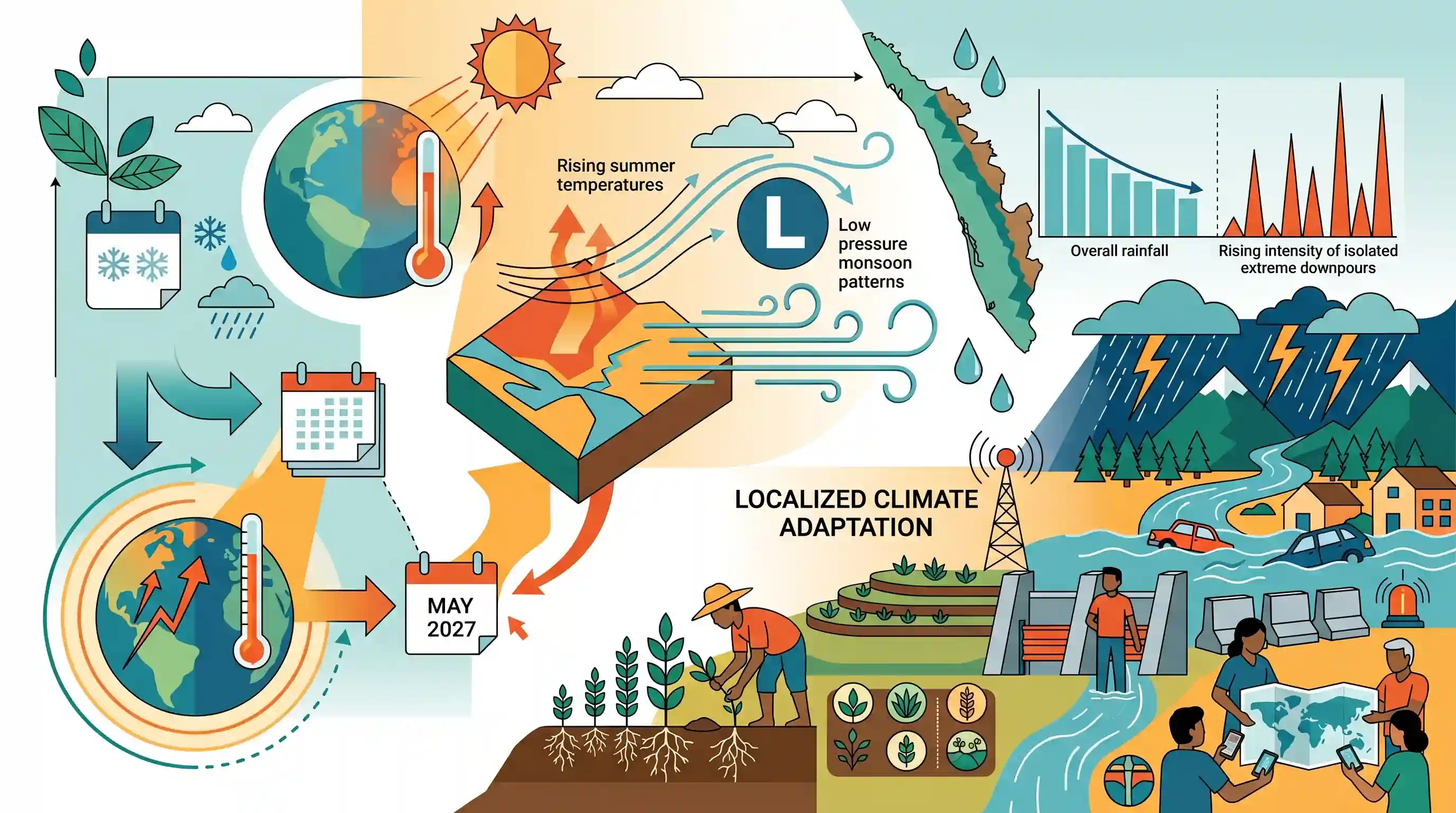
An analysis of southwest monsoon data spanning over a century reveals an increasing trend of the monsoon onset advancing to May, primarily driven by global warming. A study led by the India Meteorology Department highlights a climate paradox in Kerala: while overall southwest monsoon rainfall is steadily declining, the intensity of isolated extreme downpours is rising, escalating flood risks especially near the Western Ghats. The early development of low-pressure systems over land due to rising summer temperatures is altering traditional monsoon patterns. Experts emphasize the urgent need for localized climate adaptation strategies, resilient agricultural planning, and improved flood management systems.
Key Points
- Southwest monsoon onset in Kerala is increasingly shifting to May, driven by early low-pressure system development linked to global warming.
- Kerala faces a climate paradox with overall southwest monsoon rainfall declining by 26 cm per decade, while extreme precipitation events intensify.
- Extreme downpours are particularly increasing in central Kerala and northern Kerala regions adjacent to the Western Ghats.
- There is an urgent need for district-specific climate adaptation strategies, better flood management, and climate-resilient agriculture to address shifting rainfall patterns.
Important Terms
India Meteorology Department (IMD)

Principal agency for meteorological observations and forecasting under the Ministry of Earth Sciences, crucial for disaster management and agricultural planning.
UPSC context
GS Paper 1 (Geography) and GS Paper 3 (Disaster Management); tests knowledge of institutional roles in climate monitoring.
Southwest Monsoon
Seasonal wind system (June–September) providing ~75% of India’s rainfall; its onset over Kerala traditionally marks the rainy season's start.
UPSC context
GS Paper 1 (Climatology); a core topic examining mechanisms, variability, and socio-economic impact in India.
Western Ghats
A UNESCO World Heritage mountain range acting as a major climatic barrier, influencing rainfall distribution during the southwest monsoon.
UPSC context
GS Paper 1 (Physical Geography) and Paper 3 (Environment); focuses on ecological sensitivity and regional weather influence.
Climate Paradox (Kerala)
The phenomenon where total seasonal rainfall decreases while the intensity of extreme, localized downpours increases due to global warming.
UPSC context
GS Paper 3 (Environment/Climate Change); tests understanding of complex climate impacts beyond simple averages.
Indian Institute of Space Science and Technology (IIST)
Asia's first space university and autonomous body under the Department of Space, specializing in space and atmospheric sciences research.
UPSC context
GS Paper 3 (Science & Technology); highlights India’s specialized research capacity in atmospheric and satellite sciences.
Disaster Management (Flood Resilience)
Policies and infrastructure strategies (e.g., localized adaptation) for reducing risks associated with climate-induced events like intense flooding.
UPSC context
GS Paper 3 (Disaster Management); tests ability to propose structural and policy measures for climate-resilient development.
Prelims Trap
Increasing extreme downpours in Kerala indicate an overall long-term increase in the state's southwest monsoon rainfall.
This is a classic 'climate paradox'. Despite the rise in isolated extreme rainfall events due to global warming, Kerala's overall seasonal southwest monsoon precipitation is actually declining.
Static Concepts Connected
What are the IMD's meteorological criteria for declaring the monsoon onset over Kerala?
- Rainfall criteria: After May 10, if 60% of 14 specific weather stations in Kerala and Mangalore record 2.5 mm or more rain for two consecutive days.
- Wind field: Westerly winds must reach a specific atmospheric depth (up to 600 hPa) and speed (15-20 knots) over the equator to the South Arabian Sea.
- OLR value: Outgoing Longwave Radiation (OLR) must drop below 200 W/sq.m over the designated area, which indicates deep, persistent monsoon cloud cover.
How does the 'suction pump' mechanism drive the Indian Summer Monsoon?
- Thermal low: Intense pre-monsoon summer heating creates a massive, deep low-pressure trough over Northwest India and the Tibetan plateau.
- ITCZ migration: The Inter-Tropical Convergence Zone (ITCZ) migrates northward, actively drawing moisture-laden Southeast trade winds from the southern hemisphere across the equator.
- Jet streams: The subtropical westerly jet shifts north of the Himalayas, while the tropical easterly jet strengthens, creating upper-air divergence that reinforces the surface low-pressure system.
Cross-Topic Patterns
Monsoon anomalies + Climate-resilient agriculture
Unpredictable onsets and extreme rain necessitate shifts from water-intensive crops to millets (Shree Anna). This directly bridges physical geography with GS3 agricultural planning and food security.
Western Ghats ecology + Disaster management
Intensifying downpours interact with the steep orography of the Ghats, escalating landslides. This resurrects debates around the Gadgil/Kasturirangan Eco-Sensitive Zone reports and GS3 disaster preparedness.

Expect a multi-statement Prelims question testing the IMD's exact monsoon onset criteria against the paradox of declining total rainfall.
Linked PYQs · 3
Linked PYQs · 3
- 2015MainsGS1
How far do you agree that the behaviour of the Indian monsoon has been changing due to humanizing landscapes? Discuss.
- 2024MainsGS3
Flooding in urban areas is an emerging climate-induced disaster. Discuss the causes of this disaster. Mention the features of two such major floods in the last two decades in India. Describe the policies and frameworks in India that aim at tackling such floods.
- 2017MainsGS3
'Climate change' is a global problem. How India will be affected by climate change? How Himalayan and coastal states of India will be affected by climate change?
