Monsoon revival over Maharashtra driven by offshore troughs
Source:Indian Express ↗
Why It Matters
The mechanisms of the Indian monsoon—including its breaks and revivals—are foundational to India's geography and economy. Analyzing the weather systems that cause localized extreme rainfall helps civil servants understand the intersection of climate variability, urban planning, and disaster management.
Summary
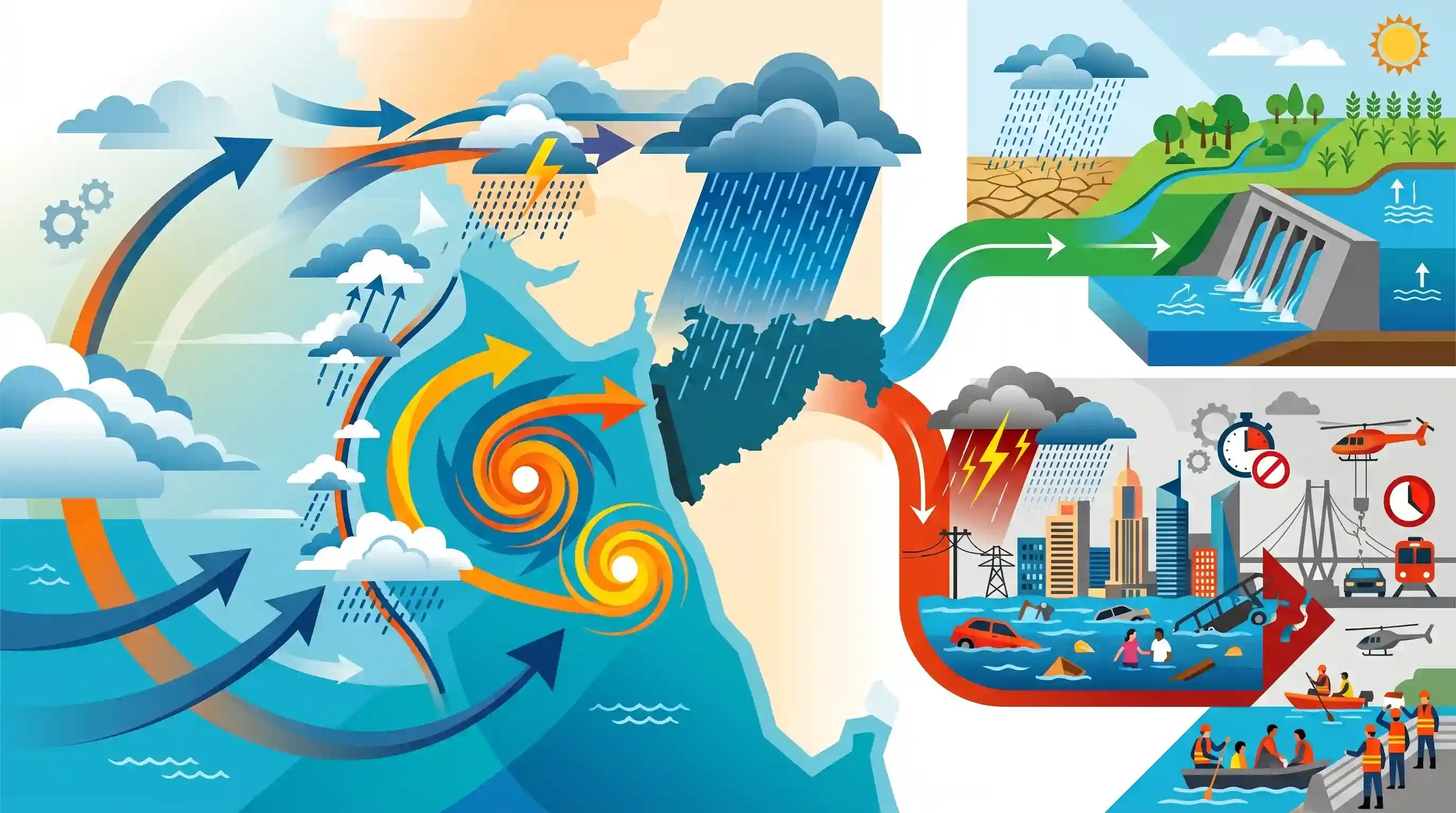
The article explains the meteorological phenomena responsible for the recent revival of the southwest monsoon and the subsequent heavy rainfall in Maharashtra. The intensification of the rains is attributed to a combination of weather systems, notably cyclonic circulations from the Bay of Bengal, an active offshore trough along the west coast, and atmospheric shear zones that facilitate immense moisture convergence. While these rains are vital for wiping out deficits and replenishing reservoirs, the resulting extreme weather events often paralyze cities like Mumbai with urban flooding, highlighting the dual impact of monsoon dynamics and the necessity for robust urban disaster management.
Key Points
- The revival of the monsoon over Maharashtra is primarily driven by cyclonic circulations or low-pressure systems forming in the Bay of Bengal that travel westward.
- An active offshore trough extending along the western coast (from South Gujarat to Kerala) intensifies moisture incursion from the Arabian Sea, leading to heavy coastal downpours.
- The formation of an east-west shear zone in the mid-troposphere acts as a strong trigger for concentrated, extreme rainfall events over the state.
- While the revival addresses seasonal rainfall deficits and benefits agriculture, the intense bursts of rain frequently lead to severe urban flooding and waterlogging in metropolises like Mumbai, stressing civic infrastructure.
Important Terms
Southwest Monsoon

The primary rainy season in India (June-September), driven by moisture-laden winds from the Indian Ocean. It provides ~75% of India's annual rainfall, vital for agriculture and the economy.
UPSC context
GS Paper 1 (Geography); critical for understanding Indian climate, agriculture, and water resource management.
India Meteorological Department (IMD)
The principal government agency under the Ministry of Earth Sciences responsible for meteorological observations, weather forecasting, and seismology. It provides critical early warnings for cyclones and heavy rains.
UPSC context
GS Paper 1 (Geography) and GS Paper 3 (Disaster Management); tests knowledge of institutional frameworks for disaster preparedness.
Urban Flooding
Inundation of land in densely populated areas occurring when intense rainfall exceeds the capacity of drainage systems. It is often exacerbated by unplanned urbanization and loss of natural wetlands.
UPSC context
GS Paper 3 (Disaster Management); focus on causes, impacts, and the NDMA guidelines for mitigation.
Offshore Trough
An elongated belt of low atmospheric pressure that develops along the West Coast of India during the monsoon, facilitating moisture convergence and intense localized rainfall.
UPSC context
GS Paper 1 (Physical Geography); relevant for explaining regional variations in monsoon intensity.
Shear Zone
An atmospheric region where there is a sharp change in wind speed or direction (wind shear). In a monsoon context, it concentrates heavy rain through opposing wind flows.
UPSC context
GS Paper 1 (Geography); tests conceptual understanding of localized meteorological phenomena causing extreme weather.
Cyclonic Circulation
A low-pressure atmospheric system where winds circulate inwards (counter-clockwise in the Northern Hemisphere). These systems often originate in the Bay of Bengal, driving moisture into the mainland.
UPSC context
GS Paper 1 (Physical Geography); fundamental to understanding the mechanics of monsoon rainfall distribution.
Prelims Trap
"Urban flooding in Mumbai is primarily caused by a significant increase in the total volume of seasonal monsoon rainfall."
Trap! Overall seasonal rainfall total isn't necessarily increasing. The culprit is the changing distribution: fewer rainy days with short-duration, extreme bursts that overwhelm drainage.
Static Concepts Connected
What meteorological systems drive the active phases of the Southwest Monsoon?
- Offshore Troughs: Shallow low-pressure areas running parallel to the west coast (Gujarat to Kerala) that drive moisture-laden Arabian Sea winds inland.
- Cyclonic Circulations: Low-pressure systems originating in the Bay of Bengal that migrate westward along the monsoon trough, bringing active rain to central India.
- Wind Shear Zones: Mid-tropospheric regions with opposing winds moving at different velocities, triggering atmospheric instability and concentrated heavy rainfall.
How does urban flooding fundamentally differ from traditional rural riverine flooding?
- Catchment Runoff: Paved, concrete surfaces in cities prevent groundwater infiltration, multiplying flood peak volumes up to 8 times compared to natural rural soil.
- Time of Concentration: Peak flood flow is reached much faster (flashy response) in urban watersheds due to artificial conduits and lack of natural friction.
- Infrastructure Deficit: Legacy storm-water drains designed for low-intensity rain (e.g., 25mm/hr) catastrophically fail against extreme, climate-induced bursts (>100mm/hr).
Cross-Topic Patterns
Climate change and monsoon extremes
The shift towards "fewer rainy days, higher intensity downpours" bridges GS1 geographic climatology with GS3 climate change impacts and urban disaster management.
Urban flooding and Sponge Cities
Recurrent coastal floods connect monsoon dynamics directly to the GS3 necessity for "Sponge City" infrastructure, permeable pavements, and urban wetland conservation.

Expect a linked mains question on how changing micro-climatic monsoon dynamics (shear zones/troughs) directly exacerbate urban flooding.
Linked PYQs · 3
Linked PYQs · 3
- 2024MainsGS3
Flooding in urban areas is an emerging climate-induced disaster. Discuss the causes of this disaster. Mention the features of two such major floods in the last two decades in India. Describe the policies and frameworks in India that aim at tackling such floods.
- 2015MainsGS1
How far do you agree that the behaviour of the Indian monsoon has been changing due to humanizing landscapes? Discuss.
- 2011PrelimsGS1
There is a concern over the increase in harmful algal blooms in the seawaters of India. What could be the causative factors for this phenomenon? 1. Discharge of nutrients from the estuaries. 2. Run-off from the land during the monsoon. 3. Upwelling in the seas. Select the correct answer from the codes given below:
