IMD Predicts Delayed Monsoons Across Uttar Pradesh Region
Source:uni-india ↗
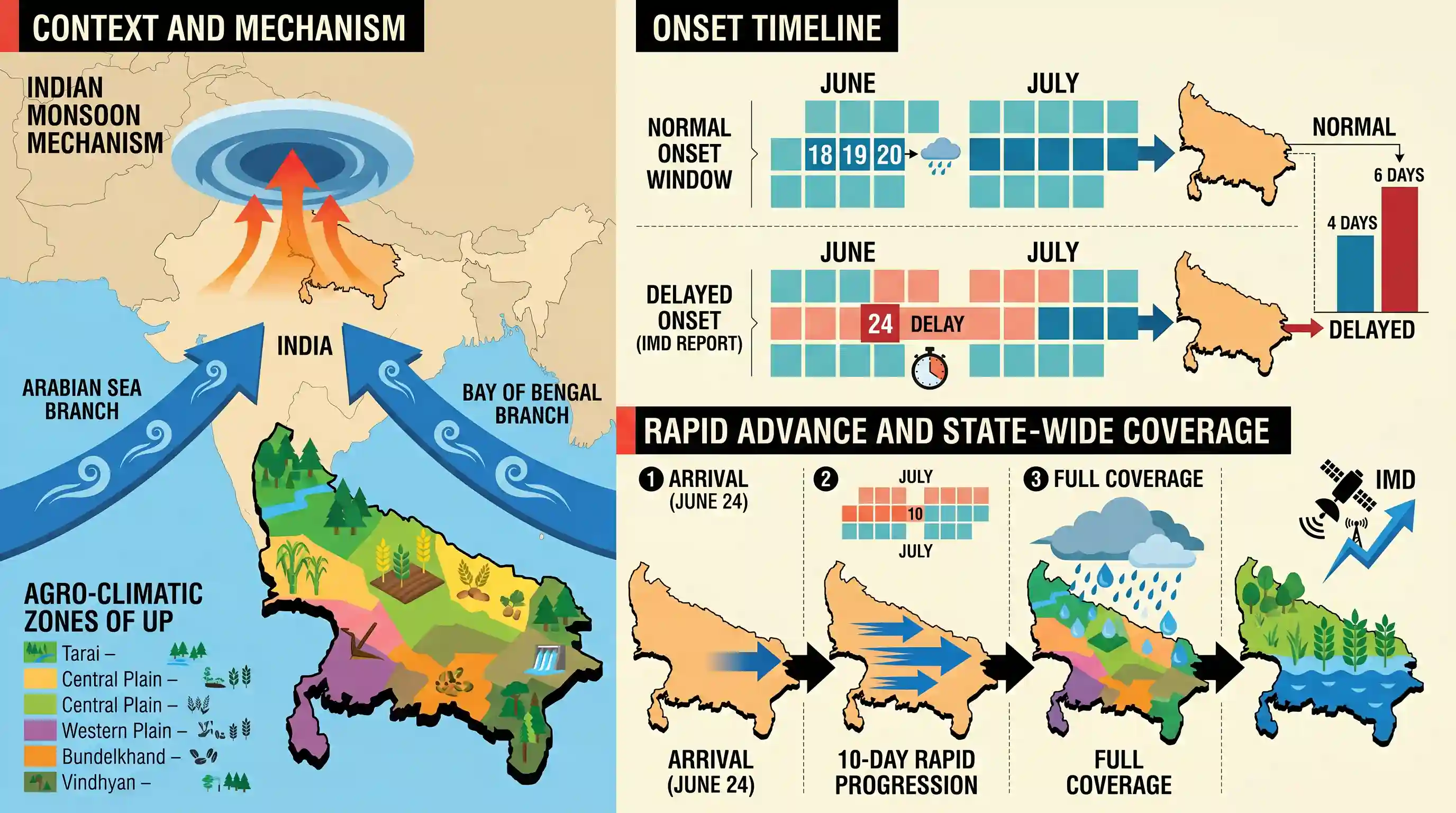
Why It Matters
Monsoon patterns, onset dates, and their deviations are critical geography topics for UPPSC. The monsoon's timely arrival is essential for agriculture across UP's 9 agro-climatic zones. The exam frequently asks questions on Indian climatology, regional weather patterns, and local climate classifications.
Summary
The Indian Meteorological Department (IMD) reported that the Southwest Monsoon is expected to enter Uttar Pradesh with a delay of 4 to 6 days. While the normal onset window is between June 18 and 20, the revised expected arrival date is around June 24. However, the IMD noted that the monsoon is projected to advance rapidly and cover the entire state of UP within 10 days of its arrival.
Key Points
- The Indian Meteorological Department (IMD) projected a delay of 4 to 6 days for the arrival of the southwest monsoon in Uttar Pradesh.
- Under normal meteorological conditions, the monsoon arrives in UP between June 18 and June 20.
- In 2026, the monsoon is expected to enter the state by June 24.
- Despite the delayed onset, the IMD predicts that the monsoon will rapidly advance to cover the entire state within 10 days of its arrival.
- Monsoon delays directly affect agricultural planning, crop sowing schedules, and water management in the state's 9 agro-climatic zones.
Important Terms
India Meteorological Department (IMD)

India's principal government agency under the Ministry of Earth Sciences, established in 1875, responsible for meteorological observations, weather forecasting, and seismology.
UPSC context
GS Paper I (Geography) & GS Paper III (Disaster Management). Tests weather monitoring systems and early warning frameworks.
Southwest Monsoon
A major seasonal wind system blowing from the southwest (June to September) that brings approximately 70–75% of India's annual rainfall, critical for agriculture.
UPSC context
GS Paper I (Physical Geography). Tests conceptual mechanism of monsoon onset, branches, and impact on agricultural planning.
Agro-Climatic Zones of Uttar Pradesh
Nine distinct agricultural regions classified based on soil type, rainfall, temperature, and water resources to optimize crop selection and regional farming strategies.
UPSC context
GS Paper III (Agriculture). Tests regional cropping patterns, land-use planning, and climate-resilient farming interventions.
United News of India (UNI)
A prominent Indian multilingual news agency established in 1959, operating as a newspaper-owned cooperative to deliver news in multiple languages.
UPSC context
GS Paper II (Media & Governance). Useful for understanding India's national news distribution channels and public communication networks.
Prelims Trap
Southwest Monsoon rainfall in Uttar Pradesh increases from west to east, with western districts receiving the highest precipitation.
It is the exact opposite. The Bay of Bengal branch enters UP from the east (as 'Purva'), meaning eastern UP receives the highest rainfall, which steadily decreases towards the dry west.
Static Concepts Connected
Why does monsoon rainfall decline from East to West in the Indo-Gangetic Plain?
- Deflection mechanism: The Bay of Bengal branch hits the Himalayas and deflects westward, moving along the plains.
- Purva easterlies: Because these deflected winds enter Uttar Pradesh from the east, they are locally known as 'Purva'.
- Moisture exhaustion: As the winds travel westward away from the sea, they shed moisture, creating a declining rainfall gradient.
How does the regional classification of agro-climatic zones function in Uttar Pradesh?
- Nine distinct zones: ICAR divides Uttar Pradesh into nine agro-climatic zones based on rainfall, soil type, and topography.
- Planning Commission scale: At the national level, the erstwhile Planning Commission divided India into fifteen broad agro-climatic regions.
Cross-Topic Patterns
Monsoon delays + Kharif crop economics
Late onsets compress the sowing window for water-intensive paddy, escalating farmers' tube-well irrigation costs and driving demand for short-duration crop varieties.
IMD calendar revision + climate change
The 2020 revision of standard monsoon dates reflects shifting rainfall patterns and longer dry spells, directly impacting agricultural policy and crop insurance parameters.

Multi-statement questions in 2026 may link the IMD's revised monsoon calendar dates with regional rainfall gradients across the Indo-Gangetic plain.
Linked PYQs · 4
Linked PYQs · 4
- 2014UPPSC_PRELIMSGS1
The number of agro-climate zones in Uttar Pradesh is
- 2017UPPSC_PRELIMSGS1
How many agro climatic zones are found in Uttar Pradesh?
- 2024UPPSC_PRELIMSGS1
Match List-I with List-II and choose the correct answer using the codes given below the lists. List-I (Famous Local Storm): (A) Mango shower (B) Blossom shower (C) Norwesters (D) Loo List-II (Place/Area): 1. Punjab to Bihar 2. Kerala 3. Karnataka Coastal Areas 4. West Bengal
- 2021UPPSC_PRELIMSGS1
Which one of the following causes is responsible for rainfall during winters in north-western part of India ?
