Southwest Monsoon Expected to Reach Uttarakhand by June Twenty Two
Source:garhwalpost ↗
Why It Matters
Understanding the onset, branches (Bay of Bengal), and delays (due to Western Disturbances) of the Southwest Monsoon is a core part of Indian Climatology. Additionally, the article highlights the geographical divisions of Uttarakhand (plains vs. hills) and the region's vulnerability to climate and water stress, which are frequently tested themes in the UKPSC PCS Prelims.
Summary
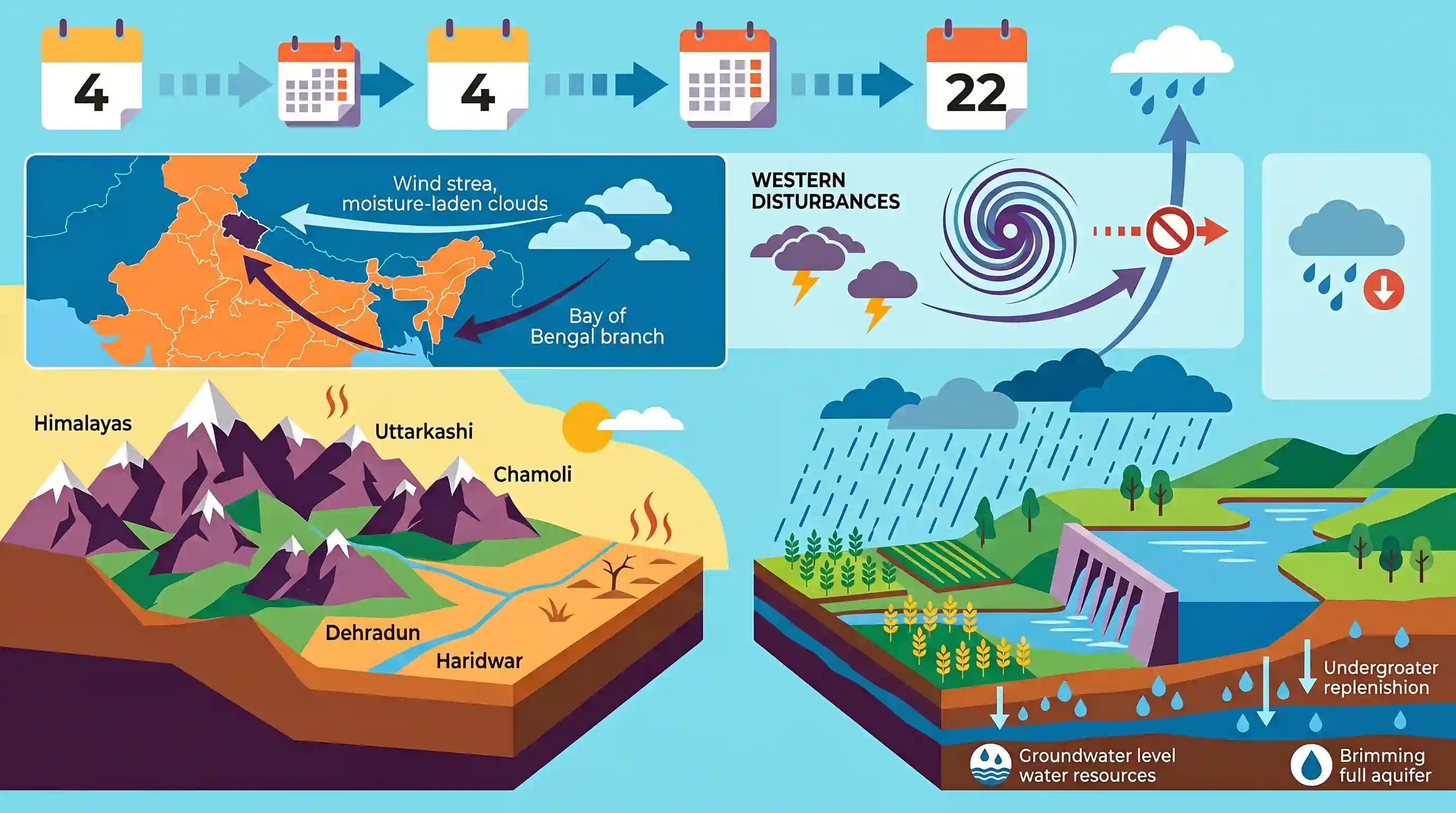
The southwest monsoon is projected to reach Uttarakhand around June 22, 2026, driven by moisture-laden winds from the Bay of Bengal branch. Although the monsoon set in over Kerala on June 4, its progress towards central and northern India was slightly delayed by atmospheric conditions and Western Disturbances. The arrival is expected to bring relief to both the plains (such as Dehradun, Haridwar, Udham Singh Nagar) and the hilly regions (such as Uttarkashi, Chamoli) of the state, benefiting agriculture, water resources, and groundwater recharge. At the national level, the IMD has projected the 2026 southwest monsoon to be slightly below normal.
Key Points
- The Southwest Monsoon is expected to make its onset over Uttarakhand around June 22, 2026, close to its normal schedule.
- Moisture-laden monsoon winds originating from the Bay of Bengal branch are advancing gradually towards northern India to bring widespread rainfall.
- In 2026, the southwest monsoon set in over Kerala on June 4. The IMD projected the overall 2026 southwest monsoon season to be slightly below normal at the national level.
- Monsoon progression over parts of central and northern India was slower than usual due to prevailing atmospheric conditions and Western Disturbances.
- The article highlights the geographic diversity of Uttarakhand, mentioning plains (Dehradun, Haridwar, Udham Singh Nagar) and hills (Uttarkashi, Chamoli), with higher reaches above 4,200 metres witnessing fresh snowfall.
- The monsoon serves as a lifeline for agriculture, groundwater recharge, and drinking water sources in Uttarakhand, which is highly vulnerable to water stress and climate change.
Important Terms
India Meteorological Department (IMD)

The principal national agency under the Ministry of Earth Sciences responsible for meteorological observations, weather forecasting, and seismology.
UPSC context
Relevant for GS Paper 1 (Geography) and GS Paper 3 (Disaster Management) for monitoring monsoons, cyclones, and climate change.
Southwest Monsoon (Bay of Bengal branch)
A primary branch of India's summer monsoon that carries moisture over the Bay of Bengal, delivering heavy rain to Northeast India and the Ganga plains.
UPSC context
Tested under GS Paper 1 (Climatology) for understanding the onset, mechanism, and regional distribution of rainfall across India.
Western Disturbances
Extra-tropical cyclonic storms originating in the Mediterranean region that travel eastward via westerly jet streams, bringing non-monsoonal precipitation to northwest India.
UPSC context
Relevant for GS Paper 1 (Indian Climate) and GS Paper 3 (Agriculture), as they crucially nourish winter Rabi crops.
Orographic Rainfall
Rainfall produced when moisture-laden winds are forced to ascend a mountain barrier, leading to adiabatic cooling, condensation, and heavy precipitation on windward slopes.
UPSC context
Tested in GS Paper 1 (Physical Geography) to explain precipitation patterns across the Western Ghats and the Himalayas.
Meteorological Centre (Dehradun)
A state-level office of the India Meteorological Department (IMD) established in 2002 to provide localized weather, agricultural, and disaster forecasting for Uttarakhand.
UPSC context
Relevant for GS Paper 3 (Disaster Management) and state PSC exams regarding extreme Himalayan weather and cloudburst monitoring.
Prelims Trap
Western Disturbances are strictly winter phenomena and cannot interact with or delay the advancement of the Southwest Monsoon.
Persistent late-season Western Disturbances bring dry westerly winds that counteract and delay the easterly-dominated advance of the Southwest Monsoon into northern India.
Static Concepts Connected
What are 'Duns' and how do they structurally differ from normal river valleys?
- Tectonic Origin: They are longitudinal tectonic valleys (synclinal depressions) formed between the Lesser Himalayas and the Shivalik range.
- Debris Accumulation: Unlike typical river-carved valleys, Duns are filled with coarse gravelly alluvium deposited by Himalayan rivers when blocked by rising Shivaliks.
- Examples: Dehradun, Patli Dun, and Kotli Dun serve as fertile zones for agriculture and human settlements.
How does the Bay of Bengal branch of the monsoon reach Northwest India?
- Deflection: The branch strikes the Myanmar hills and is deflected westward over the Indo-Gangetic plains by the Himalayas.
- Moisture Gradient: Rainfall decreases from east to west as the winds lose moisture moving towards Punjab and Rajasthan.
- Himalayan Interaction: Its collision with the Shivaliks causes intense orographic rainfall in northern hilly states like Uttarakhand.
Cross-Topic Patterns
Himalayan hydrology + GS3 Disaster Management
The collision of moisture-rich monsoon winds with steep mountain topography triggers frequent cloudbursts, making early-warning systems critical for disaster mitigation in Uttarakhand.
Micro-climate shift + Spring rejuvenation
Erratic monsoon onset directly impacts the discharge of Himalayan springs (dharas), shifting traditional mountain agriculture from rain-fed to highly vulnerable water-stressed regimes.

The atmospheric interplay between lagging Western Disturbances and Southwest Monsoon onset mechanics is a high-potential 2026 Prelims question.
Linked PYQs · 3
Linked PYQs · 3
- 2025UKPSC_PRELIMSGS1
Consider the following statements and select the correct answer from the options given below : Statement 1 : Uttarakhand is highly vulnerable to climate change. Statement 2 : Climate change is causing water stress and depleting biodiversity in Uttarakhand.
- 2024UKPSC_PRELIMSGS1
What percentage (approximately) of Uttarakhand is plain area ?
- 2025UKPSC_PRELIMSGS1
Which of the following local winds affects some parts of Kerala and Tamil Nadu during Premonsoon season ?
