Monsoon Deficit Exposes India Agricultural Vulnerability
Source:The Hindu ↗
Why It Matters
This article integrates multiple core GS3 themes: cropping patterns, water resource management, agricultural vulnerability, and the practical challenges of crop diversification. It provides vital data for Mains answers on climate-resilient agriculture, MSP issues, and irrigation constraints.
Summary
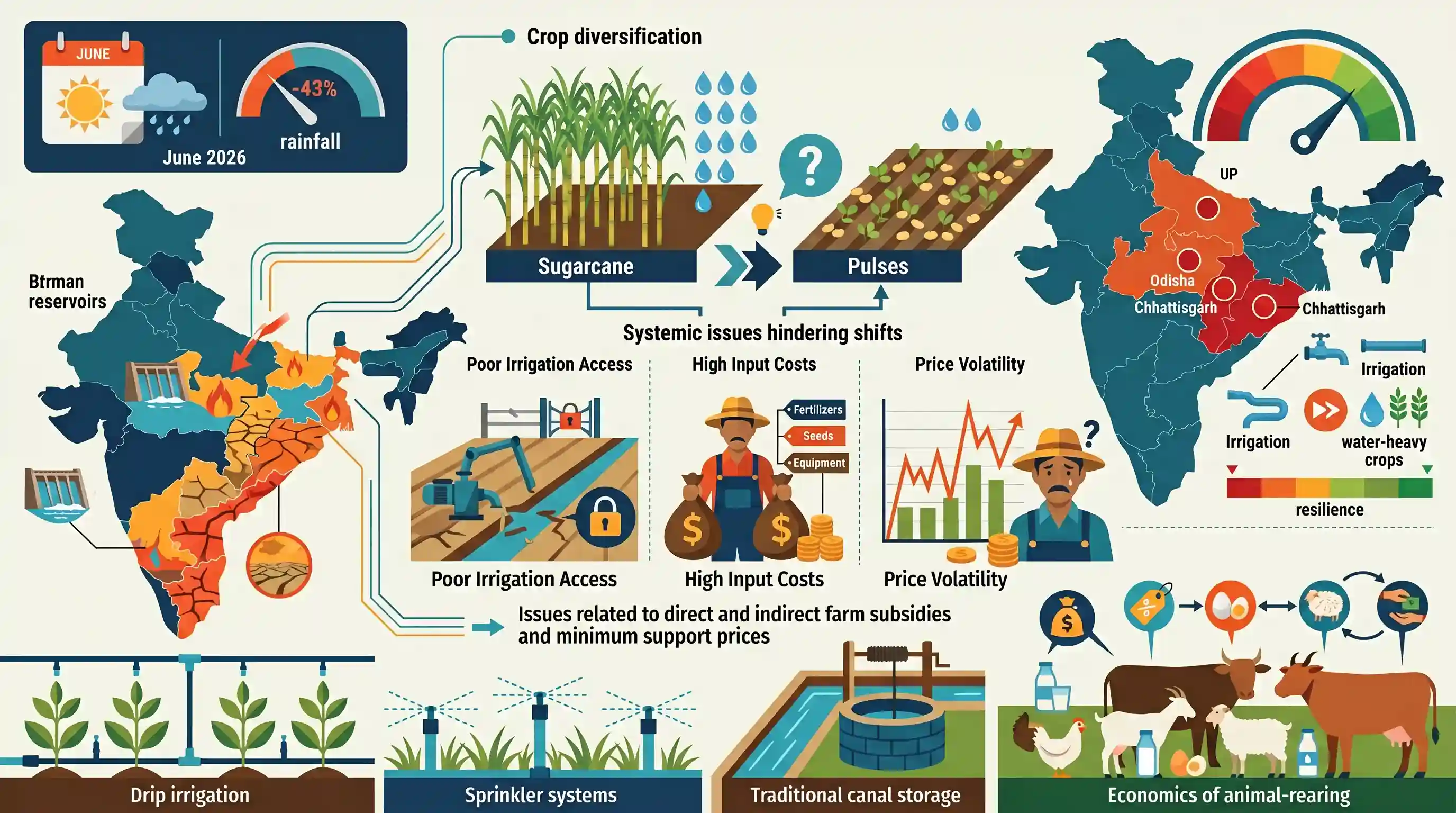
A 43% monsoon deficit in June 2026 has exposed the structural vulnerabilities in Indian agriculture, prompting calls for crop diversification from water-intensive sugarcane to pulses. However, systemic issues such as poor irrigation access, high input costs, and price volatility hinder farmers from making this shift. Further exacerbating the situation are depleted reservoirs in the Southern and Eastern regions. A resilience index by CareEdge highlights that states like Odisha, Chhattisgarh, Madhya Pradesh, and UP are particularly exposed due to their low irrigation coverage and reliance on water-heavy crops.
Key Points
- June 2026 recorded a severe 43% monsoon rainfall deficit, raising alarms for the ongoing kharif crop season.
- To cope with the deficit, the government has recommended shifting cultivation from water-guzzling crops like sugarcane to shorter-duration pulses.
- However, pulse cultivation faces significant constraints, with farmers pointing to high input costs, lack of life-saving irrigation, and fluctuating harvest prices as major hurdles.
- Central Water Commission data reveals concerning reservoir levels, particularly in the Southern and Eastern regions, which are over 14% and 19% below normal, respectively.
- Care Edge Ratings' 'State-wise Poor Monsoon Resilience Index' identifies Odisha, Chhattisgarh, Madhya Pradesh, and Uttar Pradesh as highly vulnerable due to low irrigation coverage and high reliance on water-intensive crops.
Important Terms
India Meteorological Department (IMD)

Agency under the Ministry of Earth Sciences managing meteorological observations, weather forecasting (including monsoon), and seismology.
UPSC context
GS Paper 1 (Geophysical phenomena) and GS Paper 3 (Agri/Disaster Management).
Central Water Commission (CWC)
Technical body under the Ministry of Jal Shakti responsible for coordinating water resource schemes, flood forecasting, and monitoring reservoir storage levels.
UPSC context
GS Paper 1 (Water resources) and GS Paper 3 (Agri-infrastructure).
Crop Diversification
Shifting from a single-crop system to multiple crops or switching to climate-resilient varieties to enhance soil health and income security.
UPSC context
GS Paper 3 (Major crops and cropping patterns).
Minimum Support Price (MSP)
Minimum price fixed by the Government of India for specific crops to protect farmers against sharp market price fluctuations and distress sales.
UPSC context
GS Paper 3 (Issues related to farm subsidies and MSP).
CareEdge Ratings
A SEBI-registered credit rating agency that provides independent research and indices, such as the 'State-wise Poor Monsoon Resilience Index' mentioned in the article.
UPSC context
GS Paper 3 (Agri-economics and vulnerability assessments).
Irrigation Coverage
The extent of agricultural land served by artificial water systems, reducing reliance on monsoons and mitigating risks from rainfall deficits.
UPSC context
GS Paper 3 (Irrigation systems and storage).
NITI Aayog
India's premier policy think tank providing directional and policy inputs while promoting cooperative federalism to achieve sustainable development goals.
UPSC context
GS Paper 2 (Statutory/regulatory/quasi-judicial bodies) and GS Paper 3 (Planning).
Prelims Trap
The Central Water Commission (CWC) monitors both major surface water reservoirs and groundwater levels across India.
The CWC only monitors surface water resources (rivers, reservoirs). Groundwater levels are monitored by a separate body: the Central Ground Water Board (CGWB).
Static Concepts Connected
Why are pulses prioritized over sugarcane during monsoon deficits?
- Water footprint: Pulses require only 300-500 mm of water, whereas sugarcane is a water-guzzling crop requiring around 2000 mm annually.
- Short duration: Pulses mature quickly (60-90 days), allowing farmers to salvage a harvest even if monsoon arrival is delayed.
- Soil health: Leguminous pulses fix atmospheric nitrogen, improving soil resilience in drought-stressed regions without heavy fertilizer input.
What is the mandate of the Central Water Commission (CWC)?
- Apex technical body: Functions as an attached office under the Ministry of Jal Shakti, dealing with surface water resources.
- Reservoir monitoring: Tracks the live storage capacity of major reservoirs nationwide to guide irrigation and drinking water planning.
- Flood forecasting: Provides critical early warning systems for floods and assists in resolving inter-state water disputes.
Cross-Topic Patterns
Crop Diversification & MSP Skew
The shift from sugarcane to pulses fails because MSP procurement favors paddy/wheat, and state-backed FRP protects sugarcane, leaving pulse farmers exposed to free-market price volatility.
Climate Resilience & Food Inflation
Depleted southern reservoirs threaten the Kharif harvest, creating a supply shock that cascades into food-driven CPI inflation, complicating the RBI's monetary policy trajectory.

Expect a 2026 prelims question linking crop water footprints (sugarcane vs pulses) with region-specific irrigation coverage and MSP.
Linked PYQs · 5
Linked PYQs · 5
- 2023MainsGS3
Explain the changes in cropping pattern in India in the context of changes in consumption pattern and marketing conditions.
- 2021MainsGS3
What are the present challenges before crop diversification? How do emerging technologies provide an opportunity for crop diversification?
- 2020MainsGS3
Suggest measures to improve water storage and irrigation system to make its judicious use under depleting scenario.
- 2021PrelimsGS1
Among the following, which one is the least water-efficient crop?
- 2022PrelimsGS1
Consider the following pairs: Reservoirs States 1. Ghataprabha - Telangana 2. Gandhi Sagar - Madhya Pradesh 3. Indira Sagar - Andhra Pradesh 4. Maithon - Chhattisgarh How many pairs given above are not correctly matched?
