Southwest Monsoon Covers Entire Country Day After Normal Schedule
Source:The Hindu ↗
Why It Matters
Understanding the monsoon mechanism is vital for UPSC aspirants as it influences India's physical geography, water security, and rural economy. This article highlights a key meteorological nuance: that full geographical coverage of the monsoon is distinct from its performance, volume, and distribution, especially under the suppressing influence of climate phenomena like El Niño.
Summary
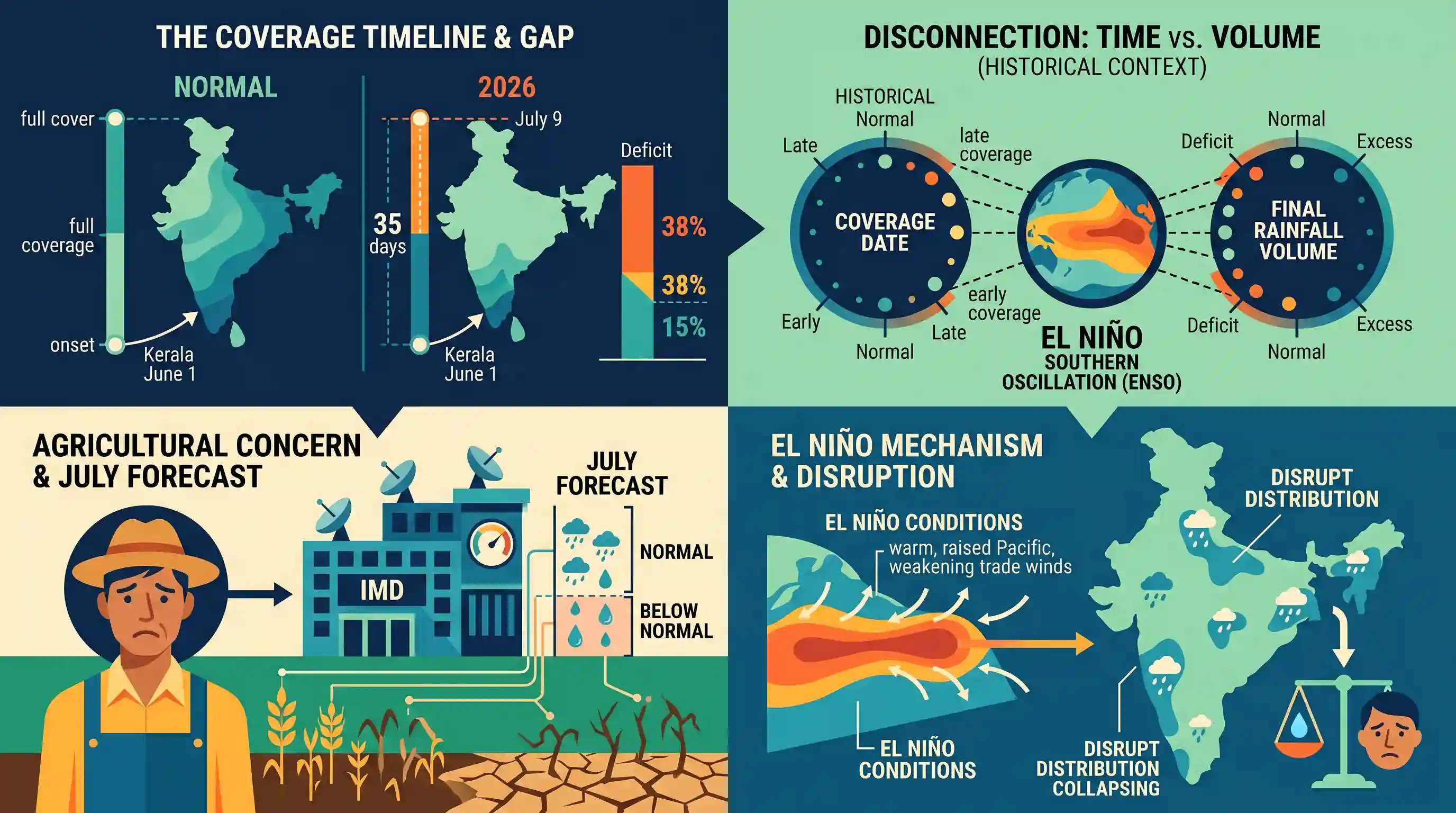
The southwest monsoon covered all of India on July 9, 2026, a day after its normal schedule, taking 35 days from its Kerala onset. While the cumulative deficit improved from 38% to 15%, the IMD's below-normal forecast for July raises agricultural concerns. Historical data reveals that timely nationwide monsoon coverage does not correlate with final rainfall volumes, as El Niño conditions can significantly suppress circulation and disrupt rainfall distribution regardless of coverage dates.
Key Points
- The southwest monsoon covered the entire territory of India on July 9, 2026, which is just one day later than its normal scheduled date of July 8.
- The monsoon completed its nationwide progression in 35 days, having arrived in Kerala on June 5, 2026.
- India's cumulative rainfall deficit improved from 38% on June 30 to 15% on July 9, following a late surge in monsoon progression.
- The IMD has forecast below-normal rainfall for July (less than 94% of the Long Period Average or LPA), which is a critical month for Indian agriculture and Kharif crop sowing.
- Meteorological history shows no direct correlation between the speed/date of nationwide monsoon coverage and the final cumulative volume of rain. For example, during El Niño years with severe droughts, coverage was completed on August 15 (2002), July 3 (2009), and June 26 (2015).
- El Niño conditions can weaken the monsoon's overarching atmospheric circulation, leading to highly uneven spatial and temporal distribution of rainfall even after full geographical coverage is achieved.
Important Terms
India Meteorological Department (IMD)

The principal government agency under the Ministry of Earth Sciences responsible for meteorological observations, weather forecasting, and seismology in India.
UPSC context
GS Paper 1 (Geography) & GS Paper 3 (Disaster Management). Tests understanding of critical government scientific bodies, forecasting systems, and disaster mitigation.
Southwest Monsoon
A major seasonal wind reversal system active from June to September, delivering nearly 75% to 80% of India's annual rainfall through differential heating.
UPSC context
GS Paper 1 (Geography/Climatology). Tests foundational knowledge of monsoon mechanisms, spatial distribution, onset schedules, and economic significance.
El Niño Southern Oscillation (ENSO)
A global climate cycle involving temperature and pressure fluctuations across the tropical Pacific Ocean, with warm (El Niño) and cold (La Niña) phases.
UPSC context
GS Paper 1 (Physical Geography). Tests global atmospheric-oceanic teleconnections, Walker circulation, and global climate drivers affecting monsoonal systems.
Monsoon Core Zone
The primarily rain-fed agricultural belt of central India that relies heavily on seasonal rains and is exceptionally vulnerable to monsoon variability.
UPSC context
GS Paper 1 (Agricultural Geography) & GS Paper 3 (Agriculture). Tests understanding of rain-fed farming dependencies and targeted block-level agricultural policies.
Long Period Average (LPA)
The historical multi-decade benchmark average of seasonal monsoon rainfall over India, used to quantify and categorize weather anomalies and deficits.
UPSC context
GS Paper 1 (Geography/Meteorology). Tests understanding of quantitative rainfall assessments, statistical baselines, and IMD’s forecasting classifications.
Prelims Trap
Completing geographical coverage ahead of the normal July 8 schedule guarantees a healthy, surplus cumulative monsoon season.
Speed of coverage does not correlate with volume. In 2015, coverage was completed exceptionally early by June 26, yet El Niño caused a severe drought.
Static Concepts Connected
What are the three scientific criteria used by the IMD to declare the Southwest Monsoon onset over Kerala?
- Rainfall quantity: After May 10, 60% of 14 designated stations in Kerala, Lakshadweep, and Karnataka must record >=2.5 mm rainfall for two consecutive days.
- Wind field depth: Westerly winds must run deep up to 600 hPa in the equatorial belt, with zonal wind speeds ranging between 15 and 20 knots.
- Convective cloudiness: Satellite-derived Outgoing Longwave Radiation (OLR) must fall below 200 W/m² in the designated box, indicating deep, heavy cloud cover.
How does El Niño physically suppress the Indian Summer Monsoon?
- Walker Cell displacement: Abnormal warming of the central/eastern equatorial Pacific shifts the rising limb of the Walker circulation eastward, away from the Indian Ocean.
- Sinking dry air: The sinking, dry branch of the altered Walker circulation establishes high-pressure conditions directly over the South Asian region.
- Weakened monsoon flow: This high pressure weakens the moisture-bearing low-level jet stream, suppressing atmospheric convection and rainfall across India.
Cross-Topic Patterns
Monsoon temporal distribution vs Kharif yields
Delayed or deficient rainfall in July directly impacts the sowing window of water-intensive crops like paddy and pulses, driving food inflation and depressing rural economic demand.
Erratic coverage and water resource management
Despite 100% geographic coverage, highly localized extreme rainfall events limit effective groundwater recharge and accelerate soil erosion compared to evenly distributed, moderate rain.

IMD's precise three-way Kerala onset criteria (rainfall, wind, OLR) and its coupling with Walker circulation shifts remain high-yield targets.
Linked PYQs · 3
Linked PYQs · 3
- 2011PrelimsGS1
La Nina is suspected to have caused recent floods in Australia. How is La Nina different from El Nino? 1. La Nina is characterised by unusually cold ocean temperature in equatorial Indian Ocean whereas El Nino is characterised by unusually warm ocean temperature in the equatorial Pacific Ocean. 2. El Nino has adverse effect on south-west monsoon of India, but La Nina has no effect on monsoon climate. Which of the statements given above is/are correct?
- 2017PrelimsGS1
With reference to 'Indian Ocean Dipole (IOD)' sometimes mentioned in the news while forecasting Indian monsoon, which of the following statements is/are correct? 1. IOD phenomenon is characterised by a difference in sea surface temperature between tropical Western Indian Ocean and tropical Eastern Pacific Ocean. 2. An IOD phenomenon can influence an El Nino's impact on the monsoon. Select the correct answer using the code given below:
- 2014MainsGS1
Most of the unusual climatic happenings are explained as an outcome of the El-Nino effect. Do you agree?
