Monsoon Disasters and Infrastructure Deficits in Himachal Pradesh
Source:The Hindu ↗
Why It Matters
The recurring nature of devastating monsoons in the Himalayan region underlines the pressing need for climate-resilient infrastructure, effective disaster preparedness (like hazard zonation mapping), and swift Center-State coordination. It serves as a vital case study for GS-1 Geography and GS-3 Disaster Management.
Summary
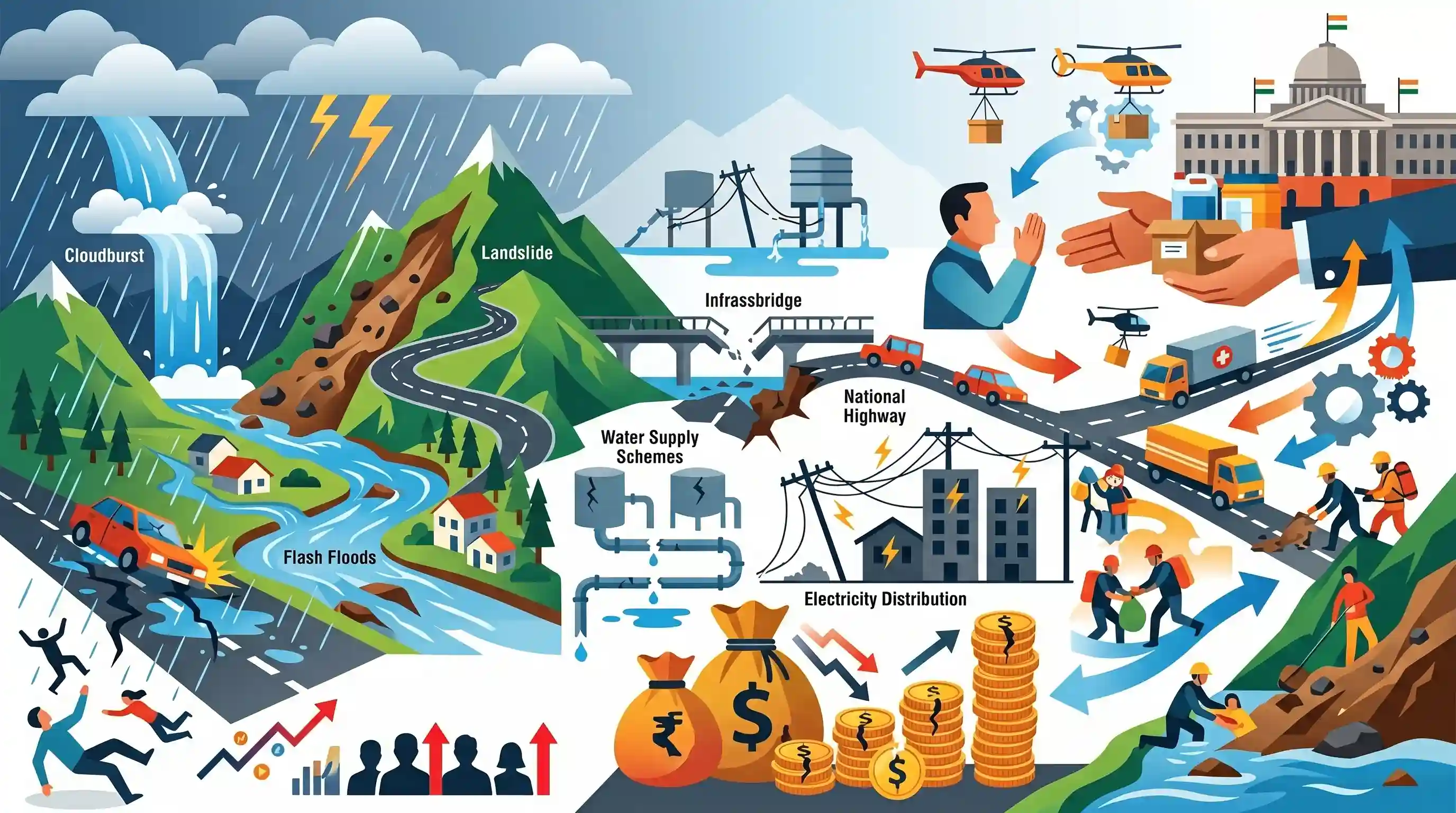
The monsoon season has unleashed severe havoc across Himachal Pradesh, claiming 109 lives between June 20 and July 16, 2025. Fatalities have been largely attributed to extreme weather events such as landslides, flash floods, and cloudbursts, alongside weather-exacerbated road accidents. The torrential rains have inflicted vast damage to critical infrastructure, including national highways, water supply schemes, and electricity distribution, costing the State over ₹883 crore this season. With cumulative disaster-related losses reaching ₹21,000 crore over three years, Chief Minister Sukhvinder Singh Sukhu has appealed for Central assistance to aid in relief and restoration efforts.
Key Points
- The 2025 monsoon claimed 109 lives in Himachal Pradesh within a month, primarily due to landslides, flash floods, cloudbursts, and road accidents.
- Districts such as Mandi and Kangra were the worst affected, each reporting 16 rain-linked fatalities.
- Heavy rainfall resulted in massive infrastructural damage, blocking 226 roads (including NH-707) and disrupting over 130 water supply schemes and 52 power transformers.
- The State Disaster Management Authority estimated monetary losses for the season at over ₹883 crore, with the State incurring a cumulative loss of approximately ₹21,000 crore over the last three years.
- Chief Minister Sukhvinder Singh Sukhu sought Central assistance from Union Home Minister Amit Shah, noting that severe natural disasters have become a recurring phenomenon in the State.
Important Terms
State Disaster Management Authority (SDMA)

A statutory body established under Section 14 of the Disaster Management Act, 2005. Chaired by the Chief Minister, it is the apex state-level body for formulating disaster policies, plans, and mitigation strategies.
UPSC context
GS Paper 3 (Disaster Management); tests knowledge of India's multi-tiered institutional framework and sub-national authorities in crisis mitigation.
State Emergency Operation Centre (SEOC)
A 24/7 centralized facility serving as the nerve center during crises. It facilitates real-time monitoring, communication, and resource mobilization (personnel, equipment) between district-level units and the state government.
UPSC context
GS Paper 3 (Disaster Management); emphasizes operational readiness, early warning dissemination, and the logistics of state-led emergency response.
Cloudburst
An extreme weather event involving sudden, intense rainfall exceeding 100 mm per hour over a small area (20-30 sq. km). It often triggers devastating flash floods and landslides in mountainous regions.
UPSC context
GS Paper 1 (Geography) and GS Paper 3 (Disaster Management); examines orographic rainfall, climate change impacts, and localized hazard mitigation.
State Disaster Response Fund (SDRF)
The primary fund available to states for immediate relief after notified disasters. In special category states like Himachal Pradesh, the Centre contributes 90% of the funds.
UPSC context
GS Paper 3 (Disaster Management/Economy); focuses on fiscal federalism and the mechanism for Centre-State financial assistance during disasters.
Infrastructure Resilience
The ability of critical systems (roads, power, water) to withstand and rapidly recover from disaster-induced shocks. It emphasizes "Building Back Better" to minimize long-term economic and service disruptions.
UPSC context
GS Paper 3 (Disaster Management/Infrastructure); tests understanding of CDRI and strategies for sustainable, risk-informed developmental planning.
Landslide
The downward movement of rock, debris, or earth under gravity, often triggered by heavy monsoon rainfall or seismic activity, particularly in the fragile Himalayan ecosystem.
UPSC context
GS Paper 1 (Geography) and GS Paper 3 (Disaster Management); concerns geo-hydrological hazards and slope stabilization techniques.
Prelims Trap
"Any extreme rainfall event causing flash floods in hilly terrains is officially classified as a cloudburst."
The IMD strictly defines a cloudburst as unexpected precipitation exceeding 100 mm per hour over a geographical region of approximately 20-30 square kilometers, not just "heavy rain."
Static Concepts Connected
What meteorological factors trigger cloudbursts in the Himalayan region?
- Orographic lifting: Steep mountainous terrain forces warm, moisture-laden monsoon winds to rise rapidly.
- Cumulonimbus formation: This rapid atmospheric ascent causes extreme condensation, forming massive, vertical, moisture-heavy clouds.
- Localized downpour: These clouds suddenly dump immense precipitation (exceeding 100mm/hr) over a highly localized area (20-30 sq km).
How are SDRF and NDRF structured for disaster financing?
- Primary response fund: The SDRF is the primary fund available to states, financed 75:25 (Centre:State) for general states and 90:10 for Himalayan states.
- Supplementary aid: The NDRF provides supplementary Central assistance only for "calamities of a severe nature" when SDRF funds are inadequate.
- Funding source: The NDRF is 100% centrally funded, primarily financed through the National Calamity Contingent Duty (NCCD) levied on specific goods.
Cross-Topic Patterns
Anthropogenic stressors + Himalayan disasters
The push for expanding national highways and hydroelectric projects in the geologically young Himalayas directly amplifies the devastation caused by natural extreme weather events like monsoons.
Extreme weather events + CDRI mandate
Recurring monsoon destruction of power grids and water supply schemes practically illustrates the necessity of the India-led Coalition for Disaster Resilient Infrastructure (CDRI) in global policy.

Expect a multi-statement Prelims question blending the strict IMD definition of cloudbursts with NDRF/SDRF funding mechanisms in 2026.
Linked PYQs · 4
Linked PYQs · 4
- 2024MainsGS1
What is the phenomenon of 'cloudbursts'? Explain.
- 2022MainsGS3
Explain the mechanism and occurrence of cloudburst in the context of the Indian subcontinent. Discuss two recent examples.
- 2021MainsGS3
Describe the various causes and the effects of landslides. Mention the important components of the National Landslide Risk Management Strategy.
- 2019MainsGS3
Disaster preparedness is the first step in any disaster management process. Explain how hazard zonation mapping will help disaster mitigation in the case of landslides.
