Early southwest monsoon onset in Maharashtra and climate anomalies
Source:Indian Express ↗
Why It Matters
The Indian Monsoon is a critical topic in UPSC GS1 (Geography). Anomalies in its onset, advancement, and withdrawal are direct evidence of changing climatic patterns and have cascading effects on the economy, agriculture (GS3), and disaster management (GS3 urban flooding).
Summary
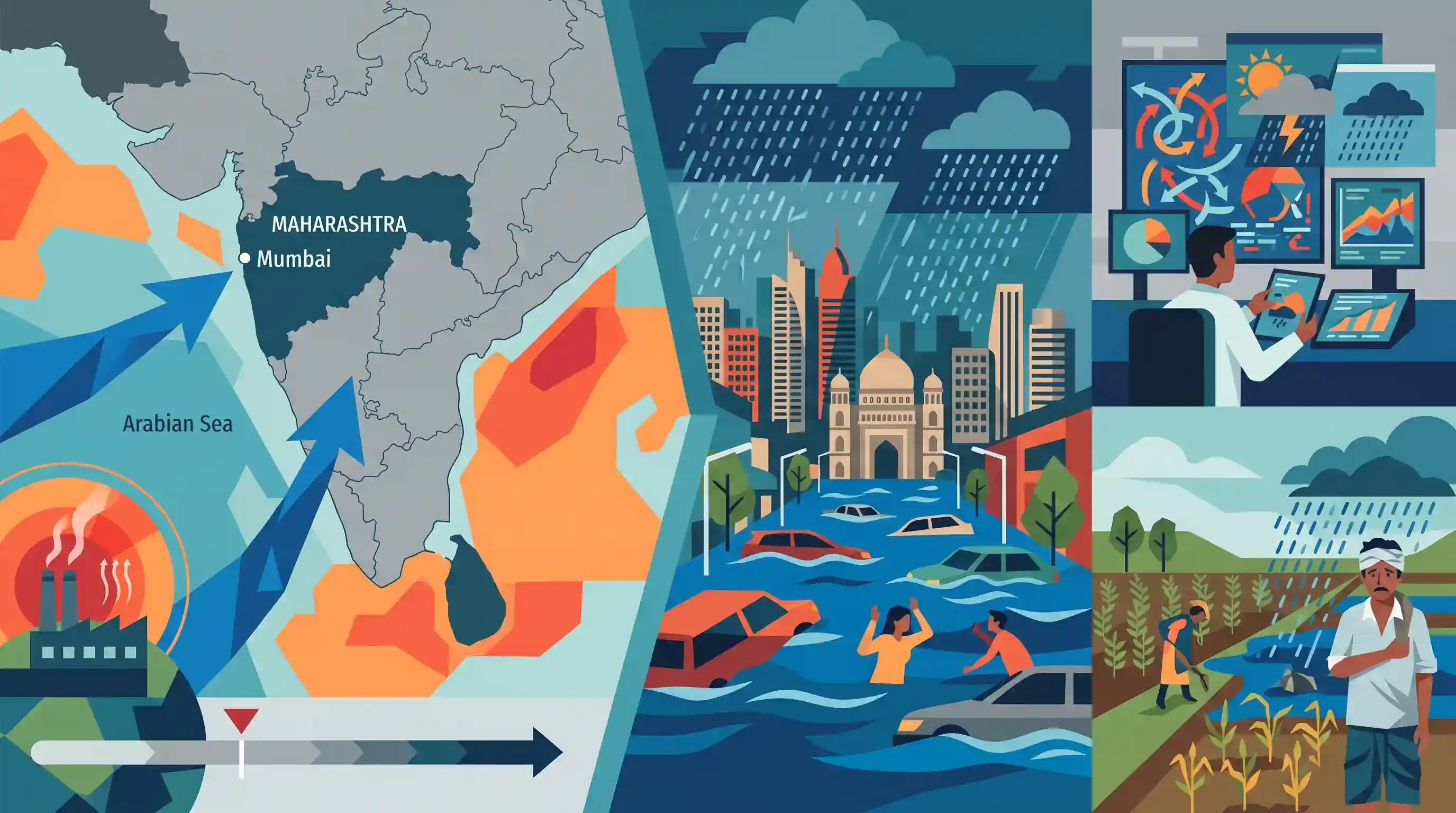
The southwest monsoon has made an unusually early arrival in Maharashtra and Mumbai, recording its earliest onset in over a decade. This early arrival underscores the changing and unpredictable nature of the Indian Summer Monsoon, potentially driven by broader climate change and ocean temperature anomalies. Such shifts in monsoon dynamics pose significant challenges for weather forecasting, agricultural planning, and disaster preparedness, particularly concerning urban flooding in vulnerable metropolitan areas like Mumbai.
Key Points
- The southwest monsoon arrived in Maharashtra and Mumbai significantly earlier than the normal onset date, marking the earliest arrival in decades.
- Early onset and erratic advancement of the monsoon reflect the shifting dynamics of the Indian Summer Monsoon system.
- Changing weather patterns, potentially driven by climate change and ocean temperature anomalies, are influencing monsoon predictability.
- These anomalies have profound implications for agricultural planning, water reservoir management, and urban flood preparedness in cities like Mumbai.
Important Terms
Southwest Monsoon

A seasonal wind system (June–September) providing nearly 75-90% of India's annual rainfall, entering through the Arabian Sea and Bay of Bengal branches.
UPSC context
GS Paper I (Geography) and Paper III (Agriculture); essential for food security and water resource management.
India Meteorological Department (IMD)
The principal government agency under the Ministry of Earth Sciences responsible for meteorological observations, weather forecasting, and early warning for natural disasters.
UPSC context
GS Paper II (Statutory/Regulatory Bodies); tested on its mandate, forecasting models, and role in disaster preparedness.
Monsoon Onset
The technical declaration of monsoon arrival based on 60% of 14 designated stations reporting 2.5mm+ rainfall, alongside specific wind speed and Outgoing Longwave Radiation criteria.
UPSC context
GS Paper I (Physical Geography); focuses on the scientific parameters and timing of the Indian Summer Monsoon.
Urban Flooding
Flooding of densely populated areas caused by intense rainfall overwhelming inadequate drainage systems, often worsened by unplanned urbanization and loss of wetlands.
UPSC context
GS Paper III (Disaster Management); emphasizes urban resilience, infrastructure planning, and the 2010 NDMA guidelines.
Indian Ocean Dipole (IOD)
A climatic phenomenon involving fluctuations in sea surface temperatures between the western and eastern Indian Ocean, significantly affecting the strength of the Indian monsoon.
UPSC context
GS Paper I (Geography); a key climatic teleconnection often analyzed alongside El Niño to predict monsoon variability.
Long Period Average (LPA)
The benchmark rainfall data (currently the 1971–2020 average) used by the IMD to classify monsoon performance as normal, deficient, or surplus.
UPSC context
GS Paper I (Geography) and Paper III (Economy); used to quantify rainfall deviations and their impact on the GDP.
Climate Change Impacts
The long-term shift in global temperatures and weather patterns, leading to more frequent extreme weather events and increased unpredictability in the Indian monsoon.
UPSC context
GS Paper III (Environment); focuses on the adaptation and mitigation strategies for shifting weather dynamics.
Prelims Trap
"An early onset of the Southwest monsoon guarantees surplus seasonal rainfall across the country."
The onset date merely marks the arrival of the monsoon system; IMD data shows it has no proven correlation with the total quantum or distribution of seasonal rainfall.
Static Concepts Connected
What criteria are used by the IMD to declare the monsoon onset over Kerala?
- Rainfall: At least 60% of 14 designated stations in Kerala and Lakshadweep must record 2.5 mm or more rain for two consecutive days after May 10.
- Wind field: Depth of westerlies must be maintained up to 600 hPa, with specific zonal wind speeds at the equator.
- OLR: Outgoing Longwave Radiation (OLR) must be below 200 W/m² in the specified lat/long grid, indicating significant cloud cover.
Why is Ocean Mean Temperature (OMT) a better monsoon predictor than Sea Surface Temperature?
- Subsurface Heat: OMT measures the thermal energy of the upper ocean up to the 26°C isotherm depth, capturing subsurface heat that drives monsoon dynamics.
- SST Limitations: SST only represents the top skin layer of the ocean, which can be easily and temporarily cooled by surface winds, giving false signals.
- Predictive Accuracy: OMT measured in January-March has demonstrated an over 80% success rate in predicting the Indian Summer Monsoon's overall performance.
Cross-Topic Patterns
Climate Anomalies & Urban Flooding
Early, highly concentrated monsoon spells combined with poor drainage directly link physical geography (GS1) to disaster management (GS3), making urban flooding a recurring systemic issue rather than just a weather event.
Ocean Indices & Kharif Agriculture
Shifts in the monsoon onset force abrupt recalibration of Kharif sowing schedules, linking ocean-atmosphere parameters like IOD/OMT directly to India's agricultural output and food inflation.

Expect a multi-statement Prelims question in 2026 correlating Ocean Mean Temperature (OMT) parameters with shifting monsoon onset dates.
Linked PYQs · 4
Linked PYQs · 4
- 2015MainsGS1
How far do you agree that the behaviour of the Indian monsoon has been changing due to humanizing landscapes? Discuss.
- 2016MainsGS1
Major cities of India are becoming more vulnerable to flood conditions. Discuss.
- 2020PrelimsGS1
With reference to Ocean Mean Temperature (OMT), which of the following statements is/are correct? 1. OMT is measured up to a depth of 26°C isotherm which is 129 meters in the south-western Indian Ocean during January - March. 2. OMT collected during January - March can be used in assessing whether the amount of rainfall in monsoon will be less or more than a certain long-term mean. Select the correct answer using the code given below:
- 2024MainsGS3
Flooding in urban areas is an emerging climate-induced disaster. Discuss the causes of this disaster. Mention the features of two such major floods in the last two decades in India. Describe the policies and frameworks in India that aim at tackling such floods.
