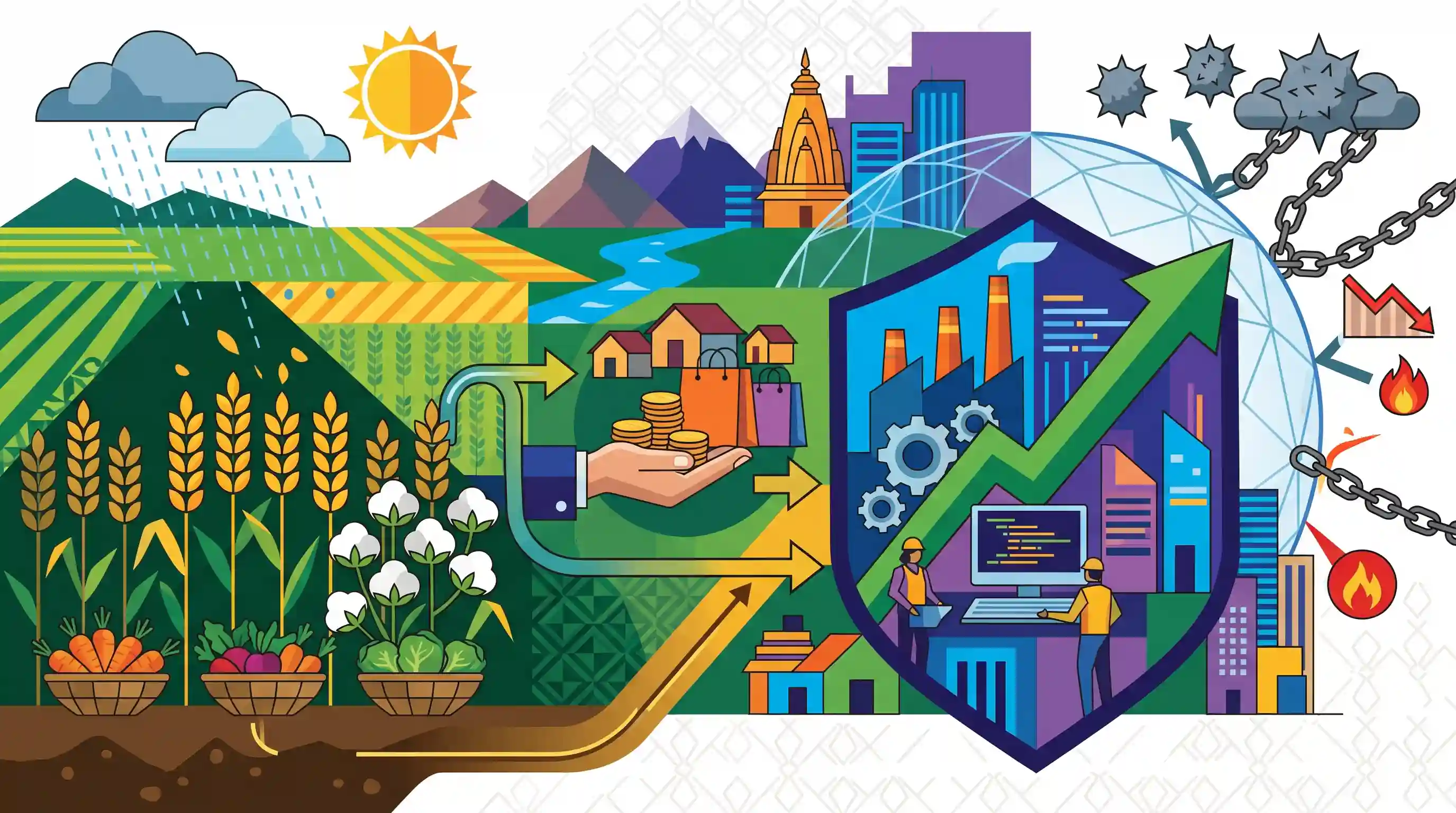
Monsoon agriculture and rural demand buffer against global risks
Source:Indian Express ↗
Why It Matters
Provides a classic macroeconomic linkage between agriculture, rural demand, and overall GDP growth. For UPSC aspirants, it is essential for answering questions on how domestic factors (like the monsoon and the primary sector) provide economic resilience against global vulnerabilities, highlighting the interconnectedness of geography, agriculture, and macroeconomics.
Summary
The article underscores the vital, albeit paradoxical, role of agriculture in the modern Indian economy. Although the sector's direct contribution to India's Gross Domestic Product (GDP) has dwindled over the years, its capacity to influence overall economic health remains immense. A good monsoon leads to higher agricultural yields, which in turn boosts rural disposable incomes and sparks a revival in rural consumption. This surge in domestic demand creates a strong multiplier effect, benefiting the manufacturing and services sectors. Crucially, as the global economy faces mounting risks—including geopolitical tensions and slowing growth—this agriculture-driven domestic consumption acts as a macroeconomic buffer, helping India buttress its economic growth projections and maintain resilience against external headwinds.
Key Points
- Despite a declining direct share in India's GDP, the agricultural sector continues to exert a disproportionately large multiplier effect on the broader economy.
- A favorable Southwest Monsoon is critical for robust agricultural output, which directly increases rural incomes and helps control food inflation.
- Higher rural purchasing power stimulates domestic consumption, driving demand for manufactured goods such as FMCG products, two-wheelers, and tractors.
- Strong domestic demand driven by agricultural performance acts as a vital buffer, insulating India's macroeconomic growth from external shocks.
- This agricultural cushion is especially crucial currently, as India aims to sustain its growth projections amidst rising global risks like geopolitical fragmentation and slowing international trade.
Important Terms
Reserve Bank of India (RBI)

India’s central bank responsible for monetary stability, currency issuance, and inflation control (targeting 4% +/- 2%). It formulates monetary policy to balance growth and price stability.
UPSC context
GS III (Economy); crucial for understanding monetary policy, banking regulation, and macroeconomic stability.
India Meteorological Department (IMD)
The principal government agency for meteorological observations and forecasting. It provides critical long-range forecasts for the Southwest Monsoon, impacting agricultural planning and food security.
UPSC context
GS I (Geography) & GS III (Agriculture); essential for studying climatic patterns and their economic impact.
Rural Consumption
Spending by the rural population (~65% of India) on goods/services. Driven by agricultural performance, it serves as a primary engine for domestic demand in manufacturing and FMCG.
UPSC context
GS III (Inclusive Growth); tests domestic demand-driven growth and the resilience of the rural economy.
Multiplier Effect
An economic phenomenon where an initial injection (like increased farm income) leads to a larger overall increase in national income through inter-sectoral demand.
UPSC context
GS III (Planning/Growth); explores linkages between agriculture and secondary/tertiary sector expansion.
Food Inflation
The persistent rise in food prices, often influenced by monsoon-driven supply shocks. It is a major component of the Consumer Price Index (CPI) monitored by the RBI.
UPSC context
GS III (Economic Development); central to debates on food security and the RBI’s interest rate decisions.
Gross Value Added (GVA)
A measure of the value of goods and services produced in a specific sector (like agriculture), used to estimate GDP from the supply side.
UPSC context
GS III (Growth/Development); vital for sectoral analysis and understanding structural shifts in the Indian economy.
Southwest Monsoon
The seasonal wind system (June-September) providing roughly 75% of India’s annual rainfall, critical for the Kharif crop and replenishing groundwater for Rabi.
UPSC context
GS I (Geography) & GS III (Agriculture); tests climatic mechanisms and their direct link to rural prosperity.
Prelims Trap
A robust Southwest monsoon directly reduces core inflation in the Indian economy.
Core inflation strictly excludes volatile food and fuel prices. While a good monsoon drastically lowers food inflation (easing headline CPI), its direct impact on core inflation is negligible.
Static Concepts Connected
What distinguishes Headline from Core Inflation in India's CPI?
- Headline Inflation: The total inflation in an economy, including highly volatile components like food and fuel. It is measured by the CPI-Combined.
- Core Inflation: Calculated by stripping food and fuel from headline inflation. It reflects underlying, long-term macroeconomic price trends.
- Monsoon Impact: Primarily affects Headline CPI by altering food supply dynamics; it does not directly alter manufacturing or service-driven core inflation.
What defines the structural imbalance in India's agricultural economy?
- Output vs. Employment: Agriculture contributes roughly 15-18% to India's Gross Value Added (GVA), yet it continues to employ nearly 45% of the total workforce.
- Disguised Unemployment: This high workforce dependency leads to near-zero marginal productivity for surplus agricultural labor, masking significant underemployment.
- Consumption Multiplier: Despite low per-capita income, the sheer volume of agricultural dependents means small shifts in yield disproportionately sway aggregate domestic demand.
Cross-Topic Patterns
Monsoons dictating Monetary Policy
The RBI's Monetary Policy Committee relies heavily on IMD's spatial monsoon forecasts, linking physical geography directly to repo rate decisions via food inflation projections.
Primary sector buffering secondary slump
When global trade shocks hit Indian manufacturing, rural disposable income—driven by farm yields—acts as a domestic consumption floor for FMCG and auto sectors.

Expect a 2026 Prelims statement testing the exact CPI weightage of food vs core inflation, heavily linked to monsoon-driven RBI policy.
Linked PYQs · 4
Linked PYQs · 4
- 2018MainsGS3
How would the recent phenomena of protectionism and currency manipulations in world trade affect macroeconomic stability of India?
- 2017MainsGS1
What characteristics can be assigned to monsoon climate that succeeds in feeding more than 50 percent of the world population residing in Monsoon Asia?
- 2022PrelimsGS1
Which of the following activities constitute real sector in the economy? 1. Farmers harvesting their crops 2. Textile mills converting raw cotton into fabrics 3. A commercial bank lending money to a trading company 4. A corporate body issuing Rupee Denominated Bonds overseas Select the correct answer using the code given below:
- 2023MainsGS3
Faster economic growth requires increased share of the manufacturing sector in GDP, particularly of MSMEs. Comment on the present policies of the Government in this regard.
