INSAT-3DS Satellite Enhances Tracking of 2026 Southwest Monsoon
Source:The Hindu ↗
Why It Matters
Understanding the mechanics of the Indian monsoon and the role of indigenous space technology (like INSAT-3DS) in weather forecasting bridges core Geography (GS1) and Science & Technology (GS3). It is foundational for questions regarding climate, agriculture, and disaster management.
Summary
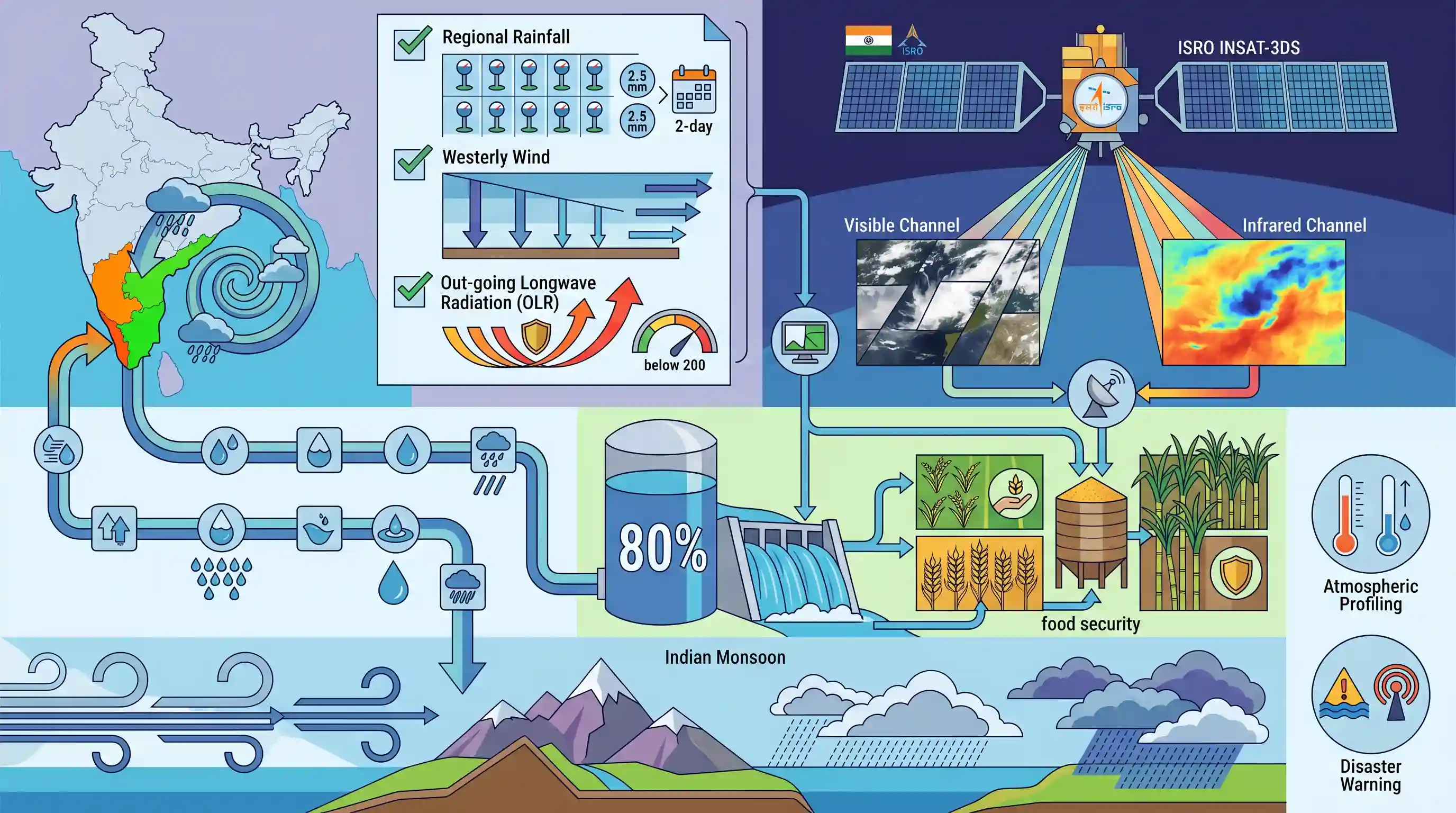
The India Meteorological Department (IMD) anticipates the southwest monsoon will make its onset over Kerala by June 4, 2026. The formal declaration of the monsoon's arrival depends on specific meteorological criteria, including regional rainfall distribution, westerly wind depth and speed, and Outgoing Longwave Radiation (OLR). Tracking this year is significantly enhanced by ISRO's INSAT-3DS satellite, which utilizes visible and infrared channels to monitor cloud structures and temperatures. The southwest monsoon remains vital for India's food security and agriculture, supplying roughly 80% of the country's annual rainfall.
Key Points
- The IMD expects the 2026 southwest monsoon to arrive in Kerala by June 4.
- Monsoon onset declaration requires strict criteria: 2.5 mm rain over two consecutive days in designated stations, westerly wind depth up to 600 hPa, wind speeds of 15-20 knots, and Outgoing Longwave Radiation (OLR) below 200 W/sq.m.
- ISRO's newly launched INSAT-3DS satellite enhances weather tracking, using Visible channels during the day and Infrared channels at night to measure Cloud Top Brightness Temperature (CTBT).
- The southwest monsoon is critical for India's economy, delivering nearly 80% of its annual rainfall and sustaining key summer (Kharif) crops like rice, pulses, and sugarcane.
Important Terms
Southwest Monsoon

The primary rainy season (June-September) driven by moisture-laden winds from the Indian Ocean, supplying approximately 75-80% of India's annual precipitation.
UPSC context
GS Paper I (Geography); tests understanding of climatic patterns, economic impact on agriculture, and food security.
India Meteorological Department (IMD)
The national agency (est. 1875) under the Ministry of Earth Sciences responsible for meteorological observations, weather forecasting, and disaster warnings.
UPSC context
GS Paper II (Governance) and Paper III (Disaster Management); tests knowledge of institutional frameworks.
INSAT-3DS
An advanced third-generation Indian meteorological satellite launched to enhance weather forecasting, disaster warning, and atmospheric vertical profiling capabilities.
UPSC context
GS Paper III (Science & Tech); tests awareness of indigenous space technology and earth observation missions.
Outgoing Longwave Radiation (OLR)
Energy emitted from Earth's atmosphere; values below 200 W/m² indicate thick cloud cover and deep convection, a key technical criterion for monsoon onset.
UPSC context
GS Paper I (Climatology); tests technical understanding of atmospheric phenomena and weather forecasting metrics.
Onset of Monsoon
The formal declaration of the monsoon's arrival in Kerala based on specific rainfall distribution, wind speed, and cloudiness (OLR) criteria.
UPSC context
GS Paper I (Geography); tests knowledge of seasonal transitions and scientific criteria for weather events.
Indian Space Research Organisation (ISRO)
The principal space agency of India, focused on designing and executing the national space program for developmental and scientific applications.
UPSC context
GS Paper III (Science & Tech); tests knowledge of space exploration and its socio-economic benefits.
Prelims Trap
High Outgoing Longwave Radiation (OLR) indicates deep convection and strong monsoon onset.
UPSC often reverses technical metrics. Low OLR (not high) indicates thick, high-altitude clouds (which are cold and emit less energy), essential for monsoon onset.
Static Concepts Connected
What are the IMD's objective criteria for declaring the monsoon onset over Kerala?
- Rainfall threshold: At least 60% of 14 designated stations in Kerala and Lakshadweep must record 2.5 mm or more rain for two consecutive days.
- Wind depth: Westerly winds must extend up to 600 hPa (approx 4.5km altitude) with speeds of 15-20 knots over the southeast Arabian Sea.
- OLR value: Outgoing Longwave Radiation (OLR) must fall below 200 W/sq.m in the designated box, confirming deep cloud convection.
How do Earth Observation satellites like INSAT-3DS monitor atmospheric conditions?
- Multi-spectral Imagers: Utilizes visible and thermal infrared bands to measure cloud structures, water vapor, and Cloud Top Brightness Temperature (CTBT) day and night.
- Atmospheric Sounders: Payloads that measure the vertical profiles of temperature and humidity throughout the atmosphere, creating a 3D weather model.
- Data Relay Transponders: Collects and relays meteorological, hydrological, and oceanographic data from remote automatic platforms (AWS) to central stations.
Cross-Topic Patterns
Weather satellites & Kharif security
Linking INSAT-3DS capabilities directly to IMD's Agromet advisories and crop insurance (PMFBY), where accurate onset and dry-spell tracking determines claim assessments.
OLR, ENSO and Indian Ocean Dipole
OLR anomalies are a primary metric used to track the eastward shift of convection during El Niño and its interplay with the Indian Ocean Dipole.

Expect a multi-statement question combining IMD's objective monsoon onset criteria (specifically OLR) with INSAT-3DS payload functions.
Linked PYQs · 4
Linked PYQs · 4
- 2015MainsGS1
How far do you agree that the behaviour of the Indian monsoon has been changing due to humanizing landscapes? Discuss.
- 2023MainsGS1
Why is the South-West Monsoon called 'Purvaiya' (easterly) in Bhojpur Region? How has this directional seasonal wind system influenced the cultural ethos of the region?
- 2017MainsGS1
What characteristics can be assigned to monsoon climate that succeeds in feeding more than 50 percent of the world population residing in Monsoon Asia?
- 2023PrelimsGS1
With reference to the Earth's atmosphere, which one of the following statements is correct?
