Mongolian President visits India to boost strategic ties
Source:The Hindu ↗
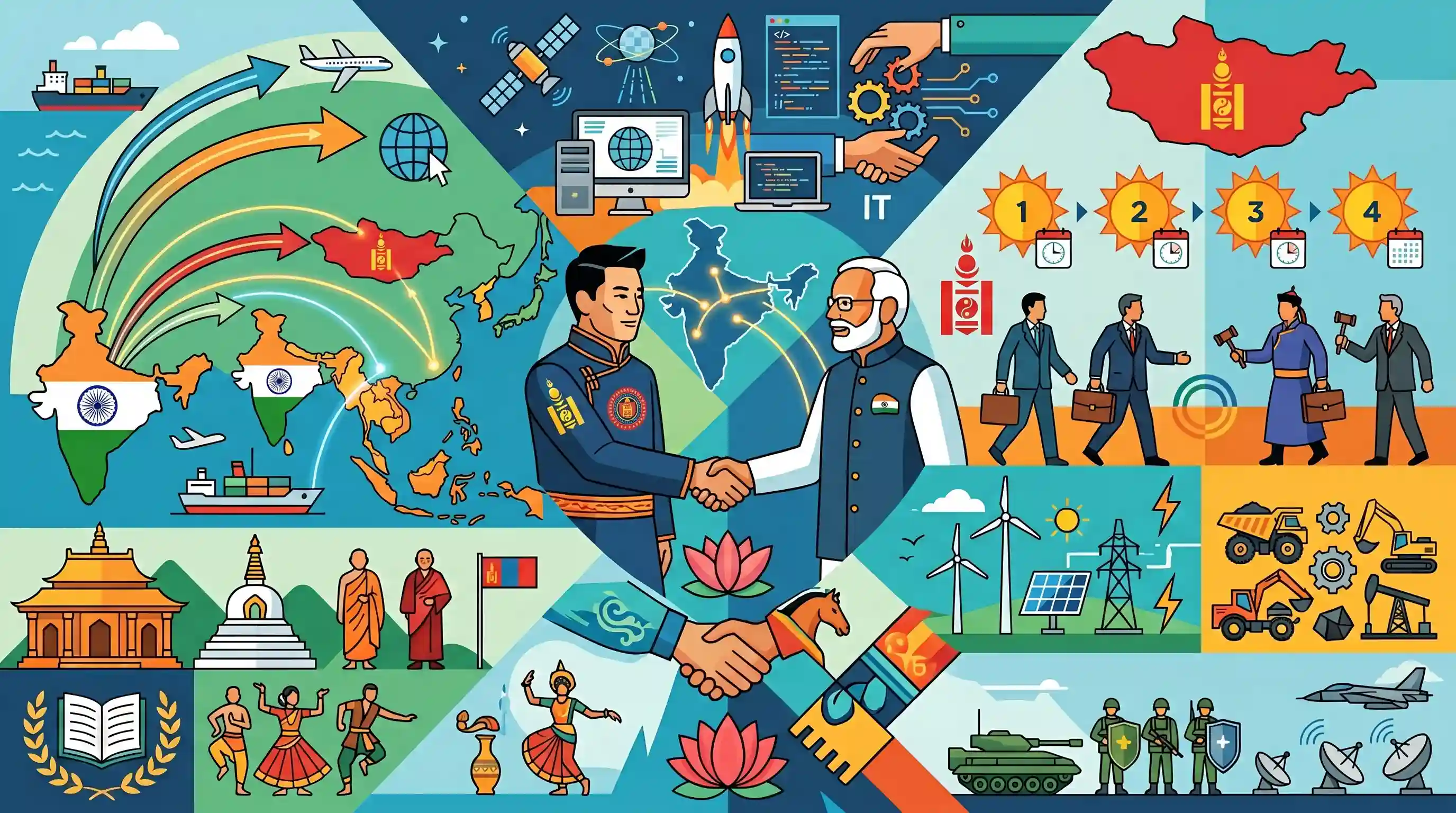
Why It Matters
Mongolia is a crucial partner in India's 'Act East' and extended neighborhood policies. Rich in natural resources like uranium and rare earth minerals, Mongolia offers significant opportunities for India's energy security and mining sectors. Additionally, leveraging soft power—referring to the nations as 'spiritual neighbours' due to shared Buddhist heritage—helps India expand its strategic footprint in a region wedged between China and Russia.
Summary
Mongolian President Khurelsukh Ukhnaa is scheduled for a four-day state visit to India from October 13-16 to bolster bilateral ties. Accompanied by top ministers, parliamentarians, and business leaders, he will hold comprehensive discussions with President Droupadi Murmu and Prime Minister Narendra Modi. The talks will focus on strengthening the India-Mongolia 'Strategic Partnership' by expanding cooperation across diverse sectors including defense, security, energy, mining, IT, education, and cultural exchanges. The visit highlights the historical and spiritual connections between the two nations, setting the stage for deeper geopolitical integration under India's extended neighborhood strategy.
Key Points
- Mongolian President Khurelsukh Ukhnaa will undertake a four-day state visit to India from October 13 to 16.
- He will hold bilateral talks with President Droupadi Murmu and Prime Minister Narendra Modi.
- The focus of the visit includes boosting ties in critical areas such as defence, energy, mining, IT, healthcare, and education.
- India and Mongolia share deep historical ties, having established formal diplomatic relations in 1955.
- The visit aims to strengthen their bilateral 'Strategic Partnership' by leveraging their status as 'spiritual neighbours' linked by shared Buddhist heritage.
Important Terms
India-Mongolia Strategic Partnership

A framework established in 2015 elevating bilateral ties to include defense, energy, and resource security. It reached its 10th anniversary during President Khurelsukh Ukhnaa’s 2025 state visit.
UPSC context
GS Paper 2: Bilateral Relations. Tests understanding of India's strategic depth in Central Asia and resource-based diplomacy.
Third Neighbour Policy
Mongolia’s foreign policy doctrine focusing on building deep ties with democratic nations beyond its immediate neighbors (Russia and China). India is recognized as a key "Third Neighbour."
UPSC context
GS Paper 2: International Relations. Relevant for analyzing how landlocked nations balance major power influences using India as a partner.
Extended Neighbourhood Strategy
An Indian foreign policy pillar expanding diplomatic and security outreach to regions beyond immediate land borders, such as Central and East Asia, where Mongolia serves as a strategic anchor.
UPSC context
GS Paper 2: India’s Foreign Policy. Evaluates grasp of India’s geographical sphere of influence and regional integration efforts.
Mongolia Oil Refinery Project
A $1.7 billion project funded by India’s largest-ever Line of Credit (LoC) to build Mongolia's first petrochemical refinery, aimed at reducing its energy dependence on Russia.
UPSC context
GS Paper 2: Energy Security and Developmental Assistance. Focuses on India's role in global infrastructure and economic statecraft.
Spiritual Neighbour
A term describing the civilizational bond between India and Mongolia rooted in shared Buddhist heritage (Dharma), used as a soft power tool to deepen diplomatic trust.
UPSC context
GS Paper 2: Soft Power Diplomacy. Tests knowledge of how cultural/religious links are leveraged in modern international relations.
Nomadic Elephant
An annual bilateral military exercise between the Indian Army and Mongolian Armed Forces focusing on counter-terrorism, peacekeeping, and interoperability.
UPSC context
GS Paper 2/3: Defence Cooperation. Specific military engagement tested in Prelims and Mains security sections.
Prelims Trap
"The 'Third Neighbour Policy' is an Indian diplomatic initiative to counter Chinese influence."
This policy belongs exclusively to Mongolia. It is designed to build strategic ties with non-bordering democracies (like India, the US, and Japan) to balance the influence of its immediate neighbors, Russia and China.
Static Concepts Connected
What are the core components of India's Line of Credit (LoC) diplomacy?
- Soft financing: LoCs are not grants; they are concessional soft loans routed through the EXIM Bank to developing nations.
- Sourcing mandate: Typically, at least 75% of the goods and services for the funded projects must be sourced from India, boosting domestic industry.
- Strategic infrastructure: Builds critical infrastructure (like Mongolia's $1.7B oil refinery) to foster goodwill and counter rival economic footprints without imposing debt traps.
How does India leverage 'Buddhist Diplomacy' in its foreign policy?
- Relic diplomacy: Sending sacred relics (e.g., Kapilavastu relics to Mongolia and Thailand) for exposition to reinforce shared spiritual heritage.
- Circuit development: Developing the Buddhist Circuit in India under the Swadesh Darshan Scheme to boost soft power and pilgrimage tourism.
- Institutional links: Establishing centers of learning and deputing Indian scholars to institutions like Mongolia's Gandan Monastery.
Cross-Topic Patterns
Critical Minerals + Third Neighbour
Mongolia's vast rare earth and uranium reserves make it vital for India's clean energy transition, linking bilateral mining cooperation to global critical mineral supply chain resilience.
Soft Power + Act East
India's "Spiritual Neighbour" positioning blends cultural diplomacy with the geopolitical Act East strategy to maintain influence in a heavily China/Russia-dominated geographic zone.

Expect a multi-statement Prelims question pairing Mongolia's 'Third Neighbour' doctrine with India's 'Act East' and 'Nomadic Elephant'.
Linked PYQs · 3
Linked PYQs · 3
- 2016MainsGS2
Evaluate the economic and strategic dimensions of India's Look East Policy in the context of the post Cold War international scenario.
- 2024MainsGS2
Critically analyse India's evolving diplomatic, economic and strategic relations with the Central Asian Republics (CARs) highlighting their increasing significance in regional and global geopolitics.
- 2025MainsGS2
"Energy security constitutes the dominant kingpin of India's foreign policy, and is linked with India's overarching influence in Middle Eastern countries.” How would you integrate energy security with India's foreign policy trajectories in the coming years?
