Money Bill route used for judge strength amid constitutional questions
Source:Indian Express ↗
কেন এটি গুরুত্বপূর্ণ
This issue goes to the heart of India's parliamentary democracy, bicameralism, and the separation of powers. It highlights executive overreach in legislative classification and challenges judicial review regarding what constitutes a 'Money Bill' under Article 110.
সারসংক্ষেপ
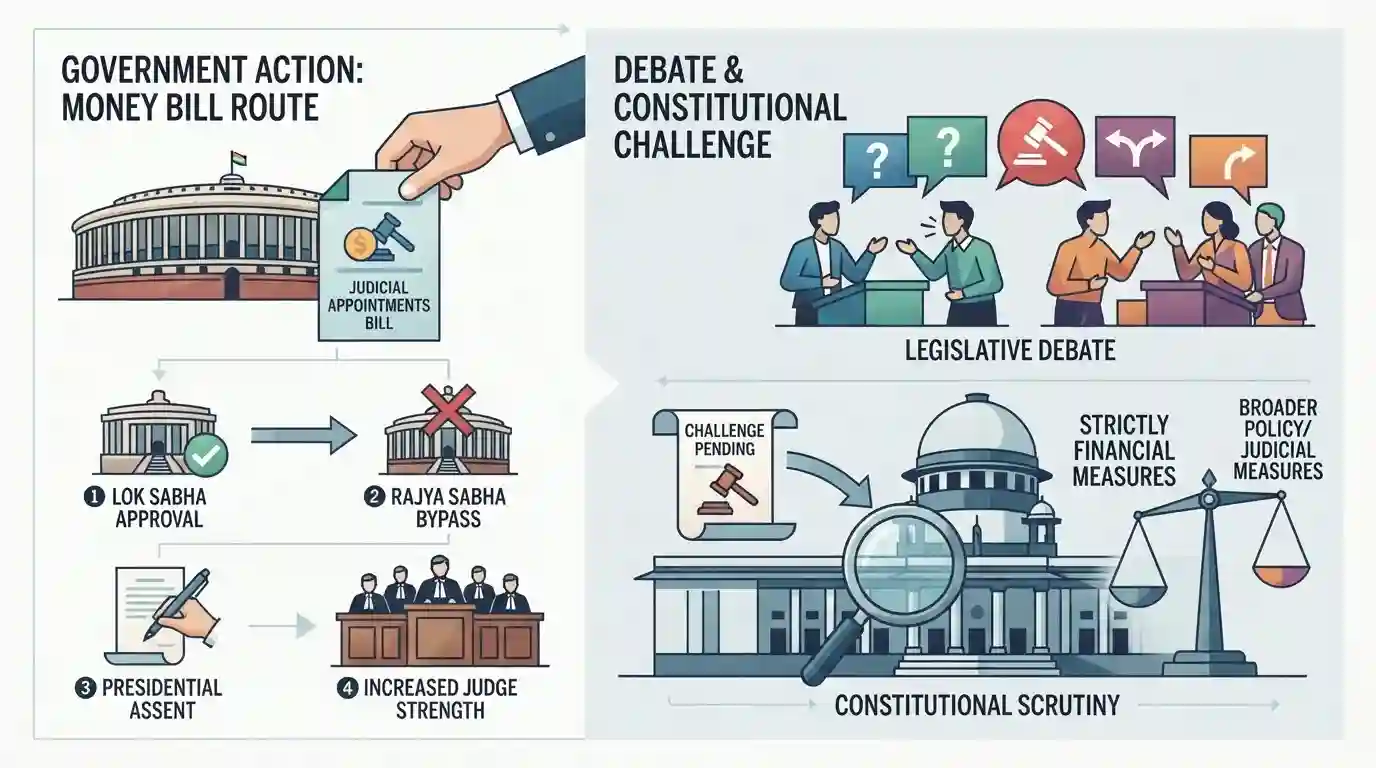
The article explores the government's decision to use the Money Bill route to increase the strength of judges, reigniting debates around legislative procedures, the bypassing of the Rajya Sabha, and the constitutionality of classifying non-strictly financial measures as Money Bills, a practice currently under challenge before the Supreme Court.
মূল বিষয়
- The Union Government chose the Money Bill route to raise the strength of judges, despite the contentious nature of bypassing the Rajya Sabha on non-financial legislation pending legal scrutiny in the Supreme Court.
- Article 110 defines a Money Bill strictly in terms of financial matters, taxation, and government borrowing; using it for broader administrative changes like judge strength remains a subject of intense debate and judicial review.
- The practice of passing legislation as Money Bills has faced criticism for undermining the bicameral character of Parliament and eroding the legislative powers of the Rajya Sabha.
- The Supreme Court is currently examining petitions challenging the misuse of the Money Bill route for legislations that do not strictly fit the criteria under Article 110.
গুরুত্বপূর্ণ শব্দ
Money Bill

A financial piece of legislation defined under Article 110 of the Constitution that deals solely with matters like taxation, borrowing, and the Consolidated Fund of India, bypassing the Rajya Sabha's concurrence.
UPSC context
Crucial for GS Paper II under Indian Constitution - Features, Parliament and State Legislatures structure, and legislative procedures.
Article 110 of the Constitution
Constitutional provision that defines a Money Bill, listing specific matters such as taxation, expenditure from or receipt into the Consolidated Fund of India, and incidental issues.
UPSC context
Important for GS Paper II under constitutional provisions, parliamentary procedures, and judicial review of legislative actions.
Supreme Court of India
The highest constitutional court of India and the final interpreter of the Constitution, possessing powers of judicial review over legislative enactments including Money Bills.
UPSC context
Essential for GS Paper II under Judiciary, Separation of Powers, and Dispute Redressal Mechanisms.
Rajya Sabha
The upper house of the Indian Parliament representing the states, possessing limited legislative powers regarding Money Bills which it cannot amend or reject.
UPSC context
Relevant for GS Paper II under Parliament and State Legislatures - Structure and Functioning.
প্রিলিমস ফাঁদ
Rajya Sabha has co-equal veto power over Money Bills, or the Speaker's certification is immune to all forms of judicial scrutiny.
Aspirants often assume the Rajya Sabha can vote to reject a Money Bill or that the Speaker's certification of a Money Bill is subject to ordinary judicial review without constitutional limits.
সংযুক্ত স্থির ধারণা
What are the constitutional provisions and limitations regarding Money Bills under Article 110?
- Exclusive Matters: A Bill is a Money Bill if it contains *only* provisions dealing with taxation, borrowing, custody of Consolidated Fund, etc., listed under Article 110(1)(a) to (g).
- Speaker's Certification: The Speaker of the Lok Sabha has the final, unchallengeable authority to certify whether a Bill is a Money Bill.
- Limited Upper House: The Rajya Sabha cannot reject or amend a Money Bill; it can only make recommendations within 14 days, which the Lok Sabha may accept or reject.
আন্তঃবিষয় প্যাটার্ন
Money Bills & Judicial Appointments Intersect
The Money Bill route debate directly intersects with judicial appointments discourse, linking Article 110 legislative bypass to structural executive-judiciary tensions and institutional independence.

Article 110 vs bicameralism tests will feature in Polity Prelims through subtle statement-traps on Rajya Sabha powers.
সংযুক্ত PYQ · 2
সংযুক্ত PYQ · 2
- 2023MainsGS2
“Constitutionally guaranteed judicial independence is a prerequisite of democracy.” Comment.
- 2017MainsGS2
Critically examine the Supreme Court's judgement on 'National Judicial Appointments Commission Act, 2014' with reference to appointment of judges of higher judiciary in India.
