Supreme Court Notice on Prosecution Sanction in Mon Killings
Source:Indian Express ↗
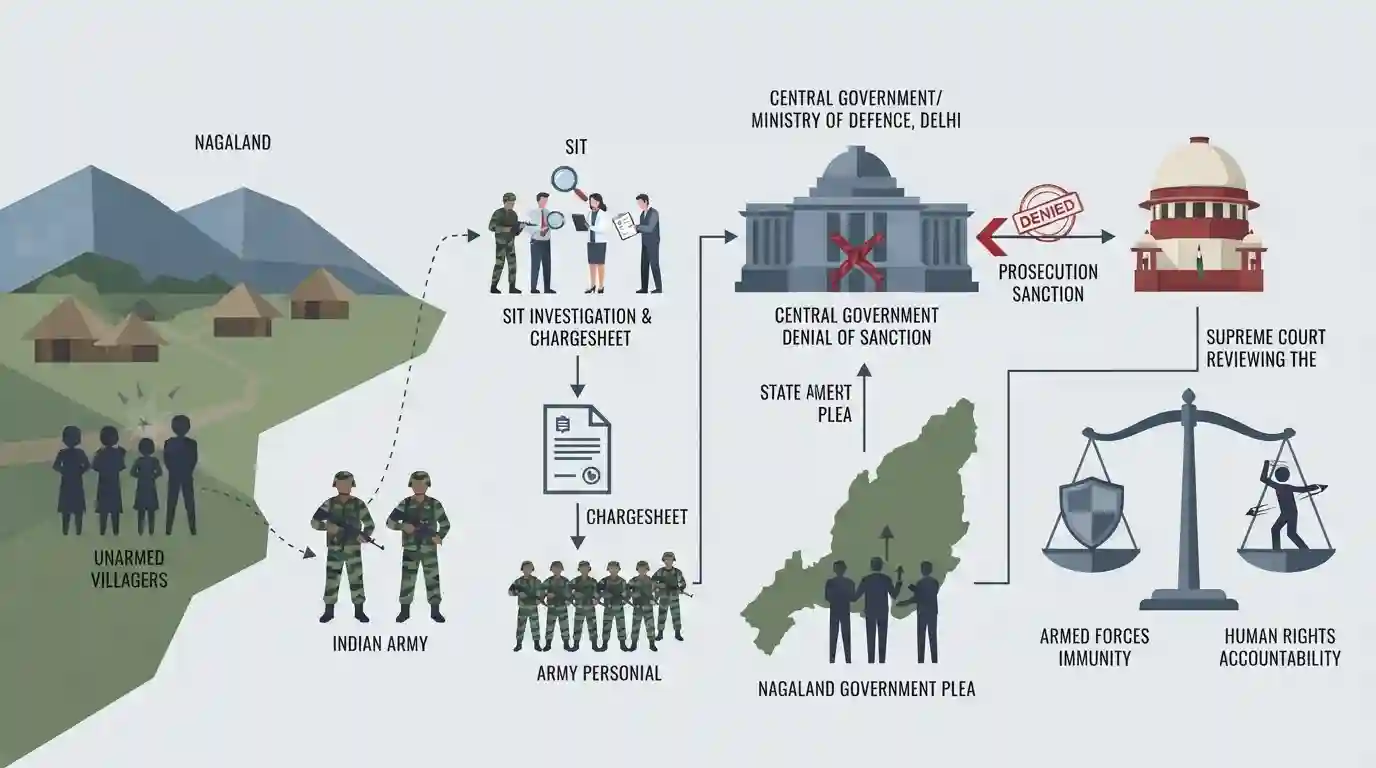
Why It Matters
This incident and subsequent legal battle are critical for understanding the practical implications and controversies surrounding the Armed Forces (Special Powers) Act (AFSPA). It touches upon internal security challenges in the Northeast, the accountability of armed forces, human rights concerns, and the complexities of Centre-State relations when state police investigate central armed forces.
Summary
The Supreme Court has sought a response from the Central government regarding a plea filed by the Nagaland government. The plea challenges the Ministry of Defence's refusal to grant prosecution sanction against 30 Indian Army personnel involved in the December 2021 Mon district killings, where 13 civilians were killed in a botched anti-insurgency operation. A state-appointed Special Investigation Team (SIT) had charged the personnel, belonging to the 21 Para Special Forces, with murder and culpable homicide. However, the Centre withheld the mandatory sanction required under Section 6 of the Armed Forces (Special Powers) Act (AFSPA), 1958. The Nagaland government contends that the denial of sanction is arbitrary, arguing that unprovoked firing upon unarmed civilians does not constitute a legitimate discharge of official duties. The case brings the controversial AFSPA back into the spotlight, underscoring the conflict between armed forces' immunity and human rights accountability.
Key Points
- The Supreme Court issued notices to the Centre based on a plea by the Nagaland government challenging the denial of sanction to prosecute 30 Indian Army personnel.
- The personnel, from the 21 Para Special Forces, were allegedly involved in the December 2021 Oting massacre in Mon district, which resulted in the deaths of 13 civilians during a botched anti-insurgency operation.
- The Centre invoked Section 6 of the Armed Forces (Special Powers) Act (AFSPA) to deny the mandatory prosecution sanction sought by the Nagaland government.
- The Nagaland state government argues the Centre's denial of sanction is arbitrary and that the army personnel's actions, which a state SIT found were unprovoked, cannot be considered legitimate official duty.
- The case highlights the tension between providing immunity for armed forces in disturbed areas and ensuring accountability for human rights violations against civilians.
Important Terms
Armed Forces (Special Powers) Act, 1958 (AFSPA)

A parliamentary act granting special powers and legal immunity to armed forces operating in designated "disturbed areas," allowing actions like arrests without warrants to maintain public order.
UPSC context
Important for GS Paper 3 (Internal Security) and GS Paper 2, focusing on the balance between national security and civilian human rights.
Special Investigation Team (SIT)
A specialized, state-appointed investigative committee of police officers and experts formed to probe complex or high-profile cases, such as the December 2021 Mon district killings in Nagaland.
UPSC context
Relevant to GS Paper 2. Tests understanding of state police jurisdiction, criminal investigations, and civil-military legal conflicts.
21 Para Special Forces
An elite special operations unit of the Indian Army tasked with counter-insurgency operations. They were involved in the controversial December 2021 Mon district civilian killings in Nagaland.
UPSC context
Features in GS Paper 3 (Internal Security) regarding counter-insurgency operations, rules of engagement, and military accountability in border regions.
Ministry of Defence
The central government ministry responsible for national security and the armed forces. Under Section 6 of AFSPA, it holds the authority to grant or deny prosecution sanctions for military personnel.
UPSC context
Vital for GS Paper 2 and 3, exploring civil-military relations and the procedural requirements for prosecuting armed forces personnel.
Prelims Trap
"Under AFSPA, prior sanction of the State Government is required to prosecute armed forces personnel for state-level crimes."
Section 6 of AFSPA explicitly mandates the prior sanction of the Central Government, not the State Government, even if a state-appointed SIT conducts the criminal investigation.
Static Concepts Connected
How is an area declared 'disturbed' and what immunity applies under AFSPA?
- Disturbed Area Declaration: Under Section 3, the Central Government, the State Governor, or the UT Administrator can declare an area 'disturbed' to authorize the deployment of armed forces.
- Prosecution Immunity: Section 6 mandates prior Central Government sanction before initiating any legal proceedings or prosecution against personnel for actions taken under the Act.
- Use of Force: Section 4 allows authorized personnel to use force, even to the extent of causing death, against persons violating laws or carrying weapons in a disturbed area.
What are the major judicial and committee views on AFSPA accountability?
- EEVFAM Judgment (2016): The Supreme Court ruled that AFSPA does not grant 'absolute immunity' and that all alleged extra-judicial killings require mandatory, thorough investigation.
- Jeevan Reddy Committee (2005): Recommended repealing AFSPA and incorporating its essential security provisions into the Unlawful Activities (Prevention) Act (UAPA) to balance counter-insurgency with human rights.
- Second ARC: Supported the Jeevan Reddy Committee's recommendation to repeal AFSPA, advising that the Union Government should review the necessity of the law periodically.
Cross-Topic Patterns
AFSPA and Federal Friction
The clash between a State-appointed SIT pressing charges and the Centre denying prosecution sanction highlights the jurisdictional tension between State (Public Order) and Union (Armed Forces) subjects in Schedule VII.
Internal Security vs. Human Rights
The incident operationalizes the EEVFAM judgment's mandate against 'absolute immunity' and the Jeevan Reddy Committee's push for accountability during counter-insurgency operations in the Northeast.

AFSPA's Section 3 (declaring disturbed areas), Section 6 (prosecution sanction), and the 2016 EEVFAM ruling will likely frame a 2026 MCQ.
Linked PYQs · 3
Linked PYQs · 3
- 2015MainsGS3
Human rights activists constantly highlight the view that the Armed Forces (Special Powers) Act, 1958 (AFSPA) is a draconian act leading to cases of human rights abuses by the security forces. What sections of AFSPA are opposed by the activists? Critically evaluate the requirement with reference to the view held by the Apex Court.
- 2017MainsGS3
The North-East region of India has been infested with insurgency for a very long time. Analyze the major reasons for the survival of armed insurgency in this region.
- 2023MainsGS3
What are the internal security challenges being faced by India? Give out the role of Central Intelligence and Investigative Agencies tasked to counter such threats.
