MP disburses financial relief to unorganized workers under Sambal
Source:indianmasterminds ↗
Why It Matters
The MPPSC State Service Prelims frequently tests candidates on state-specific welfare schemes, their precise financial allocations, target groups, and core objectives (e.g., questions on Ladli Behna, Kanyadan Yojana). The Sambal Yojana is one of the flagship schemes of Madhya Pradesh, making its provisions (especially the inclusion of gig workers and specific payout amounts) highly relevant for the exam.
Summary
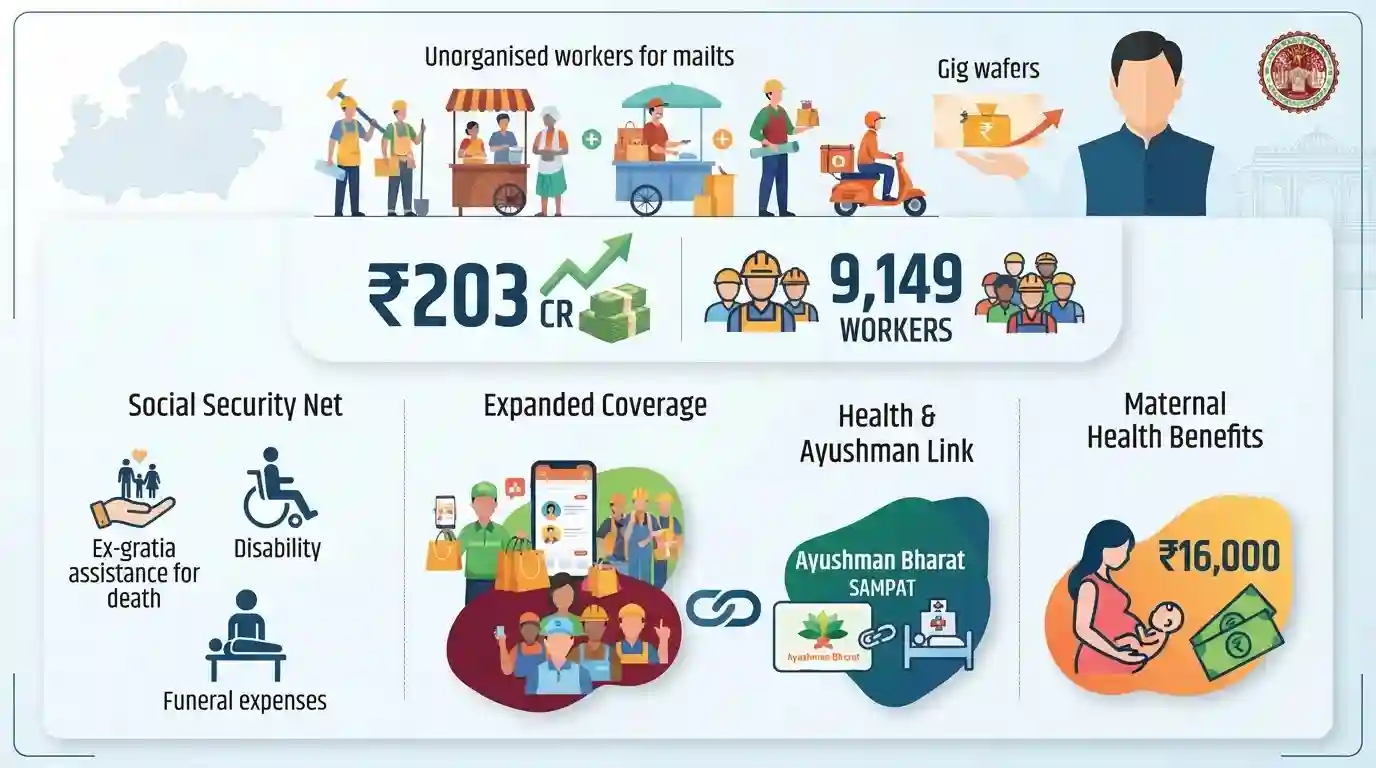
Madhya Pradesh Chief Minister Dr. Mohan Yadav has disbursed ₹203 crore to 9,149 unorganized workers under the Mukhyamantri Jan Kalyan (Sambal) Yojana 2.0. The scheme acts as a comprehensive social security net providing ex-gratia assistance in the event of accidental or natural death, disabilities, and funeral expenses. Further expanding its coverage, Sambal Yojana 2.0 now includes gig and platform workers. It is closely linked with the Ayushman Bharat health insurance scheme and additionally offers significant maternal health benefits, providing ₹16,000 to eligible pregnant workers. This holistic welfare program underscores the Madhya Pradesh government's emphasis on empowering marginalized and unorganized workforce segments.
Key Points
- Madhya Pradesh Chief Minister Dr. Mohan Yadav transferred ₹203 crore to 9,149 workers under the Mukhyamantri Jan Kalyan (Sambal) Yojana 2.0.
- The Sambal Yojana 2.0 provides crucial financial assistance to unorganised sector workers, which has now been expanded to include gig and platform workers.
- Under the scheme, beneficiaries receive financial aid such as ₹5,000 for funeral assistance, ₹2 lakh for natural death, and ₹4 lakh for accidental death.
- It also offers ₹1 lakh for partial permanent disability and ₹2 lakh for permanent disability.
- The scheme includes ₹16,000 in financial assistance for eligible pregnant women to ensure better maternal health and nutrition.
- Sambal Yojana is integrated with Ayushman Bharat Niramayam Yojana, and it also covers incentives for professional education.
Important Terms
Mukhyamantri Jan Kalyan (Sambal) Yojana 2.0

A Madhya Pradesh social security scheme for unorganized workers providing financial aid for death (₹2-4 lakh), disability, funerals, and maternity (₹16,000). The updated 2.0 framework newly extends these benefits to gig and platform workers.
UPSC context
Critical for MPPSC GS Paper 2 (State Welfare Schemes). Tests knowledge of MP-specific interventions targeting unorganized and vulnerable populations.
Ayushman Bharat Niramayam Yojana
Madhya Pradesh's implementation of the national health insurance initiative, providing ₹5 lakh annual cashless coverage per family. Beneficiaries of the Sambal scheme are automatically integrated to receive these free medical treatments.
UPSC context
Relevant for MPPSC GS Paper 2 (Health). Highlights the convergence of central health initiatives with state-level labor welfare programs.
Gig and Platform Workers
Independent workers who earn income through digital platforms outside traditional employment structures. Recognizing their vulnerability, Madhya Pradesh recently included them in the Sambal Yojana to provide formal social security benefits.
UPSC context
Important for MPPSC GS Paper 3 (Economy) and GS Paper 2 (Labor). Focuses on emerging labor market trends and welfare.
Ex-gratia Assistance
Voluntary financial compensation provided by the government on humanitarian grounds rather than legal obligation. Under the Sambal scheme, it aids workers' families facing unexpected hardships like accidental death or disability.
UPSC context
Useful for MPPSC GS Paper 2 (Governance/Welfare). Tests understanding of administrative relief mechanisms and hardship compensation models.
Prelims Trap
"Sambal 2.0 provides ₹4 lakh for natural deaths and is strictly limited to agricultural labourers."
It provides ₹4 lakh for accidental deaths (natural death is ₹2 lakh) and covers all unorganised workers, recently expanding to include gig and platform workers.
Static Concepts Connected
Who qualifies as a gig or platform worker under Indian labour laws?
- Gig Worker: A person participating in a work arrangement outside traditional employer-employee relationships, often task-based or freelance.
- Platform Worker: A gig worker who accesses organizations or individuals through an online platform to provide specific services.
- Legal Recognition: First legally defined and brought under a comprehensive social security net via the Code on Social Security, 2020.
What are the major state-sponsored maternity benefit mechanisms in MP?
- Prasuti Sahayata Yojana: Provides financial assistance to female workers of the unorganised sector during pregnancy and post-delivery to compensate for wage loss.
- Sambal Maternal Benefit: Under Sambal 2.0, eligible pregnant workers receive ₹16,000 to ensure proper nutrition, health check-ups, and safe deliveries.
- Janani Suraksha Yojana: A safe motherhood intervention under NHM to reduce maternal and neonatal mortality by promoting institutional delivery.
Cross-Topic Patterns
Gig Economy + Social Security
Rajasthan's pioneering Gig Workers Act and the national Code on Social Security 2020 make gig-worker welfare a hot topic. MP's inclusion of them in Sambal 2.0 bridges this evolving national theme.
Scheme Convergence & Health Integration
Integrating Sambal 2.0 with Ayushman Bharat Niramayam showcases scheme convergence, a key Mains Paper 2 theme regarding efficient public service delivery and multidimensional poverty alleviation.

Expect a direct factual question on specific payout amounts (₹4L accidental vs ₹2L natural) or identifying gig worker inclusion.
Linked PYQs · 3
Linked PYQs · 3
- 2025MPPSC_PRELIMSGS1
The objective of "Mukhyamantri Ladli Behna Yojana" implemented in entire Madhya Pradesh, in addition to economic self-reliance is:
- 2019MPPSC_PRELIMSGS1
In Madhya Pradesh the amount of financial help given to the marriageable girls of poor families under "Mukhya Mantri Kanyadan Yojna" was increased in the year 2019 to
- 2018MPPSC_PRELIMSGS1
Mukhya Mantri Gram Sadak Yojana in Madhya Pradesh was implemented from which year ?
