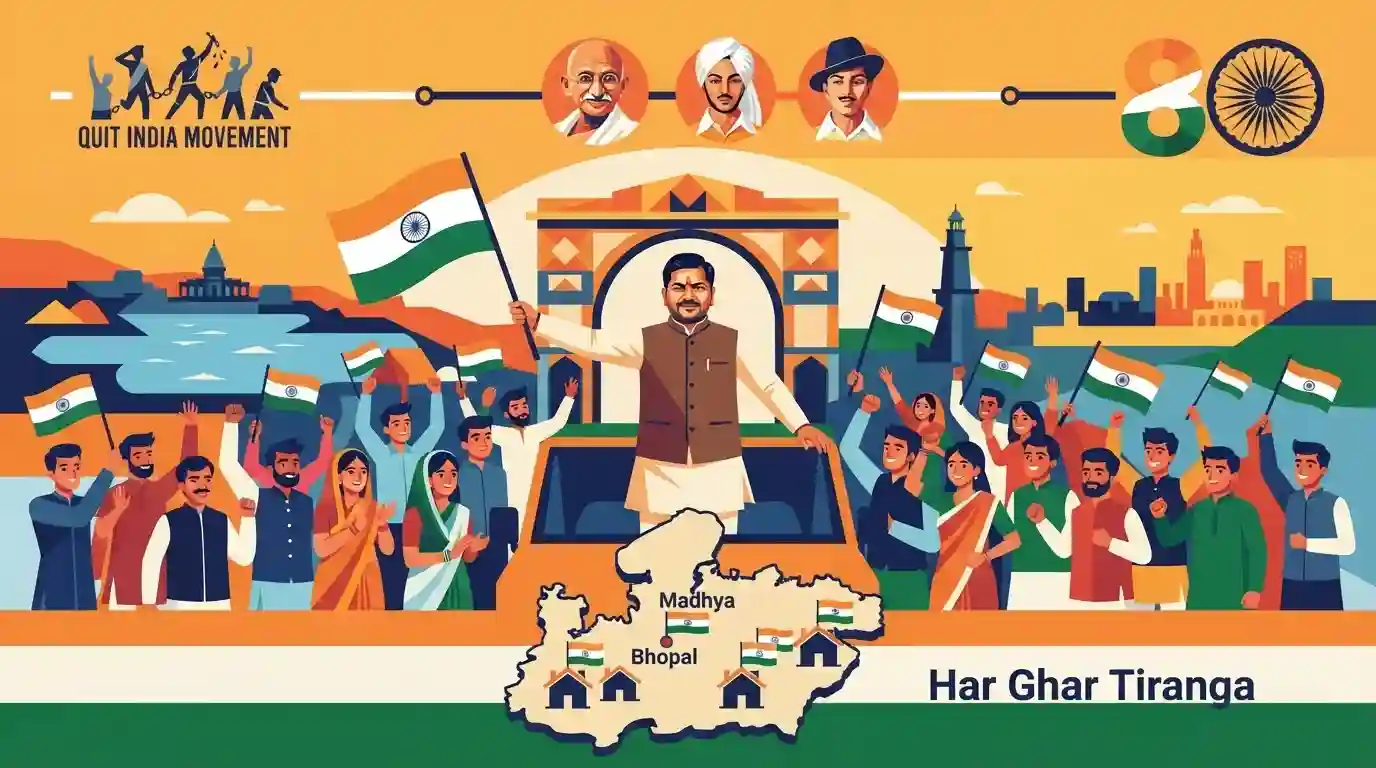
Bhopal Tiranga Yatra Marks Launch of State Independence Campaign
Source:indianmasterminds ↗
Why It Matters
State-led patriotic initiatives like the 'Har Ghar Tiranga' campaign are important for tracking regional current affairs. Furthermore, the deliberate alignment of this event with August 9 (the beginning of the Quit India Movement in 1942) reinforces crucial historical timelines that are recurrently tested in MPPSC Prelims.
Summary
Madhya Pradesh Chief Minister Mohan Yadav flagged off the Tiranga Yatra in Bhopal, marking the launch of the 'Har Ghar Tiranga' campaign in the state. Held at the TT Nagar Stadium on August 9—the anniversary of the Quit India Movement—the event saw the CM urging the youth and citizens to hoist the national flag and embrace a 'Nation First' mindset. By recalling the sacrifices of prominent freedom fighters, the initiative aims to foster deep-rooted patriotism and celebrate India's approaching 80 years of independence.
Key Points
- MP Chief Minister Mohan Yadav flagged off the Tiranga Yatra from TT Nagar Stadium in Bhopal on August 9, aligning with the historical anniversary of the Quit India Movement.
- The 'Har Ghar Tiranga' campaign is being promoted in Madhya Pradesh, with the CM urging citizens to hoist the tricolour at their residences from August 9 to 15.
- The initiative aims to instil a 'Nation First' spirit and patriotism among the youth, invoking the legacy of freedom fighters like Mahatma Gandhi, Chandra Shekhar Azad, and Bhagat Singh.
- The campaign also highlights India's core philosophy of 'Vasudhaiva Kutumbakam' as the country approaches 80 years of independence.
Important Terms
Har Ghar Tiranga

A nationwide campaign under the Azadi Ka Amrit Mahotsav encouraging citizens to hoist the Indian National Flag at their homes, aiming to transform their relationship with the Tiranga into a personal symbol of patriotism.
UPSC context
Important for Current Affairs and Governance; tests knowledge of government initiatives aimed at fostering national integration and civic responsibility.
Quit India Movement
An anti-colonial mass civil disobedience movement launched on August 8, 1942, led by Mahatma Gandhi with the slogan "Do or Die," demanding an immediate end to British rule in India.
UPSC context
Crucial for GS Paper 1 (Modern Indian History); tests knowledge of key turning points and mass mobilizations in the freedom struggle.
Non-Cooperation Movement
The first nationwide mass movement led by Mahatma Gandhi from 1920 to 1922, demanding Swaraj and withdrawal of cooperation from British institutions, later suspended after the Chauri Chaura incident.
UPSC context
Key topic in GS Paper 1 (Modern Indian History); tests understanding of Gandhian strategies, mass movements, and anti-colonial resistance.
Prelims Trap
"The 'Quit India' slogan was famously coined by Mahatma Gandhi during his address at the Gowalia Tank Maidan."
While Gandhi launched the movement and gave the famous "Do or Die" call, the slogan "Quit India" was actually coined by socialist leader Yusuf Meherally.
Static Concepts Connected
What are the recent changes to the Flag Code of India (2002)?
- Polyester allowed: The 2021 amendment permitted machine-made and polyester flags. Previously, flags were strictly restricted to hand-spun and hand-woven wool, cotton, silk, or khadi bunting.
- Day & Night display: A 2022 amendment allowed the National Flag to be flown day and night if displayed in the open or on the house of a public member.
- Fundamental Duty: Under Article 51A(a), it is a fundamental duty of every citizen to abide by the Constitution and respect its ideals, the National Flag, and the National Anthem.
What were the defining features of the Quit India Movement (1942)?
- Leaderless nature: Following the mass arrest of top Congress leaders on August 9, the movement was sustained organically by local, decentralized leadership and the masses.
- Parallel governments: The movement saw the emergence of independent local regimes, notably in Ballia (Chittu Pandey), Tamluk (Jatiya Sarkar), and Satara (Prati Sarkar).
- Underground networks: Leaders like Usha Mehta (Congress Radio), Aruna Asaf Ali, and Jayaprakash Narayan organized covert resistance and communication networks.
Cross-Topic Patterns
National Symbols + Fundamental Duties
Campaigns like 'Har Ghar Tiranga' bridge static Polity (Article 51A) with current administrative drives, a pattern UPSC uses to frame applied questions on the enforceability of Fundamental Duties.
State Anniversaries + Underground Resistance
State-led commemorations of August 9 frequently prompt UPSC to test niche facts about the Quit India Movement, such as underground radio networks or the formation of regional parallel governments.

Expect a mixed prelims question testing the 2021/2022 Flag Code amendments alongside Article 51A(a) Fundamental Duties.
Linked PYQs · 1
Linked PYQs · 1
- 2022MPPSC_PRELIMSGS1
Quit India Movement was started on ______
