Gaza conflict leadership elimination and Hamas military command
Source:Indian Express ↗
Why It Matters
The ongoing Israel-Hamas conflict is a defining issue in contemporary international relations. Understanding the leadership dynamics of non-state actors like Hamas and the geopolitical consequences of targeted assassinations is crucial for analyzing Middle Eastern stability and India's diplomatic posture in the region.
Summary
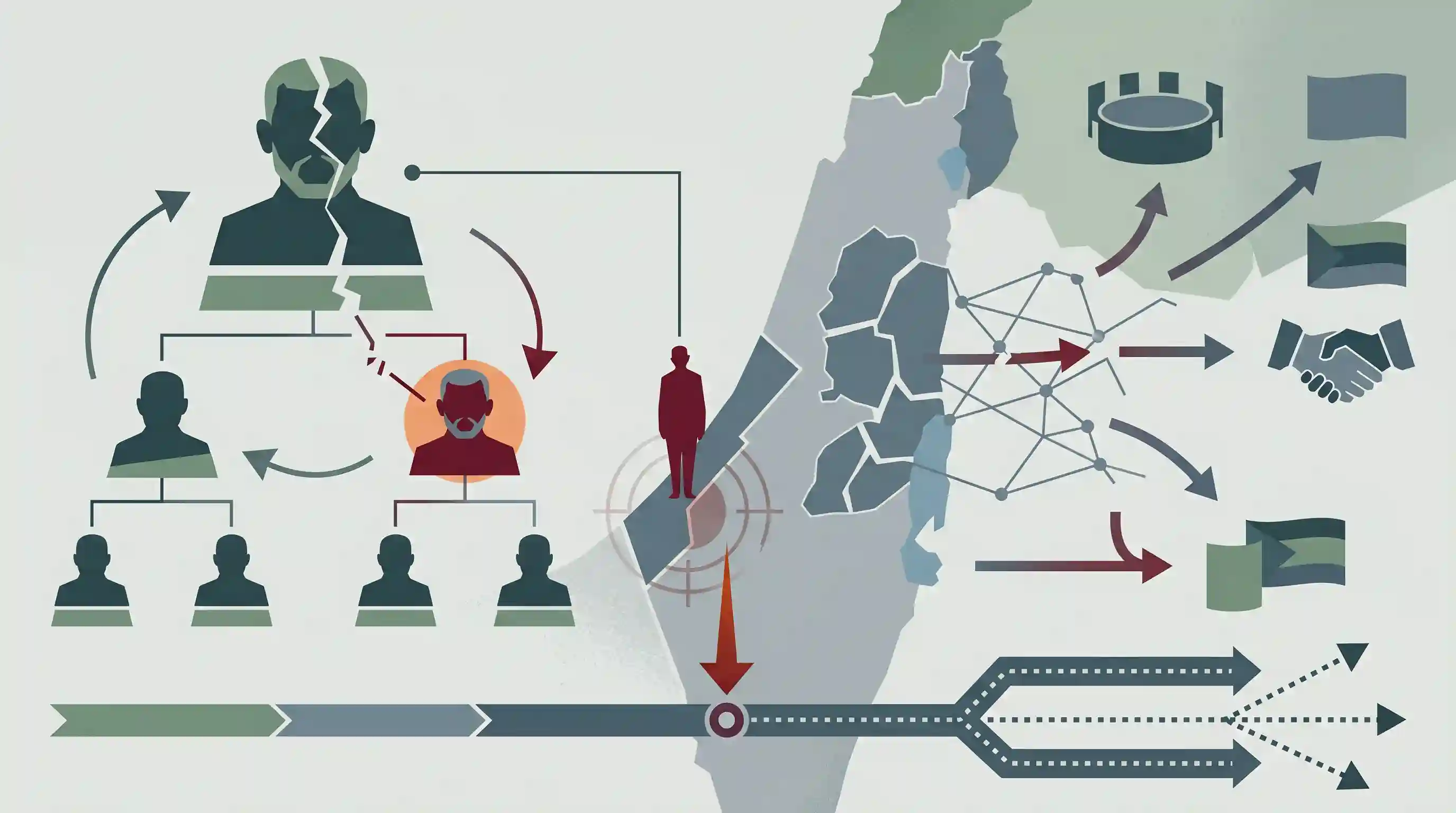
The article details the death of Mohammed Sinwar, a high-ranking Hamas commander and brother of the group's slain leader Yahya Sinwar, at the hands of the Israeli Defense Forces in Gaza. Often described as the "last man standing" of Hamas's top leadership, Mohammed operated in the shadows and was instrumental in the group's military strategy. His assassination represents a major blow to Hamas's operational capabilities and a significant milestone in Israel's military campaign, leaving a power vacuum that could reshape the trajectory of the ongoing war and future geopolitical negotiations in the Middle East.
Key Points
- Mohammed Sinwar, a top commander of Hamas and brother to the late leader Yahya Sinwar, was killed by the Israeli military in Gaza.
- He was considered the last remaining senior figure in Hamas's military leadership within the enclave, operating in extreme secrecy and surviving several past assassination attempts.
- His death marks a significant degradation of Hamas's command structure, fulfilling a major tactical objective for Israel in the ongoing conflict.
- The elimination of both Sinwar brothers leaves a leadership vacuum in Gaza that could impact both the operational capacity of the group and future ceasefire or hostage negotiations.
Important Terms
Hamas

A Palestinian Sunni-Islamic militant organization that has governed the Gaza Strip since 2007. It is designated as a terrorist group by several nations and is central to the Israel-Palestine conflict.
UPSC context
GS Paper II (International Relations); West Asia conflict's impact on India's energy security and diaspora.
Israel Defense Forces (IDF)
The national military of Israel, comprising ground, air, and naval branches. It is the primary security force responsible for the state's defense and counter-terrorism operations.
UPSC context
GS Paper II (IR) and GS Paper III (Defense); focuses on India-Israel strategic partnership.
Mohammed Sinwar
A senior commander of the Al-Qassam Brigades and brother of Yahya Sinwar. Known as "the shadow," he was a key strategist for Hamas’s military wing before being killed.
UPSC context
GS Paper II (IR); tests knowledge of leadership dynamics and conflict evolution in West Asia.
Al-Qassam Brigades
The military wing of Hamas, established in 1991. It conducts armed operations and guerrilla warfare against Israel, functioning independently from the group’s political office in some operational aspects.
UPSC context
GS Paper III (Internal Security); relevant to non-state actors and cross-border militancy.
Gaza Strip
A narrow coastal territory on the Mediterranean Sea, bordered by Israel and Egypt. It is a focal point of the Israeli-Palestinian conflict and humanitarian concern.
UPSC context
Geography and GS Paper II; critical for map-based questions and regional stability analysis.
Operation Iron Swords
The military operation launched by Israel following the October 7, 2023, attacks. Its stated goals include dismantling Hamas's military capabilities and ensuring the release of hostages.
UPSC context
GS Paper II and Prelims; specifically tracks contemporary military operations and their geopolitical consequences.
Prelims Trap
The Palestinian Authority exercises administrative control over both the West Bank and the Gaza Strip.
Aspirants often assume the internationally recognized Palestinian Authority governs all Palestinian territories. However, Hamas has controlled Gaza since 2007, while the PA governs parts of the West Bank.
Static Concepts Connected
Which countries comprise the geopolitical "Levant" region?
- Core countries: Modern-day Israel, Palestine, Lebanon, Syria, and Jordan, located along the eastern shores of the Mediterranean Sea.
- UPSC context: The term 'Levant' frequently appears in Prelims (e.g., 2022) to test map knowledge of West Asian geography and Mediterranean borders.
What are the key governance and diplomatic frameworks shaping Israel-Palestine relations?
- Palestinian Authority: Established by the 1993 Oslo Accords, this Fatah-led body exercises limited self-rule in parts of the West Bank, distinct from Hamas in Gaza.
- Abraham Accords: Bilateral agreements brokered by the US normalizing diplomatic relations between Israel and Arab states like UAE, Bahrain, and Morocco, fundamentally shifting regional geopolitics.
Cross-Topic Patterns
West Asia instability vs. IMEC
Ongoing conflict in Gaza and shifting leadership directly impacts the viability of the India-Middle East-Europe Economic Corridor (IMEC) by delaying Saudi-Israel normalization.
Rafah Crossing & Red Sea choke points
The Gaza war brings attention to the Rafah crossing (Egypt) and spillover maritime effects in the Red Sea (Houthi attacks), linking terrestrial borders to maritime choke points.

Map questions pairing West Asian borders (Rafah) with regional seas (Mediterranean, Red) and the 'Levant' are highly likely in 2026.
Linked PYQs · 4
Linked PYQs · 4
- 2018MainsGS2
“India’s relations with Israel have, of late, acquired a depth and diversity, which cannot be rolled back.” Discuss.
- 2022PrelimsGS1
The term "Levant" often heard in the news roughly corresponds to which of the following regions?
- 2017PrelimsGS1
Mediterranean Sea is a border of which of the following countries? 1. Jordan 2. Iraq 3. Lebanon 4. Syria Select the correct answer using the code given below:
- 2023PrelimsGS1
Consider the following statements: Statement-I: Israel has established diplomatic relations with some Arab States. Statement-II: The 'Arab Peace Initiative' mediated by Saudi Arabia was signed by Israel and Arab League. Which one of the following is correct in respect of the above statements?
