Mohalis Transition from Satellite Town to Digital Hub
Source:Indian Express ↗
Why It Matters
The article provides a practical case study for GS1 topics like Urbanization and Location of Industries, demonstrating the socio-economic impact of developing IT hubs in satellite or Tier-2 cities.
Summary
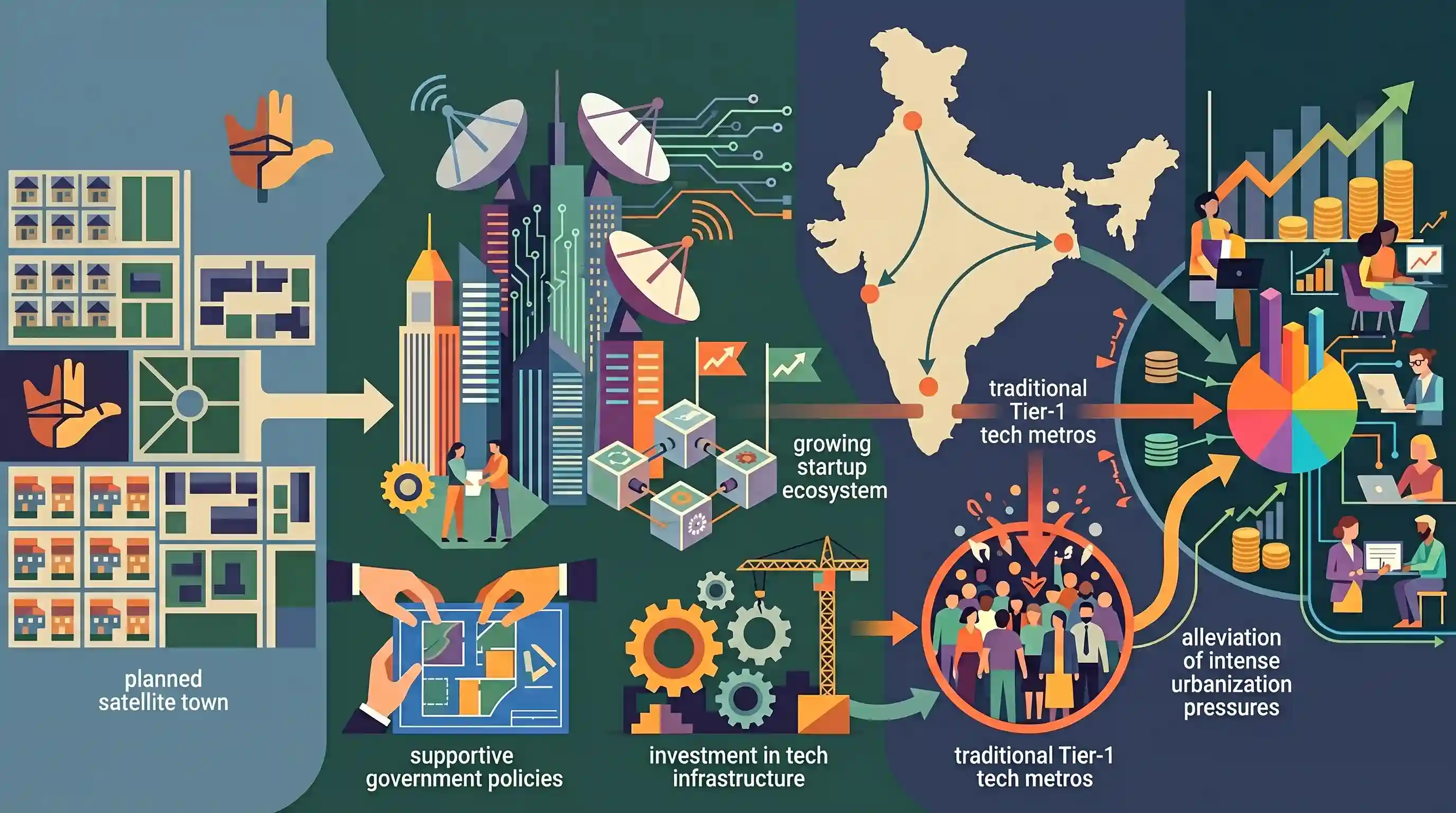
Mohali has successfully transitioned from a planned satellite town of Chandigarh to an emerging technology hub and digital powerhouse. Driven by supportive government policies, investment in tech infrastructure, and a growing startup ecosystem, the city represents the ongoing decentralization of India's IT sector into Tier-2 cities. This shift not only spurs regional economic growth and generates local employment but also helps alleviate the intense urbanization pressures currently faced by traditional Tier-1 tech metros.
Key Points
- Mohali has evolved from a planned satellite town of Chandigarh into an independent IT hub and digital powerhouse.
- The decentralization of technology industries to Tier-2 cities like Mohali helps alleviate urban congestion, infrastructural bottlenecks, and high living costs in established metropolitan IT hubs.
- State-supported infrastructure, such as IT parks and business centers, has been vital in attracting tech investments and startups to the region.
- The growth of Mohali's tech sector provides local employment opportunities, checking the outbound migration of skilled talent and fostering regional economic development.
Important Terms
Software Technology Parks of India (STPI)

An autonomous society under the Ministry of Electronics and Information Technology (MeitY), established in 1991 to encourage, promote, and boost software exports through single-window services and infrastructure.
UPSC context
GS Paper 3: Science & Technology and Economy; tests knowledge of institutional frameworks driving India's IT-led growth and exports.
Satellite Town
A planned urban center located near a major metropolis, functionally integrated with it but maintaining a separate municipal identity to alleviate overcrowding and house overspill population.
UPSC context
GS Paper 1: Urbanization and related issues; GS Paper 3: Infrastructure; essential for understanding urban planning and decongestion strategies.
Tier-2 Cities
Emerging urban centers (typically with populations between 1 and 4 million) that serve as high-potential growth markets, offering lower operational costs and expanding infrastructure compared to traditional metros.
UPSC context
GS Paper 1 & 3: Urbanization and Regional Development; tests understanding of India's shifting economic geography and decentralized industrial growth.
Industrial Decentralization
The strategic dispersal of industrial activities from overcrowded metropolitan hubs to smaller towns and rural areas to promote balanced regional growth and reduce urban pressure.
UPSC context
GS Paper 3: Location of industries and balanced regional development; critical for analysis of economic disparities and sustainable urbanization.
Digital Economy
An economic system powered by digital technologies, including digital public infrastructure (DPI), e-commerce, and IT-enabled services, aimed at transforming traditional economic models for higher efficiency.
UPSC context
GS Paper 3: Economy and S&T; central to questions on Digital India, financial inclusion, and the Fourth Industrial Revolution.
Prelims Trap
"IT industry agglomeration in Tier-2 cities depends heavily on proximity to localized raw material bases."
IT is a classic 'footloose industry'. Its location relies on digital infrastructure, human capital, and policies (like STPIs), not raw material bases.
Static Concepts Connected
What characterizes a 'footloose' industry in economic geography?
- Resource independence: Not tied to specific raw materials or weight-losing resources; can be located in a wide variety of places.
- Primary drivers: Location is dictated primarily by skilled labor availability, power supply, digital connectivity, and government incentives.
- Spatial mobility: Can easily relocate compared to heavy manufacturing, leading to rapid diffusion into emerging Tier-2 hubs like Mohali.
How does a 'Satellite Town' differ from a 'Counter-Magnet Area'?
- Satellite Towns: Located in the immediate vicinity of a metropolis (e.g., Mohali to Chandigarh) to share its economic and demographic load.
- Counter-Magnet Areas: Located far from the metropolis (e.g., Gwalior for Delhi) to intercept migrant flows long before they reach the core city.
Cross-Topic Patterns
Footloose IT + Regional Equality
The geographic diffusion of IT and Global Capability Centers to Tier-2 hubs checks regional out-migration and fosters inclusive economic growth outside traditional mega-metros.
Metropolisation + Satellite Sprawl
Developing self-sustaining satellite towns links directly to GS-1 urbanization challenges, serving as a release valve for infrastructural bottlenecks and high living costs in Tier-1 cities.

Tier-2 IT hubs as a solution to Tier-1 metropolitan urban sprawl is highly probable as an analytical GS-1 Mains question in 2026.
Linked PYQs · 3
Linked PYQs · 3
- 2021MainsGS1
What are the main socio-economic implications arising out of the development of IT industries in major cities of India?
- 2017MainsGS1
"The growth of cities as I.T. hubs has opened up new avenues of employment, but has also created new problems." Substantiate this statement with examples.
- 2023MainsGS3
What is the status of digitalization in the Indian economy? Examine the problems faced in this regard and suggest improvements.
