India China Border Talks and Special Representatives Mechanism
Source:The Hindu ↗
Why It Matters
Essential for GS-2 (India and its Neighborhood) and GS-3 (Border Security), this event highlights the diplomatic mechanisms and ongoing efforts to peacefully resolve the protracted India-China border dispute while stabilizing bilateral relations in a complex multipolar world.
Summary
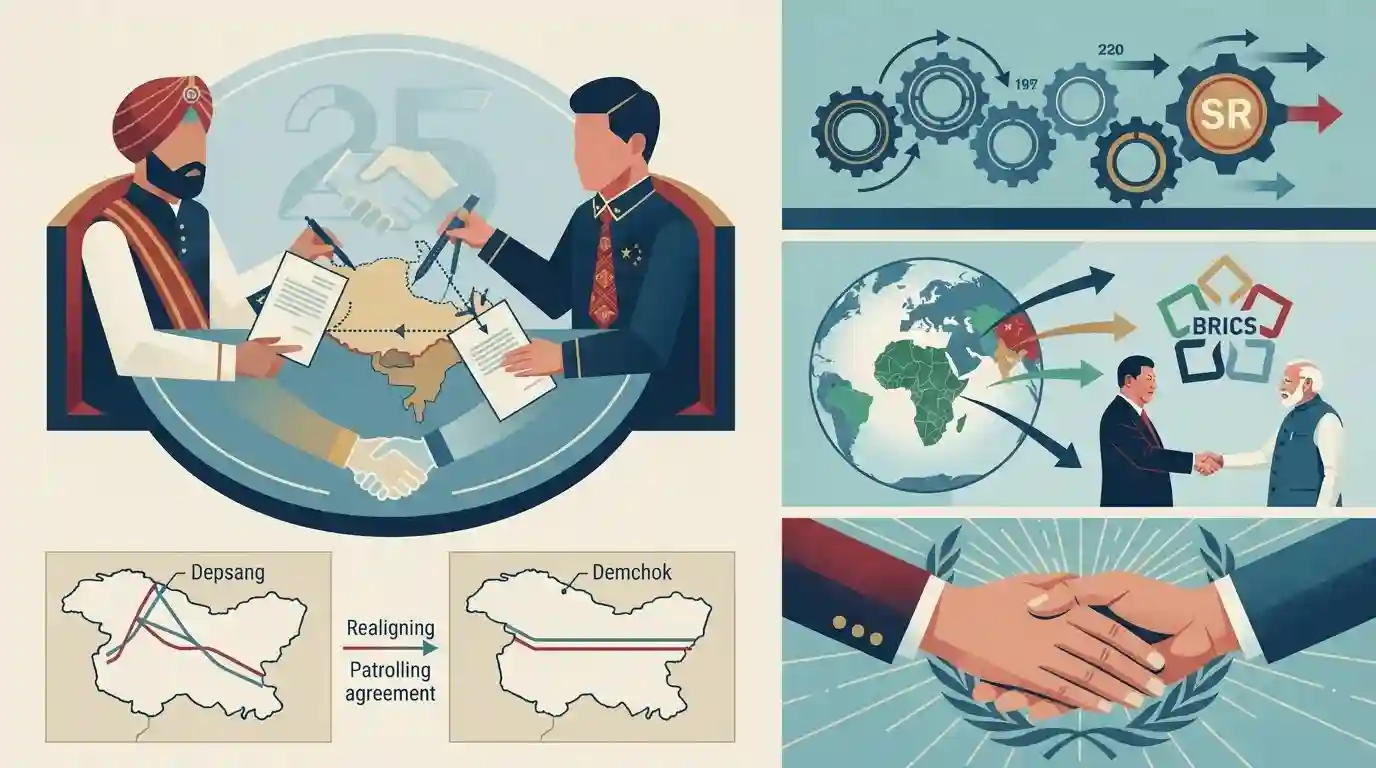
National Security Adviser Ajit Doval and Chinese Foreign Minister Wang Yi held the 25th round of Special Representatives talks on the boundary question in Beijing, marking a resumption of the dialogue after five years. The discussions aimed to advance border delimitation, clarify the Line of Actual Control (LAC), and rebuild trust following recent patrolling agreements in Depsang and Demchok. With Chinese President Xi Jinping expected to attend the upcoming BRICS summit in New Delhi, both nations highlighted the strategic importance of stabilizing ties for the broader Global South.
Key Points
- The 25th round of talks between the Special Representatives on the India-China boundary question resumed in Beijing after a five-year gap.
- NSA Ajit Doval and Chinese Foreign Minister Wang Yi focused on border delimitation, clarifying the LAC, and ensuring peace and tranquility.
- The diplomatic re-engagement follows recent agreements on patrolling arrangements in border areas like Depsang and Demchok.
- China emphasized the global and strategic significance of India-China ties, framing their cooperation as essential for the Global South.
- The talks build momentum ahead of Chinese President Xi Jinping's anticipated visit to New Delhi for the BRICS summit in September.
Important Terms
Special Representatives (SR) Mechanism

A high-level diplomatic framework established in 2003 between India and China. Led by senior officials, it aims to negotiate a mutually acceptable political solution to the long-standing boundary dispute along the Line of Actual Control.
UPSC context
Crucial for GS Paper 2 (International Relations) to understand India-China border negotiations, diplomatic dialogue architectures, and conflict resolution strategies.
BRICS
An intergovernmental organization originally comprising Brazil, Russia, India, China, and South Africa, now expanded. It promotes economic cooperation, development, and a multipolar world order outside traditional Western-dominated institutions.
UPSC context
Important for GS Paper 2 (Global Groupings). Highlights the evolving global order, South-South cooperation, and India's strategic balancing in multilateral forums.
Line of Actual Control (LAC)
The de facto, undemarcated boundary separating Indian-controlled territory from Chinese-controlled territory. It spans across the western, middle, and eastern sectors, serving as the primary flashpoint for bilateral border disputes.
UPSC context
Key to GS Papers 2 and 3. Essential for understanding India-China territorial disputes, military standoffs, and the challenges of managing unconfirmed borders.
Depsang and Demchok
Two strategic friction points in eastern Ladakh along the Line of Actual Control. They witnessed prolonged military standoffs between India and China after 2020 before recent disengagement and patrolling agreements were reached.
UPSC context
Vital for GS Paper 3 (Border Security) and GS 2. Tests knowledge of India-China territorial disputes, strategic flashpoints, and border management mechanisms.
Global South
A geopolitical term referring to developing or underdeveloped nations, primarily in Africa, Asia, and Latin America. It highlights shared historical experiences of colonialism, economic marginalization, and contemporary developmental challenges.
UPSC context
Relevant for GS Paper 2 (IR). Tests understanding of multipolarity, global inequality, and India's role as a representative voice for developing nations.
Prelims Trap
The WMCC is mandated to negotiate the final resolution of the India-China boundary question.
The WMCC handles real-time border management and confidence-building. The final boundary settlement is exclusively negotiated by the political-level Special Representatives (SR) mechanism.
Static Concepts Connected
What is the three-stage formula under the India-China SR mechanism?
- Stage 1 (Parameters): Agreeing on political parameters and guiding principles, which concluded with a landmark 2005 agreement.
- Stage 2 (Framework): Negotiating a broad framework for a final package settlement across all sectors (currently ongoing).
- Stage 3 (Demarcation): Physical delineation and demarcation of the boundary on agreed maps and on the ground.
How does the SR Mechanism differ from the WMCC?
- SR Mechanism (2003): Led by the NSA (India), it serves as the primary political channel to explore a comprehensive boundary settlement framework.
- WMCC (2012): A Joint Secretary-level platform strictly for border management, communication, and confidence-building. It cannot negotiate final boundaries.
Cross-Topic Patterns
Multilateral summits driving bilateral thaw
Key diplomatic breakthroughs, such as the 2024 patrolling pact, often precede major multilateral events like BRICS summits, highlighting how global forums catalyze bilateral boundary dialogues.
Buffer Zones vs Patrolling
While Depsang and Demchok have resumed coordinated patrolling, Galwan and Pangong Tso remain 'buffer zones'—a critical distinction for understanding the LAC's current tactical reality.

Expect a multi-statement question distinguishing the mandates of WMCC vs SR mechanism, alongside the current status of LAC buffer zones.
Linked PYQs · 3
Linked PYQs · 3
- 2024MainsGS3
India has a long and troubled border with China and Pakistan fraught with contentious issues. Examine the conflicting issues and security challenges along the border. Also give out the development being undertaken in these areas under the Border Area Development Programme (BADP) and Border Infrastructure and Management (BIM) Scheme.
- 2014MainsGS2
With respect to the South China sea, maritime territorial disputes and rising tension affirm the need for safeguarding maritime security to ensure freedom of navigation and over flight throughout the region. In this context, discuss the bilateral issues between India and China.
- 2024MainsGS2
‘The West is fostering India as an alternative to reduce dependence on China's supply chain and as a strategic ally to counter China's political and economic dominance.’ Explain this statement with examples.
