India welcomes US-Iran peace deal and energy security impacts
Source:Indian Express ↗
Why It Matters
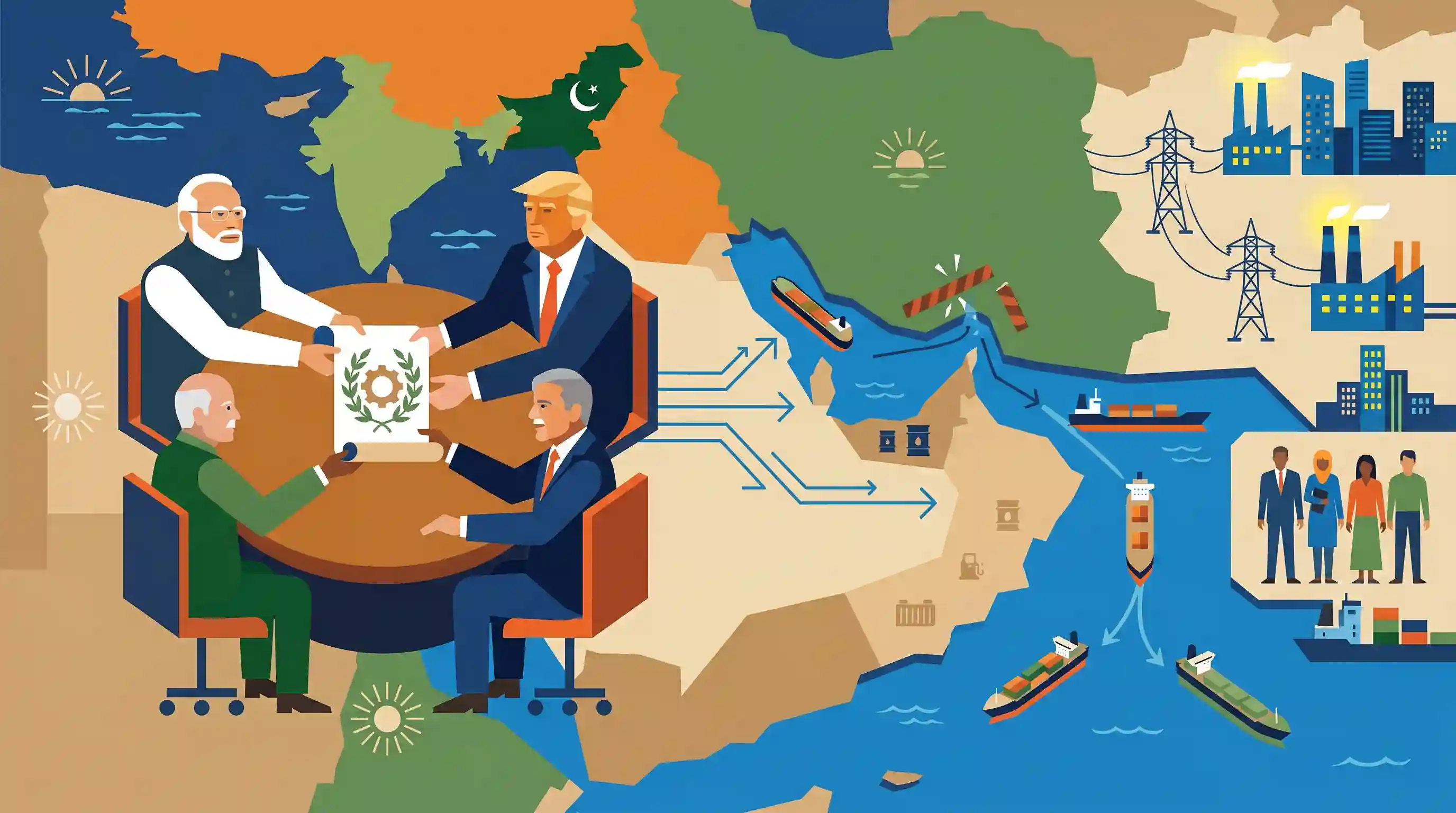
The US-Iran deal and the reopening of the Strait of Hormuz are critical to global energy markets and India's energy security, as a vast majority of India's oil imports transit through this maritime chokepoint. Understanding these geopolitical shifts is essential for analyzing India's foreign policy in West Asia.
Summary
Prime Minister Narendra Modi has welcomed the landmark US-Iran deal, facilitated by US President Donald Trump, which brings an end to the conflict in West Asia. A crucial aspect of this agreement is the reopening of the Strait of Hormuz, thereby ensuring the resumption of unhindered maritime commerce and energy supplies. The breakthrough, also highlighted by Pakistan's PM Shehbaz Sharif, is expected to restore peace, stability, and freedom of navigation in a region that is deeply strategic for India's energy security and diaspora interests.
Key Points
- PM Narendra Modi welcomed the US-Iran peace deal, which ends the recent conflict in West Asia.
- A major outcome of the agreement is the reopening of the Strait of Hormuz, a vital chokepoint for global oil and gas shipments.
- The deal, announced by US President Donald Trump and echoed by Pakistan PM Shehbaz Sharif, aims to restore regional stability and freedom of navigation.
- The development is highly significant for India's energy security and economic interests, which rely heavily on uninterrupted maritime trade through the Middle East.
Important Terms
Strait of Hormuz

A critical maritime chokepoint between the Persian Gulf and Gulf of Oman, handling roughly 20% of global oil and 35% of LNG trade. It is India's primary energy supply route.
UPSC context
GS Paper I (Geography) and Paper II/III (International Relations/Energy Security). Tests knowledge of global maritime chokepoints and India's strategic vulnerabilities.
Joint Comprehensive Plan of Action (JCPOA)
Commonly known as the Iran Nuclear Deal, this 2015 agreement between Iran and P5+1 powers aimed to limit Iran’s nuclear capabilities in exchange for lifting economic sanctions.
UPSC context
GS Paper II (International Relations). Focuses on bilateral/regional agreements affecting India's interests and the impact of major power diplomacy on regional stability.
Freedom of Navigation
An international law principle, largely codified in UNCLOS, ensuring that vessels can navigate international waters without interference. It is vital for maintaining global trade and sea lines of communication.
UPSC context
GS Paper II (International Relations) and Paper III (Security). Relates to maritime law, UNCLOS, and India’s role as a net security provider in the IOR.
West Asia Geopolitics
A strategic geopolitical region (Middle East) encompassing major oil producers and over 9 million Indian expatriates. Stability here is essential for India’s energy, trade, and diaspora safety.
UPSC context
GS Paper II (International Relations). Tests the 'Link West' policy, strategic autonomy, and balancing ties between regional rivals like Iran, Israel, and Saudi Arabia.
Energy Security
The uninterrupted availability of energy sources at an affordable price. India imports over 80% of its crude oil, mostly from West Asia, making regional peace a core national interest.
UPSC context
GS Paper III (Economy/Infrastructure/Security). Essential for understanding India's dependency on imports and the need for Strategic Petroleum Reserves (SPR).
Indian Diaspora (West Asia)
The community of ~9 million Indian nationals working in West Asia (GCC). They are vital for remittances (over $40 billion annually) but represent a humanitarian vulnerability during regional conflicts.
UPSC context
GS Paper II (International Relations). Focuses on the role of the Indian diaspora in enhancing soft power and the government's obligation for citizen safety.
Prelims Trap
"Iran has the legal right under UNCLOS to temporarily suspend maritime traffic through the Strait of Hormuz."
Hormuz is an international strait where foreign vessels enjoy 'transit passage'. Under UNCLOS, coastal states cannot lawfully suspend transit passage, even during localized conflicts.
Static Concepts Connected
What defines 'Transit Passage' versus 'Innocent Passage' under UNCLOS?
- Transit Passage: Applies to international straits (e.g., Hormuz). It ensures freedom of navigation and overflight for continuous transit, and cannot be suspended by coastal states.
- Innocent Passage: Applies to territorial seas. Submarines must navigate on the surface, and coastal states can temporarily suspend it for essential security reasons.
What is the precise geography of the Strait of Hormuz?
- Water Bodies Connected: Connects the Persian Gulf to the Gulf of Oman and the Arabian Sea, serving as the world's most critical oil chokepoint.
- Northern Border: Iran entirely flanks the northern coastline of the Strait.
- Southern Border: The Musandam Peninsula (an exclave of Oman) and the United Arab Emirates form the southern coastline.
Cross-Topic Patterns
Macroeconomics of West Asian stability
Beyond oil, the region hosts 56% of all NRIs. Peace directly secures India's inward remittances, a critical macroeconomic buffer used to finance India's structural merchandise trade deficit.
Autonomous SLOC protection: Op Sankalp
India avoids formal Western naval alliances in the Gulf, instead using continuous unilateral missions like Operation Sankalp to secure Indian-flagged vessels, showcasing strategic autonomy in maritime security.

Expect a 2026 Prelims map-pairing question linking West Asian straits (Hormuz/Bab-el-Mandeb) with bordering nations and UNCLOS rights.
Linked PYQs · 3
Linked PYQs · 3
- 2025MainsGS2
"Energy security constitutes the dominant kingpin of India's foreign policy, and is linked with India's overarching influence in Middle Eastern countries.” How would you integrate energy security with India's foreign policy trajectories in the coming years?
- 2024MainsGS2
Discuss the geopolitical and geostrategic importance of Maldives for India with a focus on global trade and energy flows. Further also discuss how this relationship affects India's maritime security and regional stability amidst international competition ?
- 2024PrelimsGS1
Consider the following statements : Statement-I : Sumed pipeline is a strategic route for Persian Gulf oil and natural gas shipments to Europe. Statement-II : Sumed pipeline connects the Red Sea with the Mediterranean Sea. Which one of the following is correct in respect of the above statements?
