India Israel Strategic Partnership and Bilateral Evolution
Source:Indian Express ↗
Why It Matters
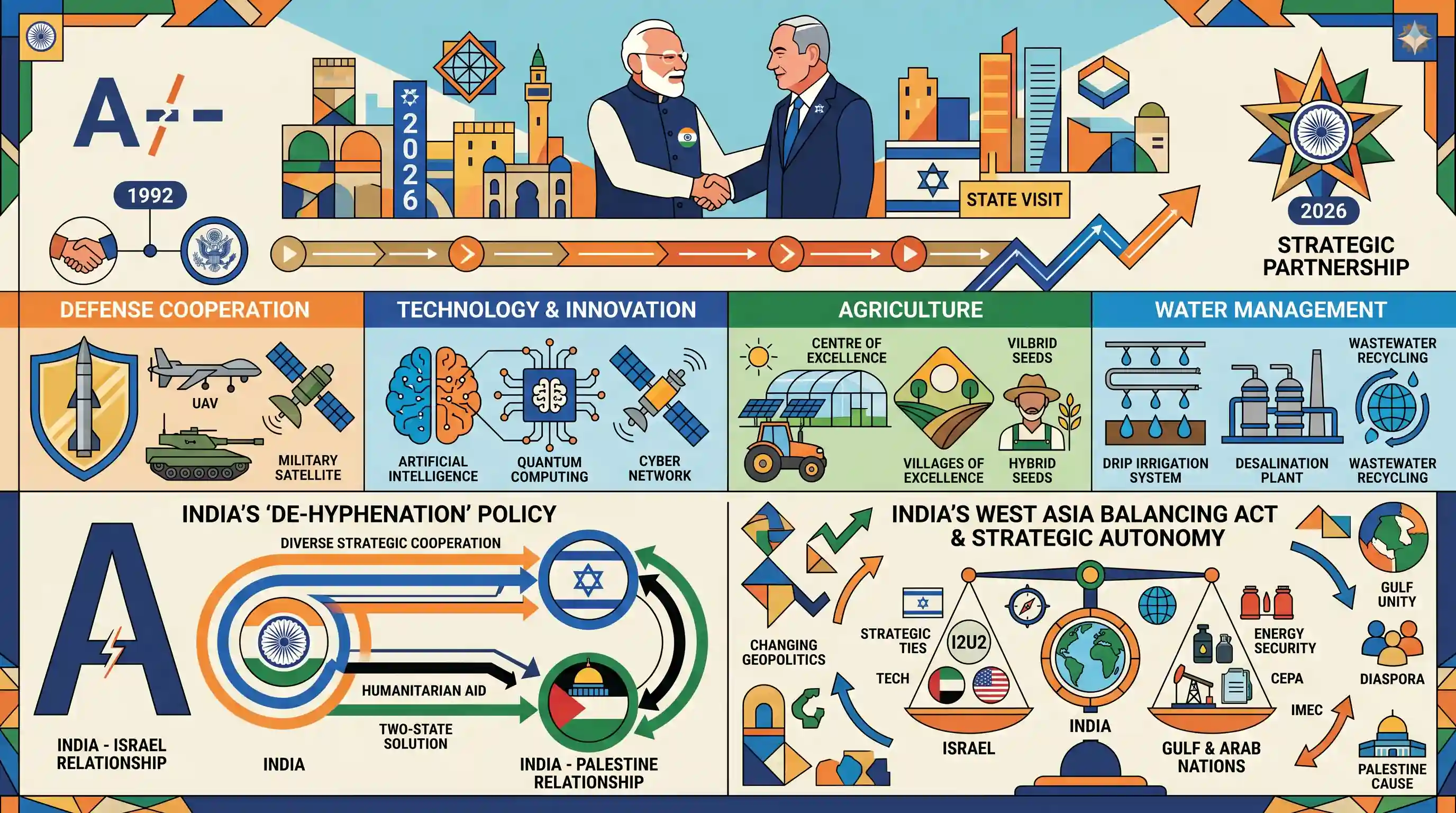
India-Israel relations are a classic case study of India's strategic autonomy and 'de-hyphenation' policy in West Asia. Understanding this bilateral relationship is crucial for Mains GS2, as it bridges defense procurement, technological innovation, and complex regional diplomacy.
Summary
Prime Minister Narendra Modi's 2026 visit to Tel Aviv underscores the deepening strategic and historical bilateral ties between India and Israel. Over the decades, the relationship has evolved from formal diplomatic recognition in 1992 to a robust partnership centered on defense cooperation, technology, agriculture, and water management. For UPSC aspirants, this visit illustrates India's 'de-hyphenation' policy—successfully decoupling its relationship with Israel from its stance on Palestine. It also reflects India's broader strategic autonomy and diplomatic balancing act in West Asia amid changing regional geopolitics.
Key Points
- The article outlines the historical evolution of India-Israel bilateral ties, culminating in Prime Minister Narendra Modi's 2026 visit to Tel Aviv.
- India and Israel's relationship has transformed into a comprehensive strategic partnership, focusing heavily on defense, agriculture, water management, and technology.
- The visit highlights India's successful 'de-hyphenation' policy, allowing it to maintain strong independent ties with both Israel and Palestine without viewing one through the lens of the other.
- Strong India-Israel relations play a key role in India's broader West Asia strategy, alongside groupings like I2U2 and shifting regional dynamics post-Abraham Accords.
Important Terms
De-hyphenation Policy

A diplomatic strategy where India maintains independent, bilateral relations with Israel and Palestine on their own merits, without letting one relationship negatively impact or dictate the terms of the other.
UPSC context
GS Paper II (International Relations). Tests understanding of India's strategic shift and balancing act in West Asian geopolitics.
Strategic Autonomy
India’s ability to make sovereign foreign policy and defense decisions based on national interest, without being constrained by external pressures or formal military alliance obligations in a multipolar world.
UPSC context
GS Paper II (International Relations). Key concept for analyzing India’s positioning between major powers like the US, Russia, and China.
I2U2
A minilateral grouping of India, Israel, the UAE, and the USA focused on geoeconomic cooperation in six areas: water, energy, transportation, space, health, and food security.
UPSC context
GS Paper II (International Relations). Tests knowledge of regional groupings and 'West Asian Quad' dynamics affecting India’s interests.
Abraham Accords
A series of 2020 normalization agreements between Israel and several Arab nations (UAE, Bahrain, Morocco, Sudan) that expanded India's diplomatic and economic space in the Middle East.
UPSC context
GS Paper II. Crucial for discussing the changing geopolitical landscape of West Asia and its impact on India's 'Link West' policy.
Link West Policy
An Indian foreign policy framework aimed at deepening strategic, economic, and energy partnerships with West Asian countries, moving beyond a traditional focus solely on energy and diaspora.
UPSC context
GS Paper II (Bilateral/Regional Relations). Tests the overarching strategy for India’s engagement with the Middle East and Gulf regions.
Prelims Trap
"India recognized Israel as a state only in 1992 when full diplomatic relations were established."
India officially recognized Israel much earlier, in 1950. However, it waited until 1992 to establish full diplomatic ties and open embassies due to Cold War dynamics and Arab solidarity.
Static Concepts Connected
What is India's 'De-hyphenation' policy in West Asia?
- Independent engagement: Treating bilateral relations with Israel and Palestine as mutually independent, standalone ties.
- Non-zero-sum game: Engaging comprehensively with one state does not mean diluting or compromising relations with the other.
- Strategic pragmatism: Balances strategic autonomy, prioritizing defense and tech with Israel alongside developmental support for Palestine.
What are the core focus areas of the I2U2 Grouping?
- West Asian Quad: Formed in 2021 by India, Israel, UAE, and the USA, often dubbed the West Asian Quad.
- Key sectors: Focuses on joint investments in six areas: water, energy, transport, space, health, and food security.
- Geo-economic shift: Shifts focus from purely security-centric alliances to geo-economics, infrastructure, and technology in the Middle East.
Cross-Topic Patterns
Israeli tech in Indian agriculture
GS2 bilateral ties often cross-pollinate with GS3 agriculture. Expect questions linking Indo-Israel Centres of Excellence to micro-irrigation, protected cultivation, and dryland farming solutions.
Arab-Israeli normalization & IMEC connectivity
The Abraham Accords removed the diplomatic friction between Israel and Arab states, directly enabling minilaterals like I2U2 and mega-corridors like IMEC involving India.

Expect a multi-statement Prelims question on West Asian minilaterals (I2U2, IMEC) or a Mains Q on India's 'de-hyphenated' balancing.
Linked PYQs · 3
Linked PYQs · 3
- 2018MainsGS2
“India’s relations with Israel have, of late, acquired a depth and diversity, which cannot be rolled back.” Discuss.
- 2025MainsGS2
"Energy security constitutes the dominant kingpin of India's foreign policy, and is linked with India's overarching influence in Middle Eastern countries.” How would you integrate energy security with India's foreign policy trajectories in the coming years?
- 2023PrelimsGS1
Consider the following statements: Statement-I: Israel has established diplomatic relations with some Arab States. Statement-II: The 'Arab Peace Initiative' mediated by Saudi Arabia was signed by Israel and Arab League. Which one of the following is correct in respect of the above statements?
