Evolution of India Israel Strategic and Bilateral Relations
Source:Indian Express ↗
Why It Matters
Understanding the evolution of India-Israel ties is crucial for the International Relations segment in GS Paper 2. It illustrates India's pragmatic foreign policy, the shift from ideological to interest-based diplomacy, the concept of de-hyphenation, and the significance of defense and technological partnerships in addressing national security and development challenges.
Summary
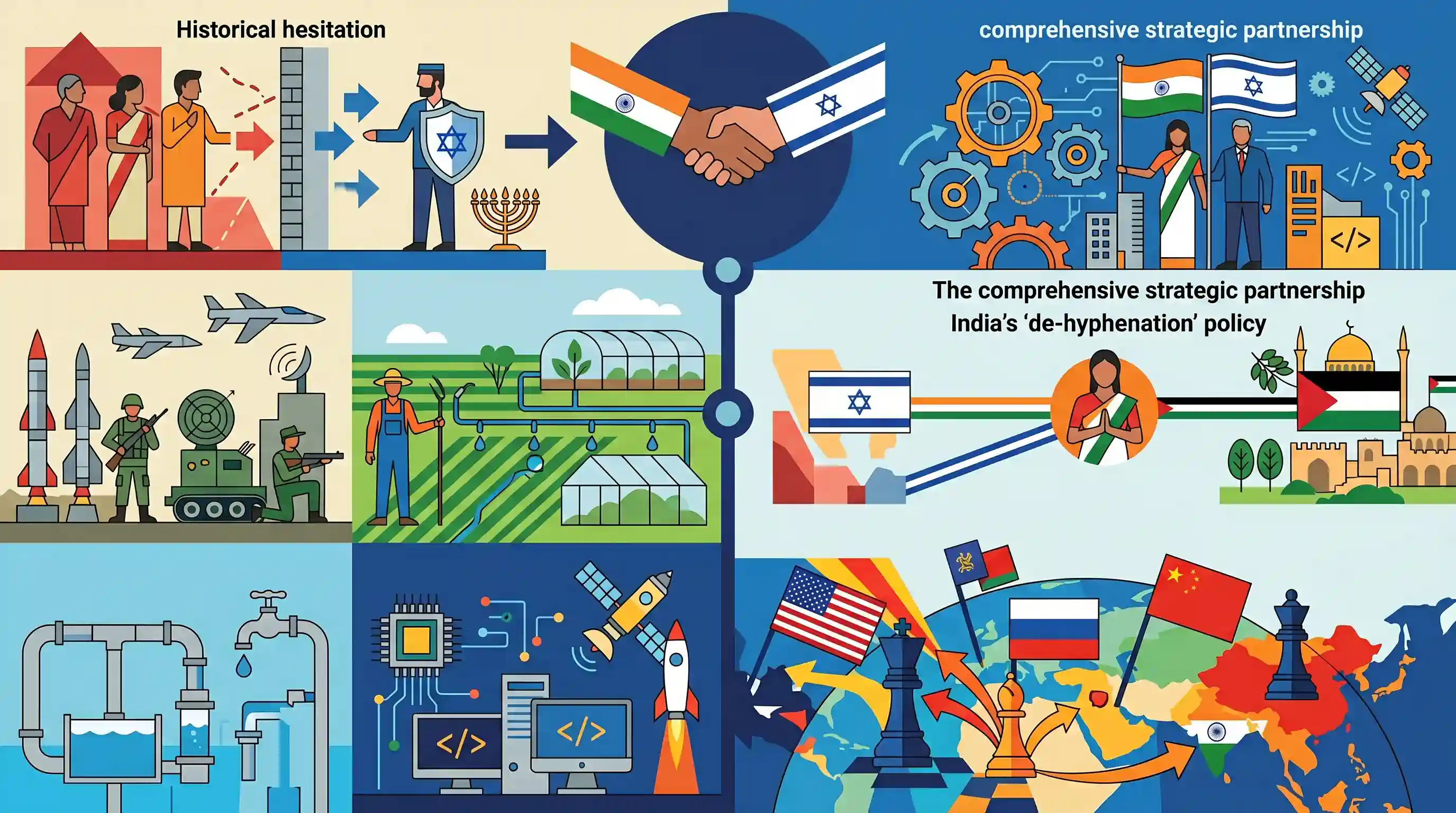
The article traces the historical evolution of India-Israel bilateral ties, particularly in the context of the Indian Prime Minister's visits. It highlights the transformation of diplomatic relations from early ideological hesitations to the eventual establishment of full diplomatic ties in 1992. Over the decades, the relationship has deepened into a comprehensive strategic partnership. Key pillars of cooperation now include defense, agriculture, water management, and technology. The progression also underscores India's successful 'de-hyphenation' policy, allowing it to balance strategic interests with Israel while maintaining its traditional stance on Palestine.
Key Points
- Historical Context: India's initial stance was influenced by its support for the Palestinian cause and solidarity with the Arab world, leading to a delay in establishing full diplomatic recognition until 1992.
- Strategic Shift: The end of the Cold War, the collapse of the Soviet Union, and India's 1991 economic reforms catalyzed a pragmatic shift, culminating in full diplomatic relations under PM P.V. Narasimha Rao.
- Defense and Security: Israel has emerged as one of India's top defense partners, providing critical military technology, arms, and intelligence-sharing.
- Economic and Tech Ties: Beyond defense, the partnership places a strong emphasis on civilian cooperation, particularly in agriculture (e.g., drip irrigation), water conservation, and technological innovation.
- De-hyphenation Policy: India's contemporary foreign policy maintains independent, robust ties with both Israel and Palestine, managing them as distinct relationships rather than viewing them through a zero-sum lens.
Important Terms
De-hyphenation Policy

A foreign policy strategy where India deals with Israel and Palestine as two separate, independent bilateral tracks, based on national interest rather than treating them as a single diplomatic block.
UPSC context
GS Paper II: International Relations; tests India’s strategic autonomy and balancing acts in West Asian geopolitics.
I2U2
A quadrilateral strategic forum comprising India, Israel, the UAE, and the USA, focusing on joint investments in water, energy, transportation, space, health, and food security.
UPSC context
GS Paper II: Bilateral and Multilateral Groupings; tests knowledge of "West Asian Quad" and regional economic cooperation.
India-Middle East-Europe Economic Corridor (IMEC)
A multi-modal connectivity project connecting India to Europe via the UAE, Saudi Arabia, Jordan, and Israel, aimed at enhancing trade and economic integration across regions.
UPSC context
GS Paper II (IR) & III (Economy); tests infrastructure, global trade routes, and strategic connectivity.
Special Strategic Partnership
An upgraded diplomatic status between India and Israel reflecting deep strategic trust, focusing on defense, innovation, agriculture, and emerging technologies like AI and cybersecurity.
UPSC context
GS Paper II: Bilateral ties involving India; tests the evolution of security and technological cooperation.
Two-State Solution
A proposed diplomatic solution to the Israeli-Palestinian conflict that envisions two separate states—an independent State of Palestine alongside the State of Israel.
UPSC context
GS Paper II: West Asia conflict; tests India’s long-standing principled position on regional peace.
Abraham Accords
A series of 2020 agreements brokered by the US to normalize diplomatic relations between Israel and several Arab nations, including the UAE and Bahrain.
UPSC context
GS Paper II: Regional Geopolitics; tests the shift in Arab-Israel relations and its impact on India.
Prelims Trap
India established full diplomatic relations with Israel in 1950 after formally recognizing the state.
India formally recognized Israel in 1950, but deliberately delayed establishing full diplomatic ties (embassies) until 1992 due to Cold War dynamics and Arab solidarity.
Static Concepts Connected
What is India's 'De-hyphenation' policy in West Asia?
- Independent Ties: Engaging with Israel and Palestine as mutually independent, standalone bilateral partnerships, moving away from a zero-sum diplomatic approach.
- Milestone Shift: Highlighted when the Indian PM visited Israel in a standalone trip in 2017, explicitly decoupling it from a customary parallel visit to Ramallah.
What is the I2U2 grouping?
- Member Nations: A minilateral cooperative forum comprising India, Israel, the UAE, and the USA, frequently termed the 'West Asian Quad'.
- Economic Focus: Focuses on joint capital investments in six crucial areas: water, energy, transportation, space, health, and food security.
Cross-Topic Patterns
Drip Irrigation + GS3 Agriculture
The Indo-Israel Agricultural Project links IR directly to GS-3 crop efficiency, transferring micro-irrigation and soil solarization techniques to Indian farmers via Centers of Excellence.
Abraham Accords + Geo-economics
Normalization of Arab-Israeli ties via the Abraham Accords enabled India to join the I2U2, shifting its West Asian diplomacy towards technological and economic minilateralism.

Prelims 2026 could test India's historical UN voting on Israel (1947/1950) alongside recent economic frameworks like I2U2 in one question.
Linked PYQs · 3
Linked PYQs · 3
- 2018MainsGS2
“India’s relations with Israel have, of late, acquired a depth and diversity, which cannot be rolled back.” Discuss.
- 2022MainsGS2
How will I2U2 (India, Israel, UAE and USA) grouping transform India's position in global politics?
- 2003PrelimsGS1
Israel has common borders with
