Bilateral Diplomacy and Third Party Claims on Ceasefire
Source:The Hindu ↗
Why It Matters
The incident highlights the diplomatic friction caused when a superpower's transactional foreign policy narrative (claiming mediation credit) clashes with India's core diplomatic tenet of bilateralism (e.g., the Simla Agreement). It underscores the complexities of managing the India-U.S. strategic partnership while safeguarding national self-esteem and independent foreign policy decisions in the context of cross-border counter-terrorism operations.
Summary
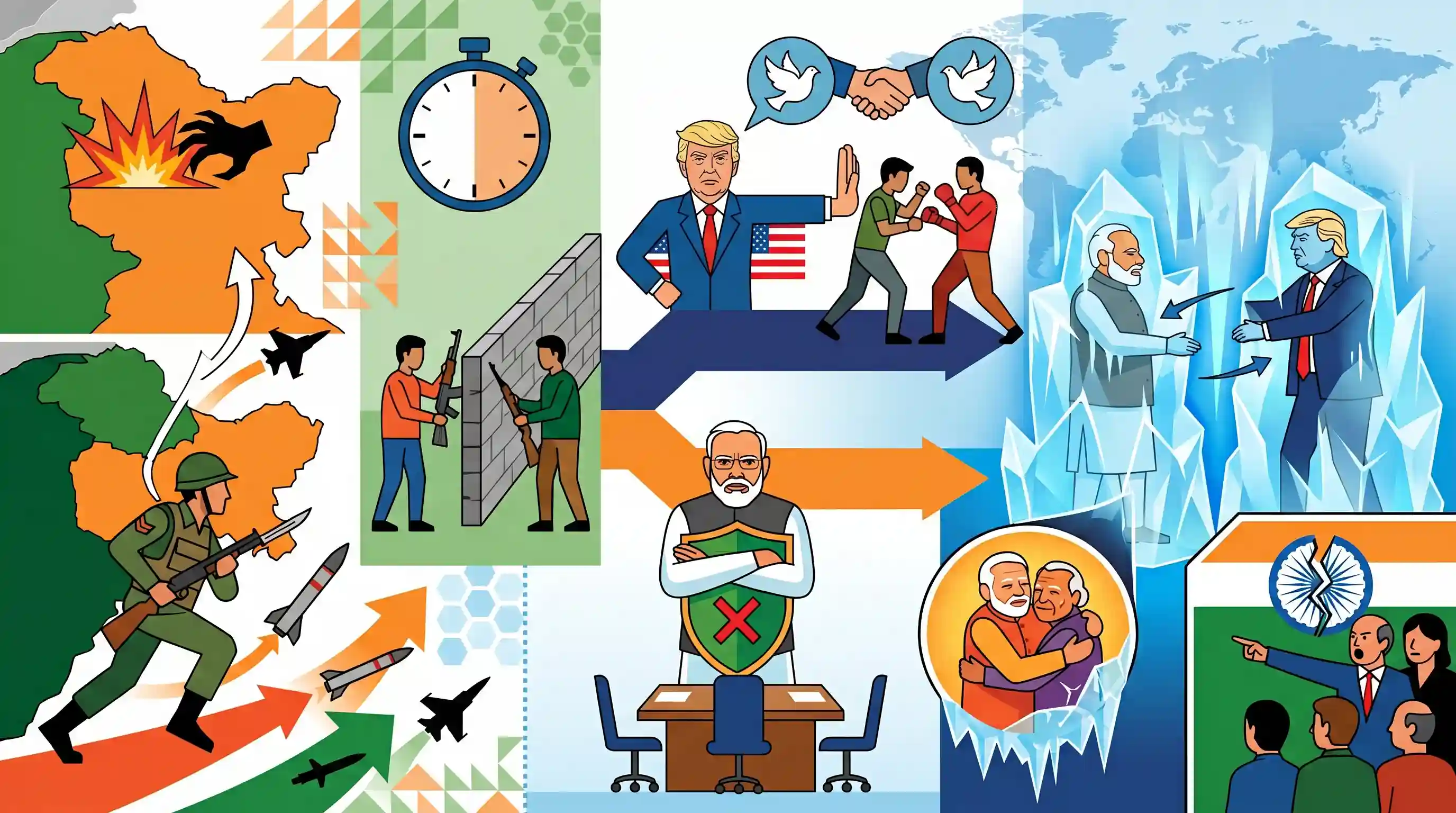
The Congress party criticized Prime Minister Narendra Modi over repeated assertions by U.S. President Donald Trump and Secretary of State Marco Rubio that the U.S. brokered a ceasefire between India and Pakistan in May 2025. Following the April 2025 Pahalgam terror attack, India launched 'Operation Sindoor' against terror camps in Pakistan and PoK, which ended in a ceasefire after four days. While the U.S. administration repeatedly took credit for halting the conflict, New Delhi maintained its firm stance rejecting any third-party mediation in bilateral disputes. Congress leader Jairam Ramesh cited these conflicting narratives to assert that the much-touted "Modi-Trump huglomacy" is now in deep freeze, highlighting a disconnect in the strategic partnership.
Key Points
- U.S. President Donald Trump and Secretary of State Marco Rubio repeatedly claimed credit for brokering a ceasefire between India and Pakistan in May 2025.
- The brief conflict, initiated by India's 'Operation Sindoor' in retaliation to the Pahalgam terror attack, targeted terror infrastructure in Pakistan and PoK.
- New Delhi has consistently rebuffed claims of U.S. mediation, maintaining its long-standing policy of strictly bilateral resolution for disputes with Pakistan.
- The Congress party leveraged the conflicting narratives to criticize the government, stating that the touted "Modi-Trump huglomacy" has entered a deep freeze.
Important Terms
Operation Sindoor

A calibrated Indian military operation in May 2025 involving precision missile and air strikes against terror infrastructure in Pakistan and PoK following the Pahalgam terror attack.
UPSC context
GS Paper III: Internal Security/Defense. Tests knowledge of recent military doctrines, surgical strikes, and India's response to cross-border terrorism.
Third-Party Mediation
Intervention by an external country or international body to resolve bilateral disputes; a concept consistently rejected by India in its dealings with Pakistan.
UPSC context
GS Paper II: International Relations. Tests understanding of India's long-standing diplomatic protocols and rejection of international intervention in sovereign matters.
Shimla Agreement (1972)
A 1972 treaty between India and Pakistan mandating that all bilateral differences, including the Kashmir issue, be resolved through peaceful bilateral negotiations without external involvement.
UPSC context
GS Paper II: History and International Relations. A foundational document for Indo-Pak relations often cited in Mains regarding diplomatic de-escalation.
Strategic Autonomy
A fundamental pillar of Indian foreign policy emphasizing independent decision-making based on national interests rather than joining military blocs or yielding to external pressure.
UPSC context
GS Paper II: International Relations. Critical for discussing India’s multi-aligned approach and its navigation of major power rivalries (US-Russia-China).
DGMO (Director General of Military Operations)
High-ranking military officers from India and Pakistan who maintain a dedicated hotline to manage border de-escalation and ensure adherence to ceasefire agreements.
UPSC context
GS Paper III: Security. Tests awareness of institutional mechanisms for conflict management and direct military-to-military diplomacy.
The Resistance Front (TRF)
A militant group active in Jammu and Kashmir, identified as a front for the UN-designated terror organization Lashkar-e-Taiba (LeT), responsible for the 2025 Pahalgam attack.
UPSC context
GS Paper III: Internal Security/Terrorism. Tests knowledge of non-state actors and the evolving nature of proxy warfare in J&K.
Huglomacy
A colloquial term for the personal, high-optics diplomatic style shared between PM Modi and President Trump, characterized by symbolic public gestures and warm rapport.
UPSC context
GS Paper II: International Relations. Relates to 'informal diplomacy' and personal leadership styles influencing bilateral strategic partnerships.
Prelims Trap
"The UN or USA has a recognized mandate to mediate the Kashmir dispute if bilateral talks break down."
India strictly adheres to the 1972 Simla Agreement, which mandates exclusively bilateral negotiations for the Kashmir issue, legally and practically rejecting all third-party mediation.
Static Concepts Connected
What is the legal basis for India rejecting third-party mediation with Pakistan?
- Simla Agreement 1972: Signed after the 1971 war, it mandates that all differences between India and Pakistan be resolved peacefully through direct bilateral negotiations.
- Lahore Declaration 1999: Reaffirmed the bilateral commitment to resolve the Kashmir issue and combat cross-border terrorism without external interference.
- UNMOGIP Irrelevance: India maintains the UN Military Observer Group has outlived its mandate following the establishment of the Line of Control under the Simla pact.
How has India's retaliatory doctrine against cross-border terrorism evolved?
- Strategic Restraint: Historically, India absorbed terror strikes without cross-border military escalation to avoid conventional or nuclear war (e.g., post-26/11 attacks).
- Proactive Retaliation: Evidenced by 2016 Surgical Strikes, 2019 Balakot, and 2025 Operation Sindoor, India now actively targets terror infrastructure across the LoC/IB.
Cross-Topic Patterns
Strategic Autonomy vs. US Overreach
While the US projects itself as a regional peacemaker, India’s firm rejection of mediation highlights its enduring pursuit of strategic autonomy. This structural friction is a classic GS2 India-US ties theme.
Limits of Personalized Summit Diplomacy
The breakdown of 'huglomacy' over strategic divergences parallels the failure of the 'Wuhan Spirit' with China, proving personalized diplomacy cannot override core national security interests and geopolitical realities.

Expect a 2026 GS2 Mains question on the limits of personalized summit diplomacy in shielding India from great-power mediation pressures.
Linked PYQs · 4
Linked PYQs · 4
- 2019MainsGS2
‘What introduces friction into the ties between India and the United States is that Washington is still unable to find for India a position in its global strategy, which would satisfy India's national self-esteem and ambitions.’ Explain with suitable examples.
- 2016MainsGS3
The terms 'Hot Pursuit' and 'Surgical Strikes' are often used in connection with armed action against terrorist attacks. Discuss the strategic impact of such actions.
- 2020MainsGS3
Analyze internal security threats and transborder crimes along Myanmar, Bangladesh and Pakistan borders including Line of Control (LoC). Also discuss the role played by various security forces in this regard.
- 2015MainsGS2
Terrorist activities and mutual distrust have clouded India-Pakistan relations. To what extent the use of soft power like sports and cultural exchanges could help generate goodwill between the two countries? Discuss with suitable examples.
