India-US Ties and BRICS Tariff Diplomacy Dynamics
Source:Indian Express ↗
Why It Matters
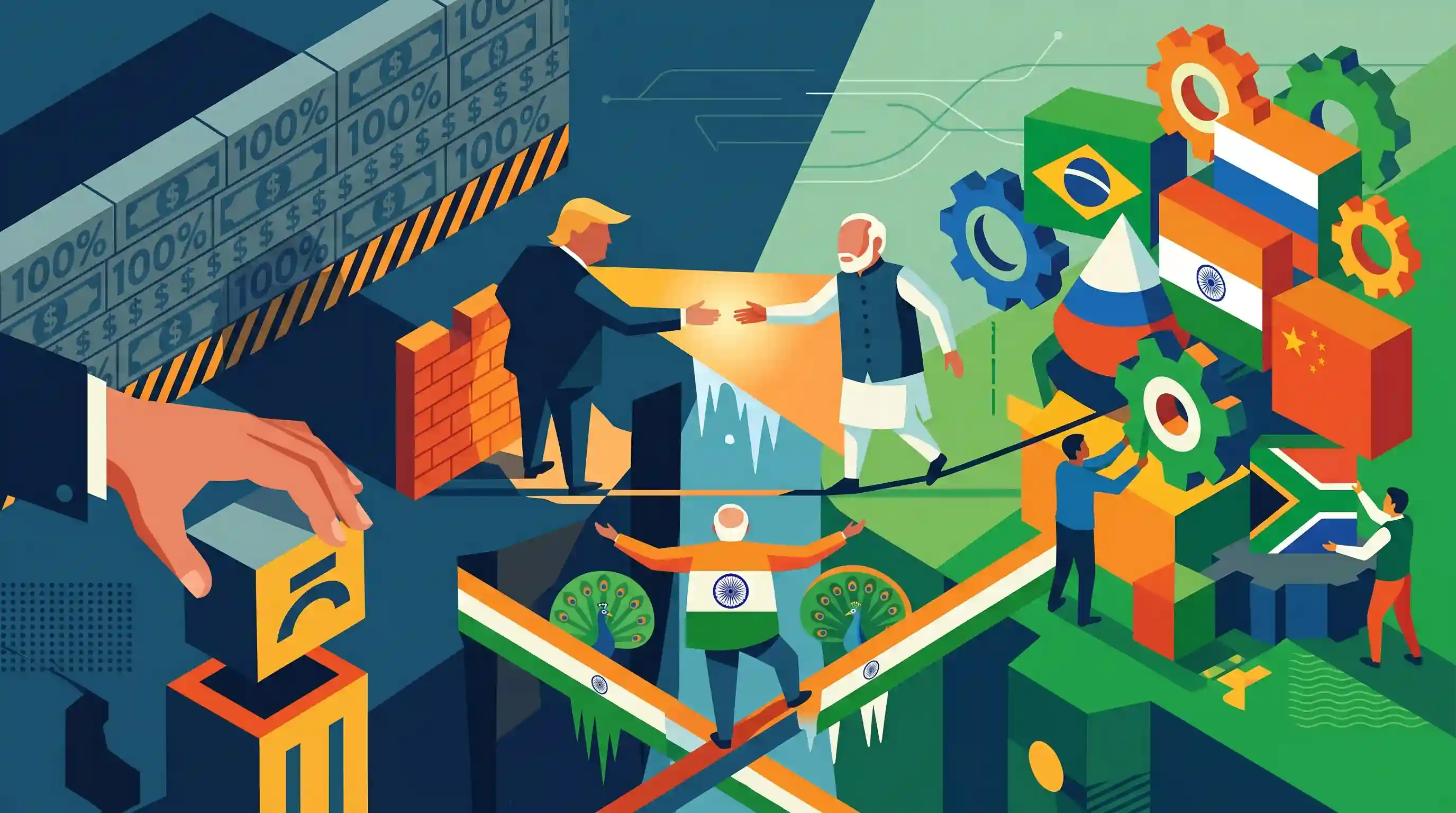
The personal diplomacy between Indian and US leadership will be pivotal in managing bilateral relations, particularly as the incoming US administration signals a return to aggressive trade protectionism and potential tariffs aimed at BRICS nations. Understanding these dynamics is crucial for grasping India's strategic economic and geopolitical positioning.
Summary
Amid concerns over US President-elect Donald Trump's threat to impose 100% tariffs on BRICS nations if they seek to undermine the US dollar, a recent exchange between Trump and PM Narendra Modi signals a positive tone for bilateral ties. Trump publicly stated that the US and India "will always be friends," a sentiment Modi affirmed by responding that India "fully reciprocates." This interaction acts as a diplomatic ice-breaker, highlighting the role of personal diplomacy in navigating potential trade tensions and protectionist policies. The exchange underscores India's delicate balancing act: maintaining strong strategic ties with the US while participating in multipolar forums like BRICS.
Key Points
- Following US President-elect Donald Trump's threat to impose 100% tariffs on BRICS nations pursuing alternatives to the US dollar, a public exchange between Trump and Indian PM Narendra Modi signaled a positive tone for bilateral ties.
- Donald Trump declared on social media that the US and India 'will always be friends,' to which PM Modi replied that India 'fully reciprocates' the sentiment.
- The interaction serves as an 'ice-breaker' amidst concerns over future US trade policies, particularly regarding protectionism and tariffs targeting BRICS members.
- The exchange underlines the significance of personal rapport between the two leaders, which could play a crucial role in managing differences over trade, tariffs, and geopolitical alignments in the coming years.
Important Terms
BRICS

An intergovernmental organization of major emerging economies (originally Brazil, Russia, India, China, South Africa) representing the Global South and advocating for reforms in the global financial and political architecture.
UPSC context
GS Paper II (International Relations); tests knowledge of multilateral groupings, India's balancing act, and the shift toward a multipolar world order.
Protectionism
Economic policy of restricting imports through methods like high tariffs and quotas to shield domestic industries and workers from foreign competition, often contrasting with free trade principles.
UPSC context
GS Paper III (Economy) and GS II (IR); critical for understanding trade wars, global supply chain disruptions, and impacts on Indian exports.
De-dollarization
The strategic process of reducing a country's or group's reliance on the US dollar for international trade settlements, financial transactions, and foreign exchange reserves.
UPSC context
GS Paper III (Economy); concerns international finance, currency stability, and the geopolitical implications of alternative payment systems like BRICS Pay.
Strategic Autonomy
A state's ability to pursue its national interests and foreign policy independently, without being constrained or dictated to by other sovereign states or international alliances.
UPSC context
GS Paper II (International Relations); a core principle of India's foreign policy when navigating ties between the US, Russia, and China.
Tariffs
Taxes or duties imposed by a government on imported goods to make them more expensive than domestic alternatives, used as a tool for revenue or protection.
UPSC context
GS Paper III (Economy); tests knowledge of trade barriers, fiscal policy, and their role in initiatives like 'Aatmanirbhar Bharat'.
Multilateralism
Formal cooperation between three or more nations within an institutional framework (e.g., UN, WTO) to solve global problems and establish shared international norms.
UPSC context
GS Paper II (International Relations); explores global governance challenges, the decline of traditional institutions, and the rise of issue-based 'minilateral' groups.
Prelims Trap
India is actively advocating for a unified BRICS currency to completely de-dollarize global trade.
India actively opposes a common BRICS currency. Instead, it favors bilateral local currency settlements (like INR-Dirham) to reduce dollar-conversion costs without directly antagonizing US financial hegemony.
Static Concepts Connected
How do bilateral local currency settlements work under RBI framework?
- Special Rupee Vostro: Authorized Indian banks open Special Rupee Vostro Accounts (SRVA) for correspondent banks of the partner trading country.
- Invoicing: All exports and imports under this specific arrangement are denominated and invoiced in Indian National Rupee (INR).
- Settlement: Balances in SRVAs can be used for trade payments, FDI, and investments in Indian government securities.
What are the WTO constraints on unilateral retaliatory tariffs?
- Bound Tariffs: Countries commit to ceiling rates at the WTO. Unilateral 100% tariff hikes generally violate these bound tariff limits unless specific exceptions apply.
- MFN Principle: Penalizing specific country blocks (like BRICS) violates the Most-Favoured-Nation rule, which requires treating all WTO members equally.
- Security Exception: Unilateral tariffs often rely on Article XXI (National Security Exception), which allows WTO members to breach trade rules during geopolitical emergencies.
Cross-Topic Patterns
Geopolitics of De-dollarization
India's push for INR internationalization is often conflated with China and Russia's aggressive de-dollarization strategy, creating friction with the US that requires constant diplomatic balancing.
BRICS vs Quad Balancing Act
India's participation in non-Western multilateral forums like BRICS and SCO continues to draw economic scrutiny from Western strategic partners, making the Quad vs BRICS tightrope a recurring theme.

Expect a 2026 prelims question testing the technical difference between India's INR internationalization vs a unified BRICS currency.
Linked PYQs · 3
Linked PYQs · 3
- 2018MainsGS3
How would the recent phenomena of protectionism and currency manipulations in world trade affect macroeconomic stability of India?
- 2025MainsGS3
What are the challenges before the Indian economy when the world is moving away from free trade and multilateralism to protectionism and bilateralism? How can these challenges be met?
- 2020MainsGS2
What is the significance of Indo-US defence deals over Indo-Russian defence deals? Discuss with reference to stability in the Indo-Pacific region.
