Security and Development Strategy Chokes Left Wing Extremism
Source:Indian Express ↗
Why It Matters
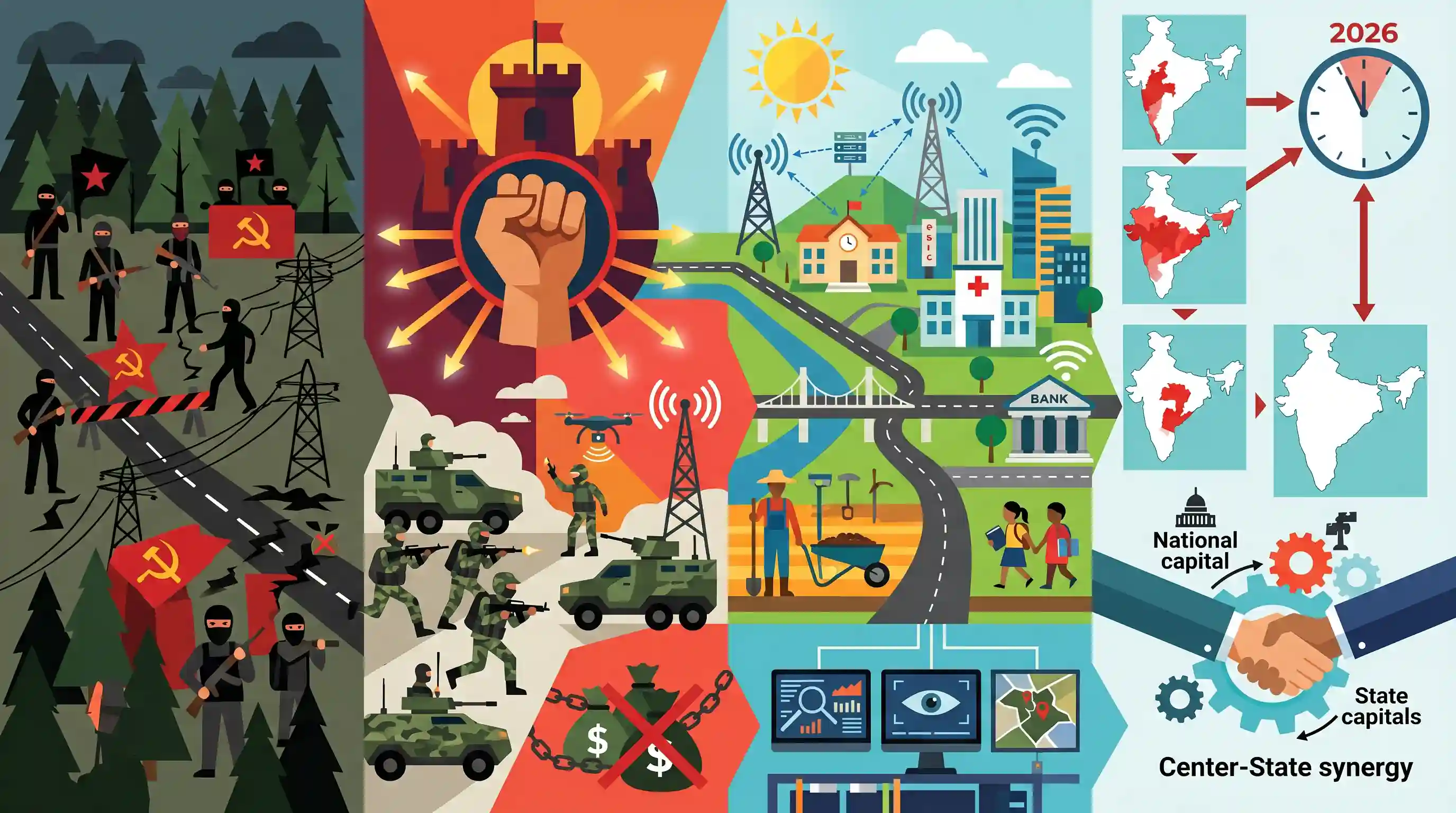
Left-Wing Extremism has historically been described as India's biggest internal security challenge. The current government's success in drastically reducing Maoist violence and the dual strategy of 'security plus development' directly addresses the core themes repeatedly tested in GS3 mains questions.
Summary
This article evaluates the Central government's robust counter-insurgency strategy against Left-Wing Extremism (LWE), led by PM Modi and Home Minister Amit Shah. Emphasizing a zero-tolerance policy, the administration has paired aggressive, intelligence-driven security operations with rapid socio-economic development in formerly inaccessible areas like Bastar. The multi-pronged approach—anchored by doctrines like SAMADHAN—focuses on building infrastructure (roads, telecom, banking), choking terror financing, and fostering Centre-State synergy. Consequently, the Maoist footprint has shrunk significantly, putting India on track to eliminate the LWE menace by 2026.
Key Points
- The government under PM Modi and HM Amit Shah has displayed strong political will to eliminate Left Wing Extremism (LWE), setting a target for its complete eradication by 2026.
- The 'Red Corridor' has shrunk significantly, marked by a drastic reduction in the number of LWE-affected districts, violent incidents, and casualties among security forces.
- A dual strategy combining kinetic security operations and robust development is at play, bridging the infrastructure deficit through road networks, mobile towers, and banking access in Maoist strongholds.
- Stronger Centre-State coordination, better intelligence sharing, and targeted strategies like the SAMADHAN doctrine are actively dismantling the Maoist ecosystem and choking their funding networks.
Important Terms
Left-Wing Extremism (LWE)

A violent Maoist insurgency, commonly known as Naxalism, that aims to overthrow the Indian state through armed struggle, primarily active in the underdeveloped forest regions of central India.
UPSC context
GS Paper III (Internal Security). A core topic examining the causes, spread, and multi-pronged governmental response to the Naxalite movement.
SAMADHAN doctrine
A comprehensive counter-insurgency framework launched in 2017. The acronym represents eight pillars including Smart leadership, Actionable intelligence, and No access to financing, aimed at holistically eliminating LWE through security and technology.
UPSC context
GS Paper III (Internal Security). Tests knowledge of modern counter-insurgency strategies and the integration of technology in internal security management.
Security Related Expenditure (SRE) scheme
A reimbursement mechanism where the Ministry of Home Affairs covers expenses incurred by states for security training, operations, ex-gratia payments, and rehabilitation of surrendered Maoists in LWE-affected districts.
UPSC context
GS Paper III (Security). Essential for understanding fiscal cooperation and capacity-building between the Centre and States in conflict zones.
Special Central Assistance (SCA)
A 100% centrally-funded scheme launched in 2017 to fill public infrastructure and service gaps in the most LWE-affected districts, ensuring development reaches the most marginalized populations.
UPSC context
GS Paper III (Security and Development). Tests the link between addressing development deficits and curbing recruitment into extremist movements.
Central Armed Police Forces (CAPFs)
Paramilitary forces under the Ministry of Home Affairs, such as the CRPF, deployed to support state police in counter-insurgency operations and maintaining internal security in conflict zones.
UPSC context
GS Paper III (Security Forces). Evaluates the role, mandate, and deployment challenges of central agencies in aiding state-led internal security efforts.
Ministry of Home Affairs (MHA)
The nodal central ministry responsible for maintaining internal security and coordinating national policy, funding, and intelligence sharing between the Centre and States to combat domestic insurgencies.
UPSC context
GS Paper II/III (Governance/Security). Tests the institutional mechanism for internal security and the nodal role of the Union in state assistance.
State Police
The primary constitutional authority for maintaining law and order; they provide critical local intelligence and specialized units, like the Greyhounds, essential for effective grassroots-level counter-insurgency.
UPSC context
GS Paper III (Internal Security). Focuses on the constitutional division of powers and the necessity of localized response in internal security.
Prelims Trap
The Centre has exclusive jurisdiction over counter-LWE operations since Left Wing Extremism is designated a national security threat.
'Police' and 'Public Order' are State subjects (Schedule VII). The Centre only supplements state efforts (CAPFs, funding); it does not have exclusive mandate or bypass state police.
Static Concepts Connected
What are the core components of the SAMADHAN doctrine?
- Leadership & Strategy: Smart Leadership and Aggressive Strategy to proactively engage insurgents rather than adopting a defensive posture.
- Intelligence & Tech: Actionable Intelligence, Harnessing Technology (UAVs, trackers), and Dashboard-based KPIs to monitor operational success.
- Financial choking: No access to Financing to completely choke the ideological and kinetic ecosystem of the Maoists.
How does the Central Government assist states in LWE management?
- Security Related Expenditure: Reimburses states for operational costs, ex-gratia payments, and rehabilitation of surrendered Naxalites under the SRE scheme.
- Special Central Assistance: Provides dedicated funds to fill critical physical and social infrastructure gaps in the most LWE-affected districts.
- Civic Action Programme: Funds CAPFs to conduct local welfare activities (medical camps, bridging bridges) to reduce the trust deficit with tribals.
Cross-Topic Patterns
LWE shrinking + FRA/PESA implementation
The shrinking of LWE is tightly linked to the better implementation of the Forest Rights Act (FRA) and PESA, which addresses the historical tribal alienation that fuels insurgency.
Tech parity in internal & border security
UAVs, geospatial mapping, and dashboard-based monitoring used in anti-Naxal operations mirror the Comprehensive Integrated Border Management System (CIBMS) deployed along hostile international borders.

Expect a GS3 Mains question evaluating the 'Clear, Hold, Build' strategy's success in shrinking the Red Corridor ahead of the 2026 target.
Linked PYQs · 4
Linked PYQs · 4
- 2025MainsGS3
The Government of India recently stated that Left Wing Extremism (LWE) will be eliminated by 2026. What do you understand by LWE and how are the people affected by it? What measures have been taken by the government to eliminate LWE?
- 2022MainsGS3
Naxalism is a social, economic and developmental issue manifesting as a violent internal security threat. In this context, discuss the emerging issues and suggest a multilayered strategy to tackle the menace of Naxalism.
- 2020MainsGS3
What are the determinants of left-wing extremism in Eastern part of India? What strategy should Government of India, civil administration and security forces adopt to counter the threat in the affected areas?
- 2018MainsGS3
Left Wing Extremism (LWE) is showing a downward trend, but still affects many parts of the country. Briefly explain the Government of India's approach to counter the challenges posed by LWE.
