India New Zealand Partnership Strengthens Indo-Pacific Ties
Source:The Hindu ↗
Why It Matters
This visit marks a major strategic and economic pivot in India's engagement with the southern Pacific region. The reciprocal naval logistics pact and joint maritime cooperation framework signal India's deepening defense footprint in the Indo-Pacific, aligning with partners to maintain a rules-based order. Furthermore, the bilateral FTA and the ambitious ₹35k-crore trade target illustrate India's ongoing strategy of securing high-standard bilateral trade pacts amid global protectionist challenges.
Summary
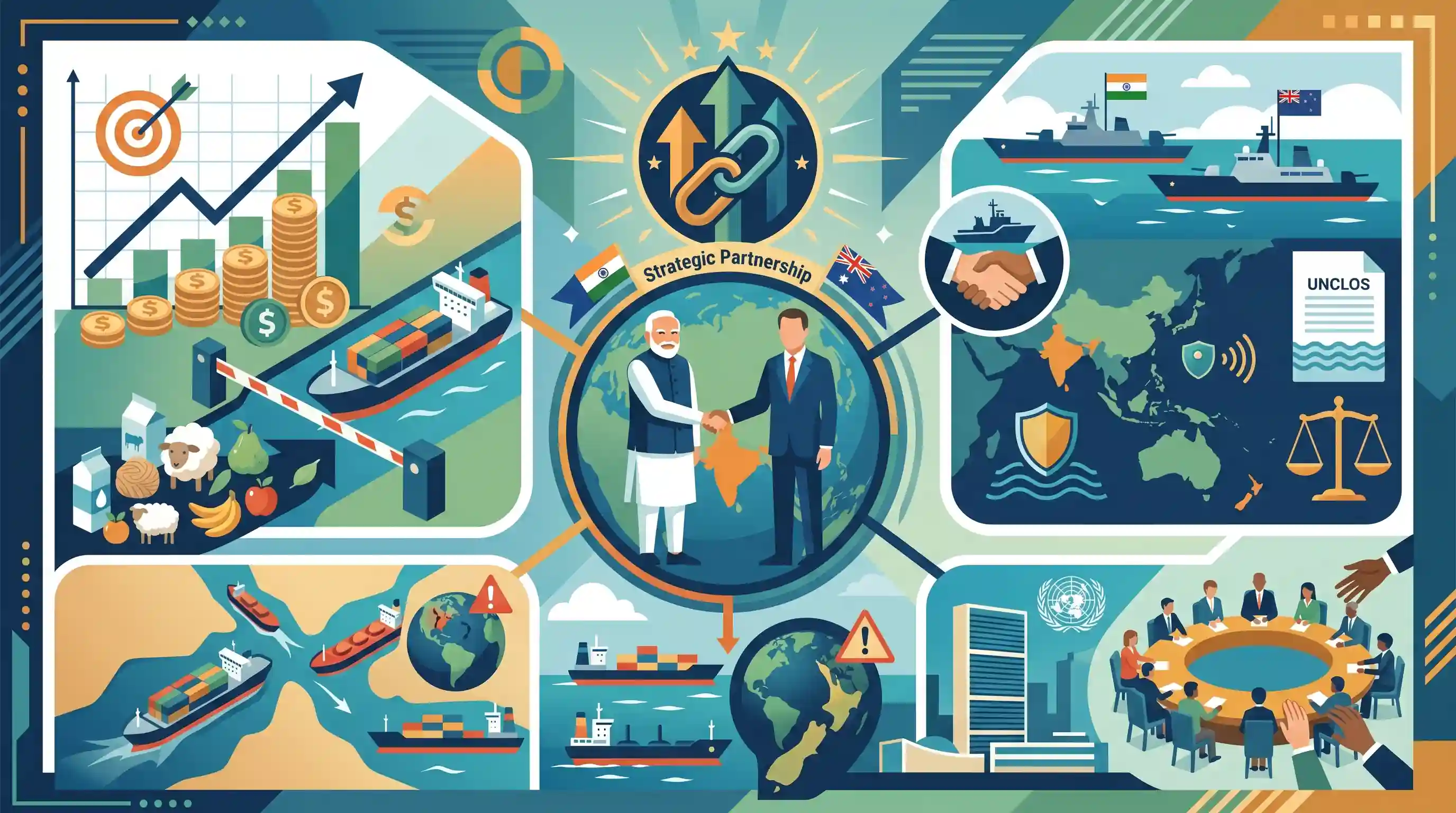
During Prime Minister Narendra Modi's historic visit to New Zealand, bilateral ties were elevated to a 'Strategic Partnership'. Key highlights include setting a target to double trade to ₹35,000 crore by 2030 via the early entry into force of the India-New Zealand Free Trade Agreement (FTA), which removes tariffs on 57% of New Zealand's exports. Defense cooperation was deepened with a reciprocal logistics support pact between their naval forces, alongside a framework for Indo-Pacific maritime security and dedicated dialogue in compliance with UNCLOS. The nations also raised joint concerns over global trade routes like the Strait of Hormuz and backed United Nations Security Council reforms.
Key Points
- India and New Zealand have elevated their bilateral relations to a Strategic Partnership during PM Narendra Modi's historic visit to Auckland, New Zealand.
- The two nations established a five-year target to double annual bilateral trade in goods and services to ₹35,000 crore ($7 billion NZD) by 2030, driven by the early implementation of the newly signed India-New Zealand Free Trade Agreement (FTA), which will make 57% of New Zealand's exports to India tariff-free.
- A reciprocal logistics support pact was concluded between the Indian Navy and the New Zealand Defence Force to simplify military-to-military coordination and supply chain resilience.
- Both countries agreed on a framework for enhancing Indo-Pacific maritime cooperation and established a dedicated maritime security dialogue to share information and align strategies under the 1982 UN Convention on the Law of the Sea (UNCLOS).
- The leaders issued shared concerns regarding the West Asia conflict, calling for the protection of civilians and the immediate restoration of unhindered freedom of navigation in key transit channels like the Strait of Hormuz.
- New Zealand reaffirmed its support for comprehensive United Nations Security Council (UNSC) reforms, including the expansion of both permanent and non-permanent seats.
Important Terms
India-New Zealand Free Trade Agreement

A bilateral trade agreement signed in April 2026, aimed at eliminating tariffs on 95% of New Zealand's exports to India and providing 100% duty-free access for Indian exports, while boosting investments and services.
UPSC context
GS Paper II: Bilateral agreements involving India; tests understanding of trade relations, tariff concessions, and economic diplomacy.
United Nations Convention on the Law of the Sea
A 1982 international treaty establishing a comprehensive legal framework to regulate all marine and maritime activities, ocean spaces, resources, and boundaries, including territorial seas and exclusive economic zones.
UPSC context
GS Paper II: Important International institutions and agencies; tests knowledge of maritime governance, territorial sovereignty, and geopolitical security.
United Nations Security Council
A principal organ of the United Nations charged with maintaining international peace and security, consisting of five permanent members with veto power and ten rotating non-permanent members.
UPSC context
GS Paper II: Important International institutions; tests understanding of global governance reforms, multilateral security, and India’s bid for permanent membership.
Indian Navy
The maritime branch of the Indian Armed Forces responsible for securing the nation's maritime borders, protecting sea lanes of communication, and maintaining presence in the Indo-Pacific region.
UPSC context
GS Paper III: Security challenges and their management in border areas; tests knowledge of naval capabilities, maritime security, and regional partnerships.
New Zealand Defence Force
The joint armed forces of New Zealand, comprising the Navy, Army, and Air Force, engaged in regional security, peacekeeping, and defense partnerships, particularly in the Indo-Pacific.
UPSC context
GS Paper II: Bilateral groupings and agreements involving India; tests knowledge of joint defense exercises, logistics agreements, and maritime security partnerships.
Prelims Trap
The India-New Zealand FTA marks a historic breakthrough by opening India's domestic dairy market to tariff-free imports from New Zealand.
To protect local cooperative dairy farmers, India completely excluded all dairy products and sensitive agricultural crops (constituting nearly 30% of total tariff lines) from tariff liberalization under this FTA.
Static Concepts Connected
What are military Logistics Support Agreements (LSAs) and India's partner network?
- Reciprocal access: Allows partner militaries to utilize each other's bases for refueling, port calls, and replenishment during joint exercises, transits, or disaster relief.
- Indian network: India has signed LSAs with all Quad members (US, Japan, Australia) alongside France, Russia, Singapore, South Korea, UK, Vietnam, and now New Zealand.
What is a 'rebalancing clause' in India's modern Free Trade Agreements?
- Investment linkage: Directly ties tariff concessions given to a trade partner to their fulfillment of long-term foreign direct investment (FDI) commitments.
- Concession suspension: Empowers India to unilaterally suspend or scale back tariff concessions if the partner country's committed investment targets fail to materialize.
Cross-Topic Patterns
White Revolution vs. Global FTAs
India's defensive stance on dairy in FTAs (RCEP, India-NZ) highlights the political economy of protecting domestic cooperative dairy farmers (supporting 80 million rural households) from highly competitive, subsidized global imports.
Logistics pacts & Pacific security
Signing military logistics pacts with island nations like New Zealand and Australia expands India's maritime domain awareness and operational reach beyond the Indian Ocean into the wider Southwest Pacific.

The inclusion of investment-linked 'rebalancing clauses' and dairy exclusions in India's newer FTAs will likely be tested in 2026.
Linked PYQs · 3
Linked PYQs · 3
- 2025MainsGS3
What are the challenges before the Indian economy when the world is moving away from free trade and multilateralism to protectionism and bilateralism? How can these challenges be met?
- 2021MainsGS2
The newly tri-nation partnership AUKUS is aimed at countering China's ambitions in the Indo-Pacific region. Is it going to supersede the existing partnerships in the region? Discuss the strength and impact of AUKUS in the present scenario.
- 2024MainsGS2
Discuss the geopolitical and geostrategic importance of Maldives for India with a focus on global trade and energy flows. Further also discuss how this relationship affects India's maritime security and regional stability amidst international competition ?
