India-Israel Bilateral Relations and West Asia Geopolitical Realities
Source:Indian Express ↗
Why It Matters
Provides critical insights into the evolution of India's foreign policy in West Asia, transitioning from bilateral de-hyphenation to managing complex multilateral balancing acts involving Israel, the Arab world, and global economic corridors.
Summary
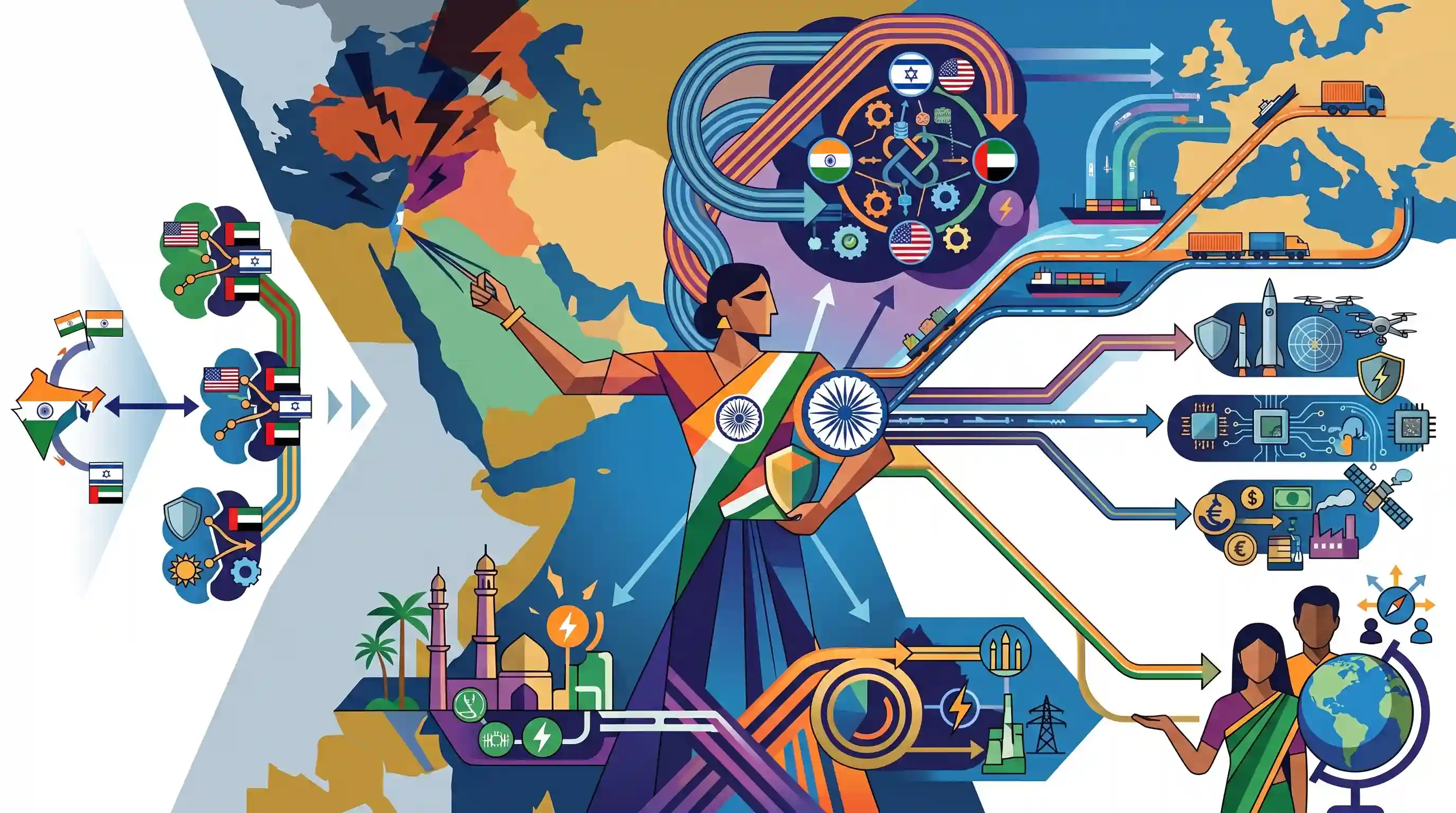
The article examines the strategic evolution of India-Israel relations in the context of Prime Minister Narendra Modi's 2026 visit to Israel, drawing a contrast with his landmark 2017 trip. While 2017 was defined by the symbolic 'de-hyphenation' of India's stance on Israel and Palestine, the 2026 visit occurs in a volatile, post-Gaza War geopolitical landscape. The relationship has matured 'beyond the hug' of personal camaraderie into a hard-nosed partnership centered on multilateral strategy. India is increasingly integrating its Middle Eastern diplomacy through frameworks like the I2U2 grouping and the India-Middle East-Europe Economic Corridor (IMEC). This high-stakes visit underscores India's nuanced balancing act: advancing critical defense, technology, and economic ties with Israel while simultaneously maintaining robust relations with Arab partners and retaining its leadership voice in the Global South.
Key Points
- PM Modi's 2026 visit to Israel shifts focus from the symbolic 'de-hyphenation' established during his historic 2017 visit to navigating complex strategic integration in a highly polarized West Asia.
- The geopolitical context has drastically changed, requiring India to balance its deepening Israeli ties with relationships across Arab nations following the post-2023 Gaza War fallout.
- Bilateral ties are moving 'beyond the hug' of personal chemistry toward hard geopolitical interests, including defense technology transfers, intelligence sharing, and counter-terrorism.
- The relationship now heavily features multilateral frameworks like I2U2 (India, Israel, UAE, USA) and IMEC, reflecting a shift toward collective economic corridors, energy security, and regional stabilization.
Important Terms
De-hyphenation

India's strategic policy shift to treat bilateral relations with Israel and Palestine as separate and independent, allowing robust engagement with both without letting one dictate the terms of the other.
UPSC context
GS Paper II (International Relations); tests India's strategic autonomy and evolving Middle East policy framework.
I2U2
A strategic partnership between India, Israel, the UAE, and the USA (the 'West Asian Quad') focusing on geoeconomic cooperation in water, energy, transportation, space, health, and food security.
UPSC context
GS Paper II (Bilateral/Regional Groupings); tests knowledge of minilateralism and India's role in West Asian security and economic architectures.
IMEC (India-Middle East-Europe Economic Corridor)
A multi-modal infrastructure project linking India to Europe via the Middle East through railways, ports, and digital links, designed to boost trade and provide an alternative to traditional routes.
UPSC context
GS Paper II & III (Connectivity/International Relations); tests understanding of strategic trade routes and competition with China's BRI.
Abraham Accords
A set of 2020 agreements mediated by the US to normalize diplomatic relations between Israel and several Arab nations, including the UAE, Bahrain, Sudan, and Morocco.
UPSC context
GS Paper II (International Relations); critical for analyzing regional realignment and its impact on India's West Asian diplomacy.
Global South
A collective term for developing and emerging nations in Africa, Asia, and Latin America, often used to emphasize shared economic challenges and a common voice in global governance.
UPSC context
GS Paper II (Global Groupings); tests India's leadership role and its efforts to balance interests between major powers and developing states.
West Asia Geopolitics
The strategic study of political, economic, and security dynamics in the Middle East, primarily influenced by energy security, regional rivalries, and the involvement of global powers.
UPSC context
GS Paper II (Effect of Policies on India's interests); tests ability to analyze regional stability, energy security, and diaspora welfare.
Prelims Trap
India's 'de-hyphenation' policy mandates equal and simultaneous diplomatic engagement with both Israel and Palestine.
De-hyphenation means India treats its relations with Israel and Palestine as independent and exclusive. It does not require equal or simultaneous engagement.
Static Concepts Connected
What are the foundational pillars of the I2U2 grouping?
- Members: India, Israel, UAE, and the USA. It was conceptualized during the meeting of their foreign ministers in 2021.
- Core Focus: Joint investments in six mutually identified areas: water, energy, transportation, space, health, and food security.
- Nature: It operates primarily as an economic and technological partnership, not a military or security alliance.
What is the geographical significance of Israel's borders?
- Land Borders: Bordered by Lebanon (north), Syria (northeast), Jordan (east), and Egypt (southwest). The West Bank and Gaza Strip are contiguous territories.
- Maritime Access: It has coastline on the Mediterranean Sea to the west (Haifa port) and the Red Sea (Gulf of Aqaba) to the south, critical for IMEC.
Cross-Topic Patterns
IMEC's vulnerability to regional conflicts
The Gaza War exposes IMEC's chokepoint reliance on a stable Levant, contrasting with China's BRI routes. This makes West Asian maritime security a critical economic imperative for India's European trade.
Defense JVs: From Buyer to Co-developer
India's ties with Israel mirror a broader shift in its defense strategy, moving from direct imports (early UAVs) to joint co-development and technology transfers (Barak-8 missiles).

Expect a Prelims question integrating I2U2's economic focus, IMEC's geographical port-routing (like Haifa), and Levant map entries.
Linked PYQs · 3
Linked PYQs · 3
- 2018MainsGS2
“India’s relations with Israel have, of late, acquired a depth and diversity, which cannot be rolled back.” Discuss.
- 2022MainsGS2
How will I2U2 (India, Israel, UAE and USA) grouping transform India's position in global politics?
- 2022PrelimsGS1
The term "Levant" often heard in the news roughly corresponds to which of the following regions?
