India-Israel Strategic Partnership and De-hyphenation Foreign Policy
Source:Indian Express ↗
Why It Matters
India's evolving relationship with Israel is a landmark study in pragmatic foreign policy, frequently tested in UPSC Mains (e.g., the direct 2018 question on the depth of India-Israel ties). Furthermore, the application of Israeli micro-irrigation and water conservation technologies directly intersects with GS3 topics on agricultural efficiency and resource management.
Summary
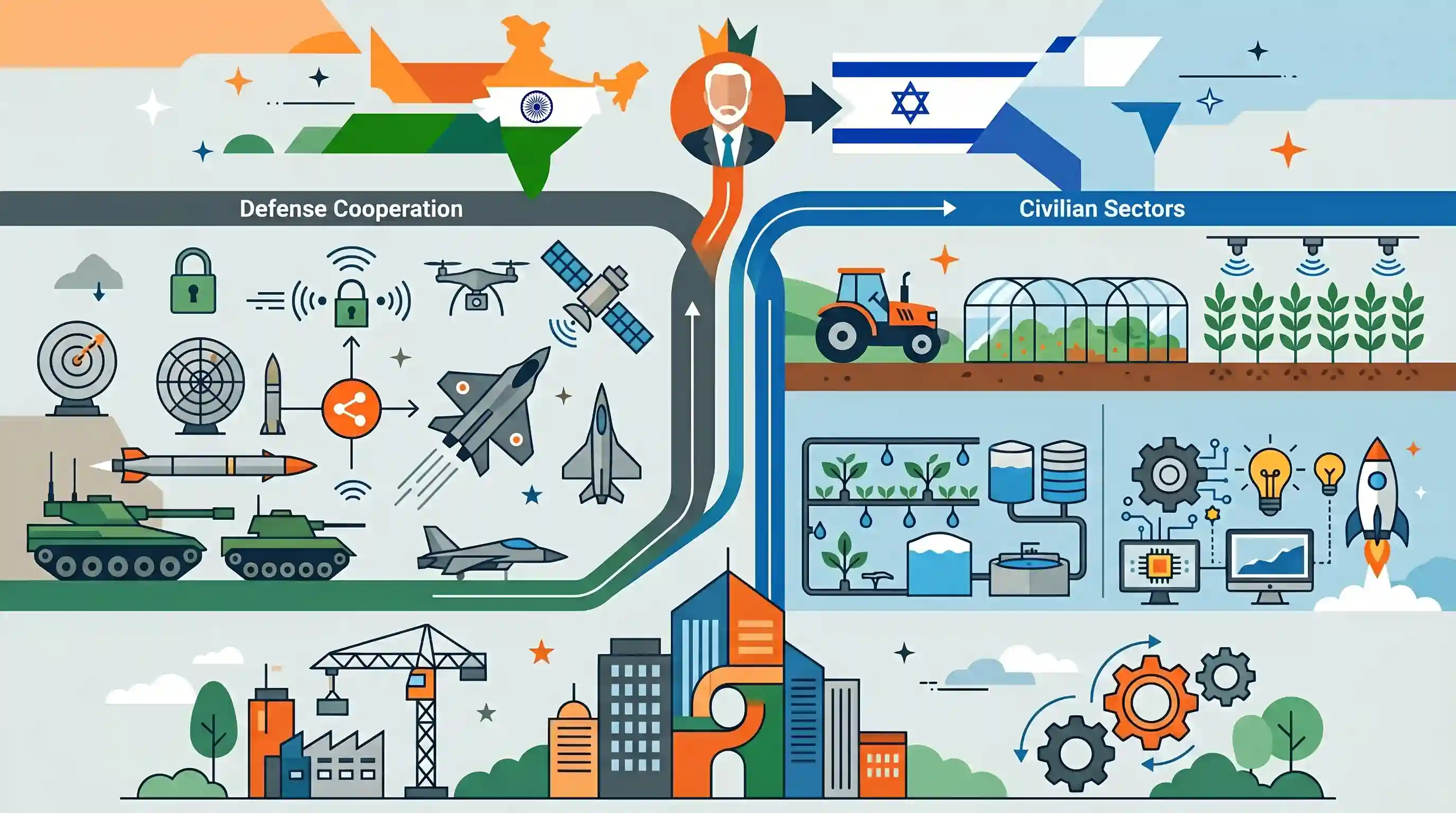
The article examines the evolution and strengthening of the India-Israel strategic partnership, portraying the two nations as ideal partners whose strengths perfectly complement each other. It highlights the pivotal role of Prime Minister Narendra Modi's diplomatic outreach, which underscored India's pragmatic 'de-hyphenation' policy, effectively decoupling ties with Israel from the Palestinian issue. The piece details the expanding scope of bilateral cooperation from traditional defense and intelligence sharing to critical civilian sectors like agriculture, water management (micro-irrigation), and technological innovation. Ultimately, it emphasizes that the relationship has transcended a transactional nature, acquiring deep structural and strategic dimensions driven by mutual national interests and developmental goals.
Key Points
- Prime Minister Narendra Modi's historic engagement with Israel elevated the bilateral relationship to a comprehensive strategic partnership based on mutual trust and geopolitical alignment.
- India's 'de-hyphenation' policy has been instrumental in allowing standalone, robust ties with Israel, independent of the Palestinian issue or relations with Arab nations.
- Defense and homeland security represent foundational pillars of the alliance, with Israel emerging as a crucial supplier of advanced military technology, border management solutions, and intelligence-sharing.
- Civilian cooperation is flourishing, particularly through the application of Israeli expertise in water management, desalination, and micro-irrigation to address India's agricultural challenges.
- The relationship is increasingly focused on future-oriented sectors, leveraging the robust innovation and startup ecosystems in both countries to drive economic and technological growth.
Important Terms
De-hyphenation Policy

A pragmatic foreign policy where India maintains independent, bilateral relations with conflicting parties (like Israel and Palestine) based on its own national interests, ensuring ties with one do not impede the other.
UPSC context
GS Paper II (International Relations). Tests understanding of India’s shift from ideological non-alignment to interest-driven strategic autonomy in West Asia.
India-Israel Strategic Partnership
A multi-dimensional bilateral relationship (upgraded in 2026) focusing on defense, cybersecurity, agriculture, and water management as core pillars of cooperation between India and Israel.
UPSC context
GS Paper II (Bilateral Agreements). Important for questions on defense indigenization, technology transfer, and India’s regional footprint.
I2U2 Grouping
A strategic partnership between India, Israel, the UAE, and the USA—often called the "West Asian Quad"—aimed at joint investments in water, energy, transportation, space, health, and food security.
UPSC context
GS Paper II (Regional Groupings). Tests understanding of new mini-lateral architectures and India’s geo-economic integration in West Asia.
Indo-Israel Agricultural Project (IIAP)
A bilateral partnership that establishes "Centers of Excellence" across Indian states to facilitate the transfer of Israeli farming technology and best practices to Indian farmers.
UPSC context
GS Paper III (Agriculture). Relevant for topics on doubling farmers' income and technology-driven agricultural transformation.
Micro-irrigation
High-efficiency water delivery systems (drip and sprinkler) where Israeli expertise helps India maximize crop yields and water-use efficiency in water-stressed regions.
UPSC context
GS Paper III (Water Management). Essential for questions on sustainable agriculture and climate-resilient farming under PM-Krishi Sinchayee Yojana.
MASHAV
Israel’s Agency for International Development Cooperation, which leads the technical implementation of the IIAP and oversees rural development and technology transfer in India.
UPSC context
GS Paper II/III (International Cooperation). Tests knowledge of institutional frameworks facilitating tech-transfer and soft power diplomacy.
Prelims Trap
"India's de-hyphenation policy implies a formal withdrawal of its diplomatic support for the Palestinian two-state solution."
De-hyphenation does not mean abandoning Palestine. It means India treats its relations with Israel and Palestine as mutually independent, pursuing standalone partnerships with both based on national interests.
Static Concepts Connected
What is the I2U2 grouping and its primary geoeconomic focus?
- Member Nations: Comprises India, Israel, United Arab Emirates (UAE), and the United States. It is often colloquially referred to as the 'West Asian Quad'.
- Geoeconomic Focus: Prioritizes joint investments and economic cooperation over military security, targeting specific sectors like water, energy, transport, space, health, and food security.
- Private Capital Mobilization: Aims to mobilize private sector capital and technological expertise to modernize infrastructure, lower carbon pathways, and improve public health globally.
What are the primary agricultural benefits of Micro-Irrigation systems?
- High Water Efficiency: Delivers water directly to the plant's root zone via drip or sprinkler networks, drastically reducing evaporation, deep percolation, and runoff losses.
- Effective Fertigation: Integrates soluble fertilizers with irrigation water, optimizing nutrient application, lowering input costs, and preventing harmful groundwater leaching.
- Salinity Management: Maintains optimal soil moisture levels without waterlogging, thereby preventing the buildup of salts in the root zone and managing soil salinity.
Cross-Topic Patterns
Defense JVs and Indigenization
The shift from buyer-seller to joint production (Barak-8 missiles, Heron drones) reflects India's broader 'Make in India' defense strategy, reducing foreign dependency while acquiring critical tech.
Agri-diplomacy and Soft Power
Israel's Centres of Excellence showcase how targeted technology transfers in micro-irrigation and desalination act as powerful diplomatic tools to secure ties with countries facing climate stress.

I2U2 combined with India's Middle East corridor (IMEC) and de-hyphenation policy forms a highly probable multi-statement IR question for 2026.
Linked PYQs · 3
Linked PYQs · 3
- 2018MainsGS2
“India’s relations with Israel have, of late, acquired a depth and diversity, which cannot be rolled back.” Discuss.
- 2016MainsGS3
What is water-use efficiency? Describe the role of micro-irrigation in increasing the water-use efficiency.
- 2024MainsGS3
What are the major challenges faced by Indian irrigation system in recent times? State the measures taken by the government for efficient irrigation management.
