Foreign Policy Debates on Strategic Alignment in West Asia
Source:The Hindu ↗
Why It Matters
The debate touches on core tenets of India's foreign policy—balancing strategic ties with Israel against historical relationships with Iran and the Arab world. It also directly tests aspirants' understanding of Article 51 of the Constitution (promotion of international peace) and the domestic political implications of foreign policy shifts in a multipolar world.
Summary
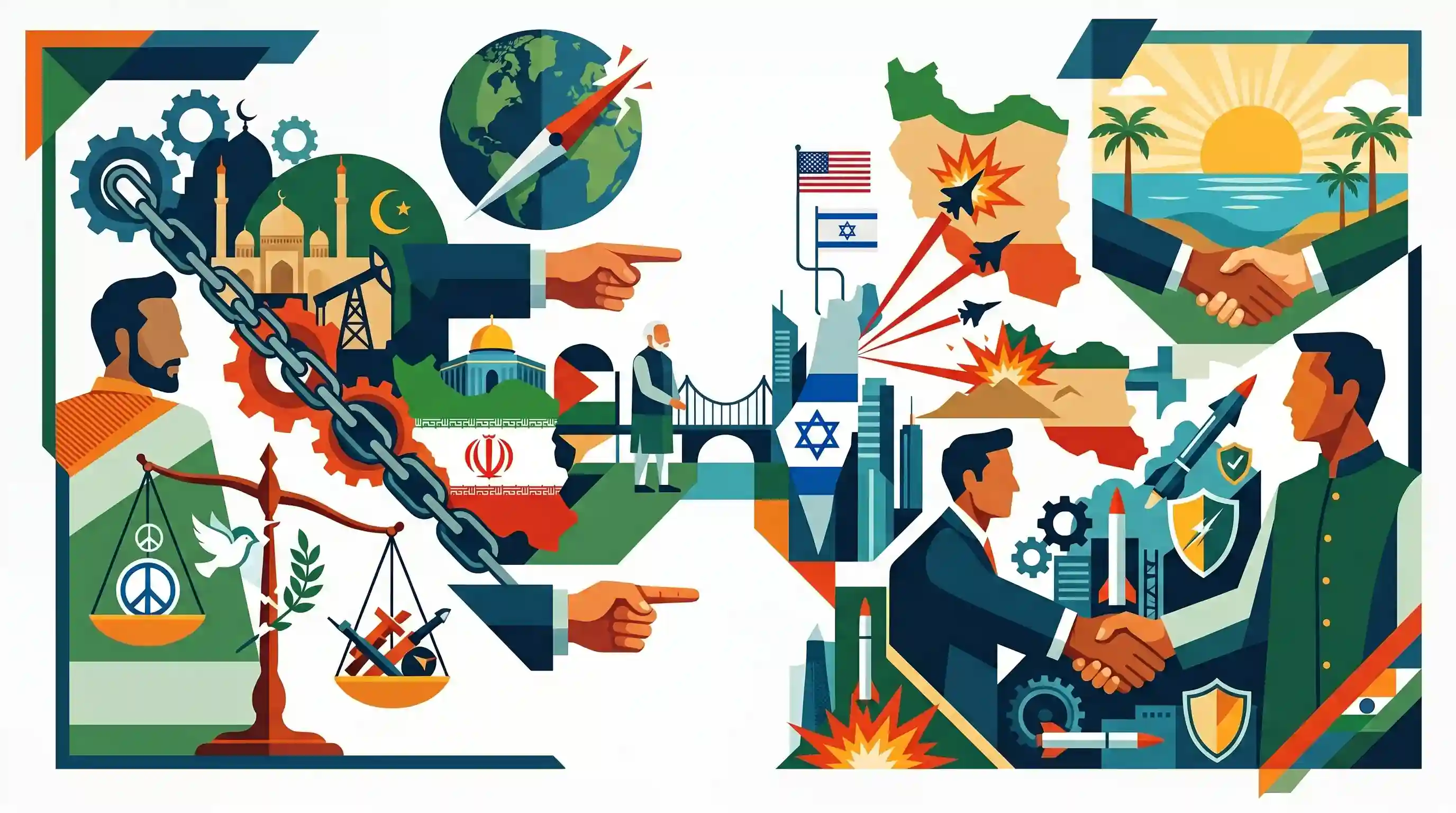
The Indian National Congress has strongly criticized Prime Minister Narendra Modi's recent visit to Israel, calling it poorly timed as it preceded joint US-Israeli military operations against Iran. The opposition claims the visit projects an implicit political endorsement of military escalation, which goes against India's traditional non-aligned stance, the UN Charter, and Article 51 of the Constitution regarding the promotion of international peace. Congress stressed the importance of India's historic ties with Iran and Palestine, warning against a skewed West Asia policy. In response, the government noted that its strategic partnership with Israel does not preclude its support for regional peace initiatives and stability in the Middle East.
Key Points
- The Congress party criticized PM Narendra Modi's visit to Israel as 'ill-timed', as it occurred just before major US-Israel combat operations against Iran.
- The opposition argued the visit creates a perception of political endorsement of military escalation, contradicting India's historic non-aligned foreign policy.
- Congress emphasized that endorsing military action violates Article 51 of the Indian Constitution and the UN Charter, which advocate for the peaceful settlement of disputes and international peace.
- The party reiterated the need to balance relations in West Asia, noting India's longstanding ties with Iran, Palestine, and the broader Arab world.
- PM Modi maintained that India stands with Israel against terrorism, but also supports the Gaza peace initiative, linking Middle Eastern stability directly to India's security interests.
Important Terms
Article 51 of the Indian Constitution

A Directive Principle of State Policy (DPSP) in Part IV of the Indian Constitution that mandates the State to promote international peace, maintain just relations, and respect international law.
UPSC context
GS Paper II (Polity/International Relations); tests constitutional mandates for foreign policy and India’s global peace commitments.
Non-Aligned Movement (NAM)
An international forum of 120 developing nations not formally aligned with any major power bloc, established in 1961 to advocate for sovereignty and peaceful coexistence.
UPSC context
GS Paper II (International Relations); focuses on India's historical foreign policy, strategic autonomy, and Global South leadership.
UN Charter
The founding treaty of the United Nations (1945), establishing the organization’s structure, principles, and legal mandate to maintain international peace and security.
UPSC context
GS Paper II (International Relations); tests knowledge of international law, collective security, and global governance frameworks.
United Nations (UN)
An intergovernmental organization founded in 1945 to maintain global peace, security, and develop friendly relations among nations based on sovereign equality.
UPSC context
GS Paper II (International Relations); tests India's role in multilateralism and its influence in international institutions.
Indian National Congress (INC)
India's oldest political party, founded in 1885, which led the independence movement and shaped early foreign policy principles like non-alignment and anti-colonialism.
UPSC context
GS Paper I & II; tests political history and the evolution of national foreign policy discourse.
Prelims Trap
Article 51 explicitly mandates India to follow the policy of Non-Alignment in its foreign affairs.
Article 51 directs the State to promote international peace, security, and arbitration, but it never mentions 'Non-Alignment'. NAM is a geopolitical doctrine, not a constitutional directive.
Static Concepts Connected
What are the four specific directives under Article 51 (DPSP)?
- International peace: Promote international peace and security.
- Honourable relations: Maintain just and honourable relations between nations.
- Treaty obligations: Foster respect for international law and treaty obligations in dealings of organized peoples.
- Arbitration: Encourage settlement of international disputes by arbitration.
What is India's 'De-hyphenation Policy' in West Asia?
- Independent ties: Treating bilateral relations with Israel and Palestine as separate, mutually independent tracks rather than a zero-sum game.
- Strategic autonomy: Allows India to pursue deep defense and tech cooperation with Israel without compromising its traditional support for the Palestinian two-state solution.
Cross-Topic Patterns
DPSP shaping Foreign Policy
Article 51 is the Constitution's sole anchor for foreign policy, linking domestic governance principles (DPSP) directly to India's geopolitical posture and its historical commitment to the UN Charter.
Iran vs Israel Geoeconomic Balancing
India must balance its Chabahar Port investment (gateway to Central Asia via Iran) against the I2U2 minilateral (India, Israel, UAE, US) and the India-Middle East-Europe Economic Corridor (IMEC).

Expect a 2026 prelims question testing the exact constitutional wording of Article 51 against India's strategic autonomy in West Asia.
Linked PYQs · 3
Linked PYQs · 3
- 2018MainsGS2
“India’s relations with Israel have, of late, acquired a depth and diversity, which cannot be rolled back.” Discuss.
- 2002PrelimsGS1
Which one of the following Articles of the Directive Principles of State Policy deals with the promotion of international peace and security?
- 2014PrelimsGS1
In the Constitution of India, promotion of international peace and security is included in the
