Digital Public Infrastructure and E-Governance Growth
Source:The Hindu ↗
Why It Matters
Provides official perspective on the progress of India's e-governance and digital public infrastructure (DPI) initiatives. Relevant for analyzing the successes, limitations, and future potential of digitalization in governance, economy, and essential sectors like healthcare and education.
Summary
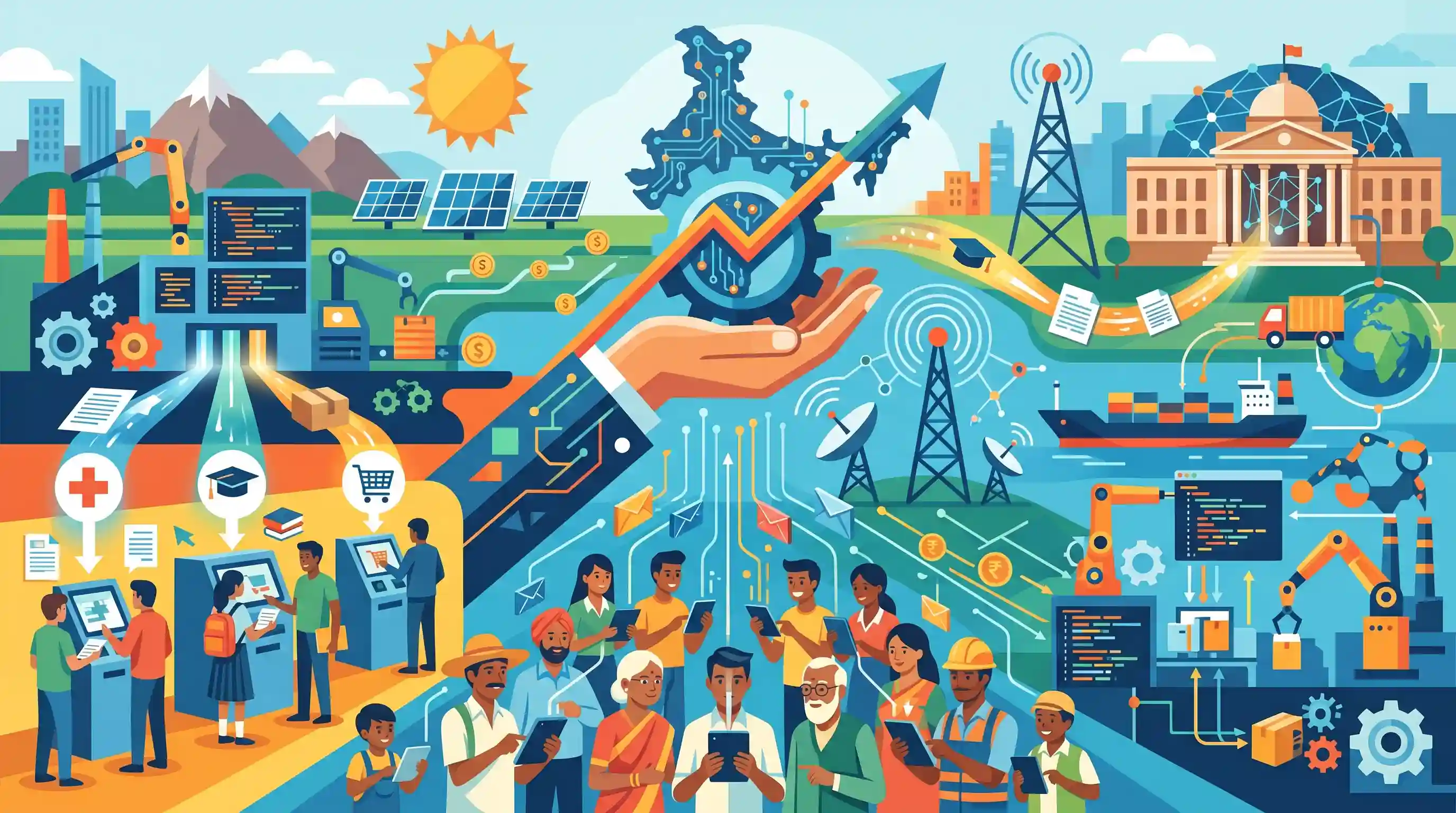
Union Home Minister Amit Shah highlighted the achievements of the Narendra Modi-led government over the past 11 years, emphasizing the democratization of technology. The administration claims that its digital revolution has successfully harnessed technological power for the business sector and transformed everyday sectors like healthcare, education, trade, and commerce. This widespread digital integration has been instrumental in positioning India as a prominent global digital economy under the overarching 'Digital India' initiative.
Key Points
- Union Home Minister Amit Shah stated that the government has successfully democratised the use of technology over its 11-year tenure.
- The digital revolution has transformed crucial sectors such as healthcare, education, trade, and commerce.
- Widespread technological adoption has helped establish India as a leading digital economy globally.
- The approach reflects a shift towards using digital public infrastructure to boost the business sector and improve citizen-centric governance.
Important Terms
Digital India Initiative

A flagship program launched in 2015 to transform India into a digitally empowered society and knowledge economy through enhanced infrastructure, digital literacy, and online service delivery.
UPSC context
GS Paper 2 (Governance) and Paper 3 (S&T); essential for discussing digital inclusion and administrative reforms.
E-Governance
The application of Information and Communication Technology (ICT) to simplify, moralise, and make government processes accountable, responsive, and transparent (SMART governance).
UPSC context
GS Paper 2; central to the topic 'Important aspects of governance, transparency and accountability'.
Democratisation of Technology
The process of making advanced technological tools, such as AI and high-speed internet, accessible and affordable to the general population to reduce social inequalities.
UPSC context
GS Paper 3 (S&T) and GS Paper 2 (Social Justice); involves bridging the digital divide for inclusive growth.
Digital Public Infrastructure (DPI)
Open, interoperable digital blocks (like Aadhaar, UPI, and DigiLocker) that enable governments and businesses to provide essential services at scale.
UPSC context
GS Paper 3 (Economy/Infrastructure); India's global leadership in DPI is a frequent essay and mains topic.
Digital Economy
Economic activity resulting from billions of everyday online connections among people, businesses, devices, and data; India aims for a $1 trillion digital economy.
UPSC context
GS Paper 3 (Indian Economy); focuses on growth drivers, employment, and structural economic transformation.
Public Service Delivery
The management and provision of essential utilities and social benefits (e.g., healthcare, education, subsidies) to citizens via digital platforms like UMANG and DBT.
UPSC context
GS Paper 2; relates to 'Issues relating to development and management of Social Sector/Services'.
Prelims Trap
ONDC is a centralized government-owned e-commerce application designed to compete directly with private retail giants.
ONDC is an open-source protocol or network, not a unified application or platform. It enables interoperability across existing buyer and seller platforms rather than acting as a standalone marketplace.
Static Concepts Connected
What are the three foundational layers of India's Digital Public Infrastructure (India Stack)?
- Identity Layer: Anchored by Aadhaar and eKYC, this layer provides a universal, verifiable digital identity to residents, establishing trust for public and private service delivery.
- Payments Layer: Powered by UPI and the Aadhaar Enabled Payment System (AePS), it ensures interoperable, high-volume, and low-cost digital financial transactions.
- Data Empowerment Layer: Utilizing Account Aggregators and DigiLocker, it allows citizens to securely store and share their data across institutions through a strict, consent-based framework.
How does the Direct Benefit Transfer (DBT) system bypass intermediaries to minimize leakages?
- JAM Trinity: It links bank accounts, Aadhaar, and mobile numbers to uniquely identify citizens, effectively eliminating ghost or duplicate beneficiaries from welfare rolls.
- Aadhaar Payment Bridge: Subsidies are routed through the NPCI's APB directly into an Aadhaar-seeded bank account, completely bypassing physical cash-handling layers and bureaucratic middlemen.
Cross-Topic Patterns
India Stack as Soft Power
India's push to export its Digital Public Infrastructure (like UPI and MOSIP) to the Global South is a major foreign policy tool, heavily highlighted during its G20 presidency.
E-governance & Financial Inclusion
The intersection of DBT, Jan Dhan accounts, and mobile connectivity (JAM Trinity) frequently appears alongside topics covering rural poverty alleviation and women's financial empowerment.

A 2026 Prelims multi-statement question contrasting ONDC's open-network protocol with traditional platform-centric e-commerce is highly likely.
Linked PYQs · 4
Linked PYQs · 4
- 2024MainsGS2
e-governance is not just about the routine application of digital technology in service delivery process. It is as much about multifarious interactions for ensuring transparency and accountability. In this context evaluate the role of the 'Interactive Service Model' of e-governance.
- 2025MainsGS2
e-governance projects have a built-in bias towards technology and back-end integration than user-centric designs. Examine.
- 2023MainsGS2
e-governance, as a critical tool of governance, has ushered in effectiveness, transparency and accountability in governments. What inadequacies hamper the enhancement of these features ?
- 2023MainsGS3
What is the status of digitalization in the Indian economy? Examine the problems faced in this regard and suggest improvements.
