Economic inequality and wealth concentration trends in India
Source:The Hindu ↗
Why It Matters
This article directly ties contemporary political criticism to core UPSC syllabus themes, specifically the constitutional mandate against the concentration of wealth (Article 39(c) of DPSP) and the economic challenge of ensuring inclusive growth. It provides context for evaluating government policies regarding MSMEs, inflation management, and social sector spending in addressing structural inequality.
Summary
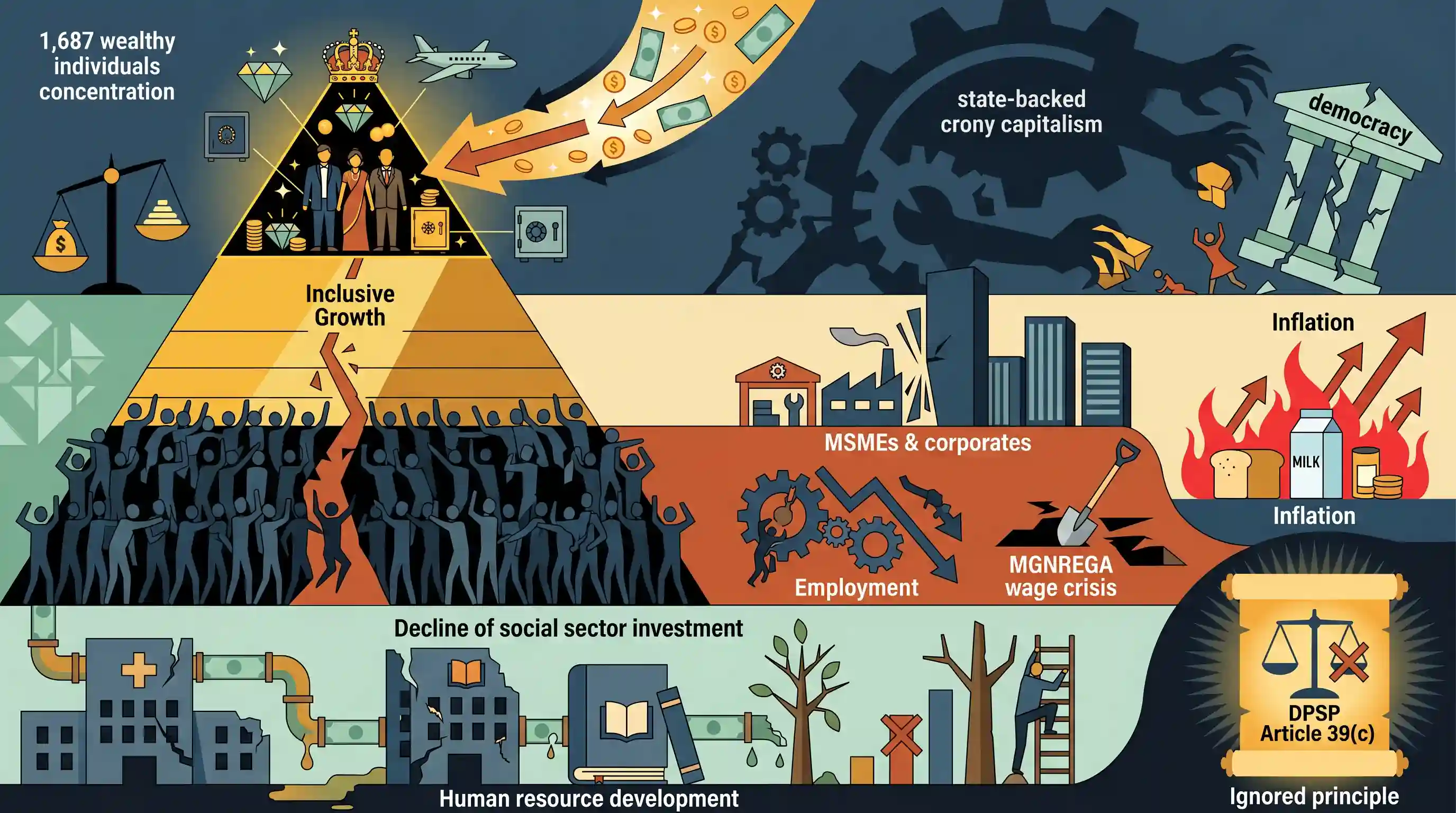
Citing the M3M Hurun India Rich List 2025, Congress leader Jairam Ramesh accused the Union government of fostering severe economic inequality, noting that a mere 1,687 individuals control half the nation's wealth. He termed this trend an attack on the 'soul of democracy', attributing it to state-backed crony capitalism. The criticism encompasses the resulting macroeconomic distress, highlighting pressure on the MSME sector, stagnant wages (including MGNREGA wage crises), persistent inflation, and dwindling real public investments in essential sectors like health and education. These issues underscore the ongoing debate surrounding inclusive growth and the constitutional mandate (Article 39(c)) against the concentration of wealth.
Key Points
- The Congress party criticized the Union government, citing the M3M Hurun India Rich List 2025 to highlight growing wealth concentration, with just 1,687 individuals holding half of India's wealth.
- Congress leader Jairam Ramesh termed this extreme inequality an attack on democratic institutions, attributing it to state-sponsored 'crony capitalism'.
- The criticism emphasized resultant economic pressures, including a struggling MSME sector, shrinking earning opportunities, persistent inflation, and wage crises linked to schemes like MGNREGA.
- Ramesh also highlighted structural deficits in human capital development, pointing to declining real public investment in health and education sectors.
Important Terms
Article 39(c)

A Directive Principle of State Policy (DPSP) mandating that the economic system's operation should not result in the concentration of wealth and means of production to the common detriment.
UPSC context
GS Paper II (Polity) and GS III (Economy); tests understanding of constitutional mandates for social and economic justice.
Inclusive Growth
Economic growth that is distributed fairly across society, creating opportunities for all sections, particularly marginalized groups, while ensuring equitable participation and benefit from the growth process.
UPSC context
GS Paper III (Economy); a core syllabus topic regarding development and issues arising from economic growth.
MSME
Enterprises classified by investment and turnover: Micro (<=₹1cr/₹5cr), Small (<=₹10cr/₹50cr), and Medium (<=₹50cr/₹250cr). They are considered the 'backbone' of the Indian economy for employment and exports.
UPSC context
GS Paper III (Economy); essential for understanding industrial policy, employment generation, and the manufacturing sector.
MGNREGA
A demand-driven social security law providing at least 100 days of guaranteed wage employment per financial year to rural households whose adult members volunteer for unskilled manual work.
UPSC context
GS Paper II (Social Justice) and GS III (Economy); critical for rural development and poverty alleviation topics.
Crony Capitalism
An economic system where business success depends on close relationships between business leaders and government officials, characterized by favoritism, subsidies, and privileged access to state resources.
UPSC context
GS Paper IV (Ethics) and GS III (Economy); relates to corruption, corporate governance, and market distortions.
Concentration of Wealth
The accumulation of a large portion of a nation's total assets or resources in the hands of a small group of individuals or entities, often criticized for undermining economic equity.
UPSC context
GS Paper III (Economy) and GS II (Polity); central to debates on inequality and DPSP implementation.
Prelims Trap
Laws enacted to prevent wealth concentration under Article 39(c) automatically override all Fundamental Rights.
Article 31C protects such laws only from Articles 14 and 19, not all Fundamental Rights. Furthermore, they remain subject to judicial review regarding their actual nexus to the DPSP.
Static Concepts Connected
How do DPSP Articles 39(b) and 39(c) interact with Fundamental Rights?
- Article 31C Shield: Inserted by the 25th Amendment, it protects laws giving effect to Article 39(b) and (c) from being voided for violating Articles 14 (equality) and 19 (freedoms).
- Judicial Review: These laws are not immune to judicial scrutiny; courts can examine if the law genuinely advances the stated DPSP goals (established in the Minerva Mills case).
- Private Property Limit: A recent 9-judge SC bench ruled that not all private property automatically qualifies as 'material resources of the community' for arbitrary state redistribution under 39(b).
What are the standard macroeconomic tools used to measure wealth and income inequality?
- Lorenz Curve: A graphical curve mapping the cumulative percentage of the population against the cumulative percentage of income/wealth to visually depict distribution inequality.
- Gini Coefficient: A mathematical ratio derived from the Lorenz curve; a value of 0 denotes perfect equality, while 1 (or 100%) denotes absolute concentration of wealth.
- Palma Ratio: An alternative metric that measures the ratio of the richest 10% of the population's share of national income divided by the poorest 40%'s share.
Cross-Topic Patterns
K-shaped recovery + MSME distress
Surging billionaire wealth paired with shrinking MSME share and stagnant MGNREGA wages highlights a K-shaped economic trajectory, a recurring GS3 Inclusive Growth theme.
DPSP mandate + Judicial Interpretation
Political accusations of 'crony capitalism' frequently invoke DPSP 39(c), bridging GS3 macroeconomic realities with GS2 constitutional jurisprudence on property and redistribution.

Expect a GS3 Mains question connecting extreme wealth concentration (Gini/Hurun data) with MSME stagnation and India's K-shaped recovery.
Linked PYQs · 4
Linked PYQs · 4
- 2021PrelimsGS1
Under the Indian Constitution, concentration of wealth violates
- 2022MainsGS3
Is inclusive growth possible under market economy ? State the significance of financial inclusion in achieving economic growth in India.
- 2023MainsGS3
Faster economic growth requires increased share of the manufacturing sector in GDP, particularly of MSMEs. Comment on the present policies of the Government in this regard.
- 2020MainsGS3
Explain intra-generational and inter-generational issues of equity from the perspective of inclusive growth and sustainable development.
