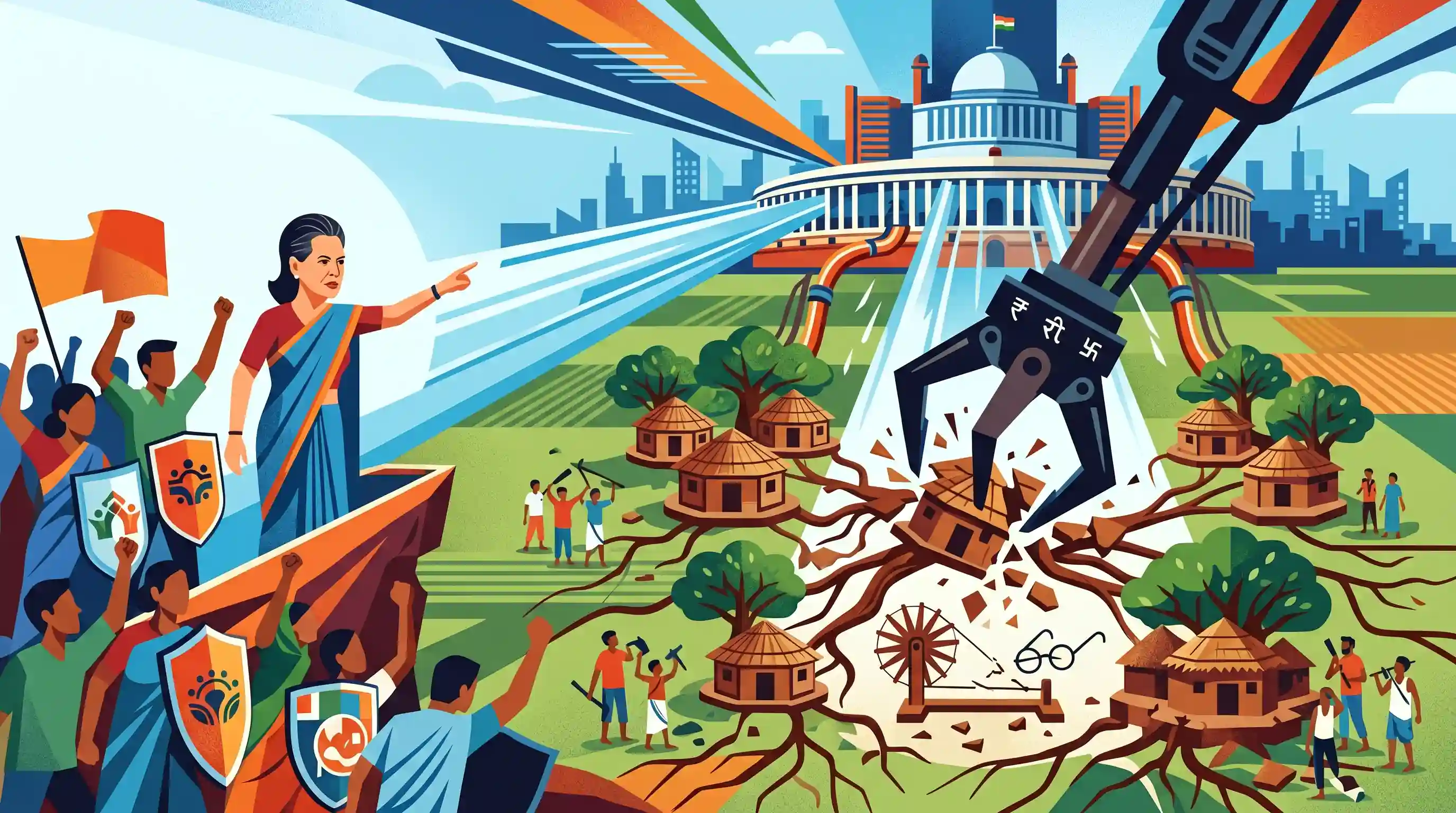
राजनीतिक विरोध के बीच नए ग्रामीण रोजगार विधेयक ने MGNREGA की जगह ली
स्रोत:द हिंदू ↗
क्यों मायने रखता है
भारत की प्रमुख ग्रामीण रोजगार गारंटी योजना—MGNREGA—को VB-G RAM G विधेयक से बदला जाना एक बड़े नीतिगत बदलाव का संकेत है। UPSC उम्मीदवारों के लिए, यह GS-2 में 'विकेंद्रीकरण बनाम केंद्रीकरण' (ग्राम पंचायतों बनाम केंद्र की भूमिका) और गरीबी उन्मूलन तथा ग्रामीण संकट को दूर करने के उद्देश्य से बनाए गए सामाजिक सुरक्षा तंत्र (social security nets) के विकास से जुड़ी महत्वपूर्ण बहसों को रेखांकित करता है।
सारांश
Congress leader Sonia Gandhi launched a scathing attack on the Modi government over the passage of the Viksit Bharat Guarantee for Rozgar and Ajeevika Mission (Gramin) (VB-G RAM G) Bill, which effectively replaces the Mahatma Gandhi National Rural Employment Guarantee Act (MGNREGA). Calling it a 'black law,' she argued that the new legislation dismantles the concept of 'Gram Swaraj' by transferring the power to allocate employment from local Gram Panchayats to the Central Government in Delhi. Gandhi accused the government of deliberately erasing Mahatma Gandhi's legacy and neglecting the fundamental needs of the rural poor and unemployed, pledging sustained political resistance against the move.
मुख्य बिंदु
- Sonia Gandhi criticised the Union government for replacing MGNREGA with the new Viksit Bharat Guarantee for Rozgar and Ajeevika Mission (Gramin) (VB-G RAM G) Bill, labeling it a 'black law.'
- The main critique is that the new bill centralizes power, shifting decision-making regarding rural employment from Gram Panchayats (undermining 'Gram Swaraj') to the Central Government in Delhi.
- Gandhi highlighted that the new legislation removes Mahatma Gandhi's name from the employment guarantee scheme and allegedly ignores the welfare of the rural poor and unemployed.
- उन्होंने संकल्प लिया कि उनकी पार्टी इस कानून के खिलाफ विरोध जारी रखेगी और हाशिए पर रहने वाली ग्रामीण आबादी के अधिकारों की वकालत करेगी।
महत्वपूर्ण शब्द
महात्मा गांधी राष्ट्रीय ग्रामीण रोजगार गारंटी अधिनियम (MGNREGA)

एक अधिकार-आधारित सामाजिक सुरक्षा कानून (2005) जो आजीविका सुरक्षा बढ़ाने और सामुदायिक संपत्तियों के निर्माण के लिए ग्रामीण परिवारों को प्रति वर्ष 100 दिनों के अकुशल शारीरिक कार्य की गारंटी देता है।
UPSC context
GS Paper 2 (Welfare Schemes) & GS 3 (Employment). Tests the evolution of rights-based demand-driven safety nets.
Viksit Bharat Guarantee for Rozgar and Ajeevika Mission (Gramin) (VB-G RAM G) Act
A 2025 legislation replacing MGNREGA; it increases work guarantees to 125 days but adopts a 60:40 Centre-State funding model with centralized budget caps.
UPSC context
GS Paper 2 (Governance/Federalism). Critical for analyzing shifts in fiscal federalism and rights-based vs. mission-mode governance.
ग्राम स्वराज
ग्राम स्वराज्य का एक गांधीवादी दृष्टिकोण जहाँ प्रत्येक गाँव एक आत्मनिर्भर गणराज्य है, जो विकेंद्रीकृत शासन के माध्यम से अपने मामलों का स्वयं प्रबंधन करता है।
UPSC context
GS Paper 2 (Panchayati Raj). Tests knowledge of Gandhian philosophy and the struggle for democratic decentralization.
ग्राम पंचायतें
भारत की त्रि-स्तरीय स्थानीय शासन प्रणाली की आधारशिला, जिसे ग्राम-स्तर पर आर्थिक विकास और सामाजिक न्याय की योजना बनाने और उन्हें कार्यान्वित करने के लिए 73वें संशोधन द्वारा सशक्त बनाया गया है।
UPSC context
GS Paper 2 (PRI). Focuses on administrative devolution and the challenges of grassroots implementation.
Devolution of Powers
सरकार के उच्च स्तरों से स्थानीय निकायों को प्रशासनिक और वित्तीय अधिकारों (Funds, Functions, Functionaries) का वैधानिक हस्तांतरण।
UPSC context
GS Paper 2 (Devolution). Tests the impact of centralization on the autonomy of Panchayati Raj Institutions.
प्रारंभिक ट्रैप
नया VB-G RAM G अधिनियम मांग-आधारित आधार पर सार्वभौमिक रूप से 125 दिनों के रोजगार की गारंटी देता है।
False. While the limit increased to 125 days, the scheme shifted from a universal, demand-driven statutory right to a budget-capped, supply-driven framework restricted to specific centrally notified areas.
संबंधित अवधारणाएँ
How does Article 40 interact with the 73rd Amendment regarding village empowerment?
- Article 40: A DPSP directing the State to organize village panchayats and endow them with powers to function as units of self-government, reflecting Gandhian 'Gram Swaraj'.
- 11वीं अनुसूची: Added by the 73rd Amendment, it enumerates 29 subjects (including poverty alleviation and rural employment) over which Panchayats should have devolved administrative control.
- ग्राम पंचायत का अधिदेश: Under the original MGNREGA, Gram Panchayats held a statutory mandate to plan and execute at least 50% of rural works, actively operationalizing this decentralization.
अधिकार-आधारित कल्याणकारी मॉडल को आपूर्ति-संचालित मॉडल से क्या अलग करता है?
- Rights-Based Model: कानूनी रूप से नागरिकों को मांग करने पर लाभ का अधिकार देता है। इसे प्रदान करने में विफल रहने पर अनिवार्य मुआवजे का प्रावधान है, जैसे MGNREGA का बेरोजगारी भत्ता।
- Supply-Driven Model: लाभ पूर्व-निर्धारित बजट सीमाओं द्वारा सीमित हैं और राज्य द्वारा भौगोलिक या जनसांख्यिकीय रूप से लक्षित हैं, जिनमें कोई सार्वभौमिक कानूनी पात्रता (जैसे, VB-G RAM G) नहीं है।
अंतर-विषय पैटर्न
Fiscal Federalism vs. Centralization
Stripping Gram Panchayats of employment allocation powers mirrors broader concerns about the centralization of funds, functions, and functionaries in Centrally Sponsored Schemes (CSS).
Statutory Enforceability of DPSPs
Repealing a rights-based framework (fulfilling Article 41's Right to Work) for a budget-capped model highlights the non-justiciable and reversible nature of legislative welfare guarantees.

Expect a 2026 Prelims question contrasting MGNREGA's demand-driven universality with VB-G RAM G's budget-capped, targeted 125-day model.
संबद्ध PYQ · 4
संबद्ध PYQ · 4
- 2024MainsGS2
Analyse the role of local bodies in providing good governance at local level and bring out the pros and cons merging the rural local bodies with the urban local bodies.
- 2022MainsGS2
To what extent, in your opinion, has the decentralisation of power in India changed the governance landscape at the grassroots?
- 2023MainsGS3
Most of the unemployment in India is structural in nature. Examine the methodology adopted to compute unemployment in the country and suggest improvements.
- 2019MainsGS2
There is a growing divergence in the relationship between poverty and hunger in India. The shrinking of social expenditure by the government is forcing the poor to spend more on non-food essential items squeezing their food-budget. - Elucidate.
