New Rural Employment Bill Replaces MGNREGA Amid Political Opposition
Source:The Hindu ↗
Why It Matters
The replacement of MGNREGA—India's flagship rural employment guarantee scheme—with the VB-G RAM G Bill marks a major policy shift. For UPSC aspirants, this highlights critical debates in GS-2 around 'decentralization vs. centralization' (the role of Gram Panchayats vs. the Centre) and the evolution of social security nets aimed at poverty alleviation and rural distress.
Summary
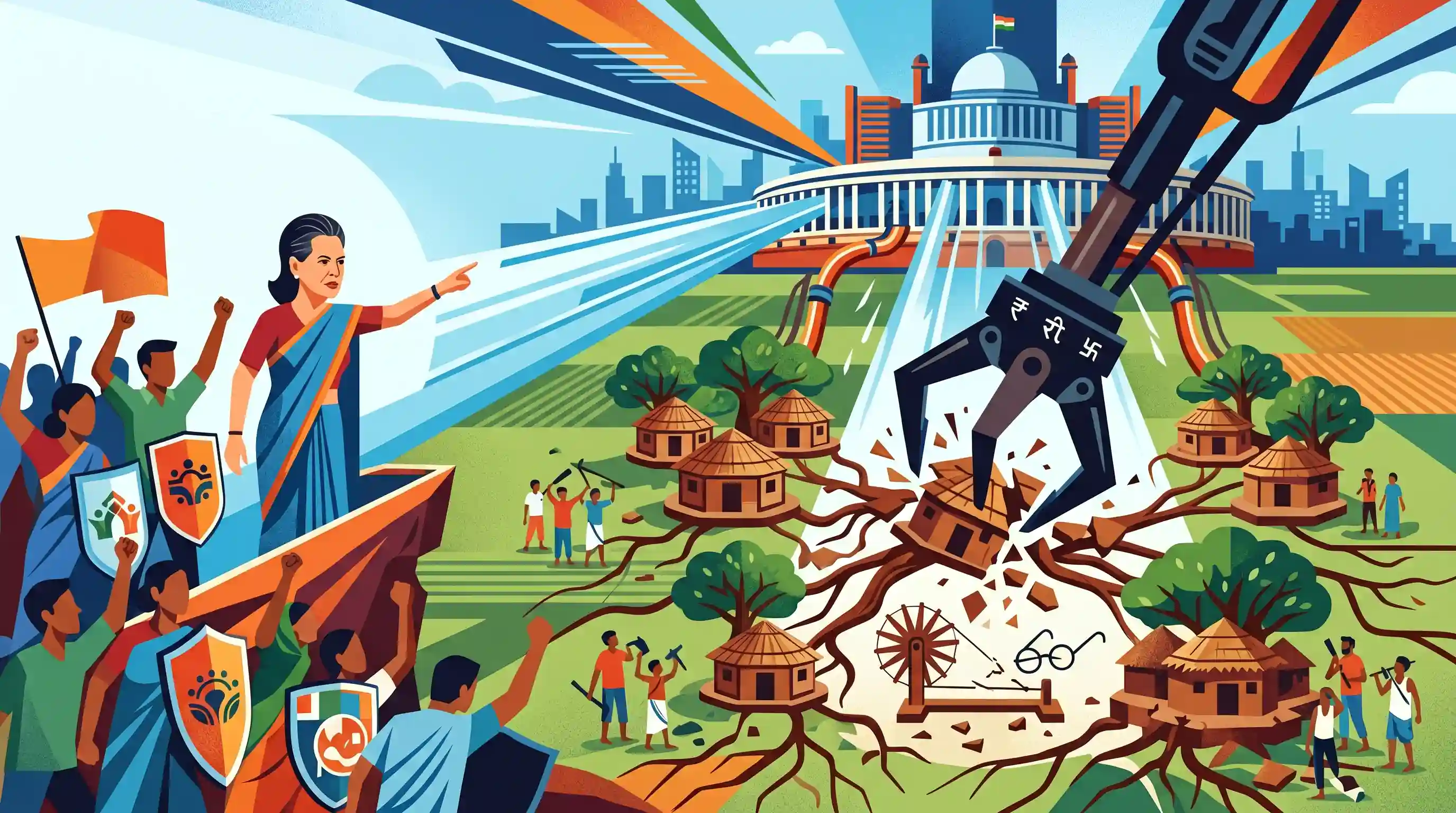
Congress leader Sonia Gandhi launched a scathing attack on the Modi government over the passage of the Viksit Bharat Guarantee for Rozgar and Ajeevika Mission (Gramin) (VB-G RAM G) Bill, which effectively replaces the Mahatma Gandhi National Rural Employment Guarantee Act (MGNREGA). Calling it a 'black law,' she argued that the new legislation dismantles the concept of 'Gram Swaraj' by transferring the power to allocate employment from local Gram Panchayats to the Central Government in Delhi. Gandhi accused the government of deliberately erasing Mahatma Gandhi's legacy and neglecting the fundamental needs of the rural poor and unemployed, pledging sustained political resistance against the move.
Key Points
- Sonia Gandhi criticised the Union government for replacing MGNREGA with the new Viksit Bharat Guarantee for Rozgar and Ajeevika Mission (Gramin) (VB-G RAM G) Bill, labeling it a 'black law.'
- The main critique is that the new bill centralizes power, shifting decision-making regarding rural employment from Gram Panchayats (undermining 'Gram Swaraj') to the Central Government in Delhi.
- Gandhi highlighted that the new legislation removes Mahatma Gandhi's name from the employment guarantee scheme and allegedly ignores the welfare of the rural poor and unemployed.
- She vowed that her party will continue to protest against the law and advocate for the rights of marginalized rural populations.
Important Terms
Mahatma Gandhi National Rural Employment Guarantee Act (MGNREGA)

A rights-based social security law (2005) guaranteeing 100 days of unskilled manual work annually to rural households to enhance livelihood security and create community assets.
UPSC context
GS Paper 2 (Welfare Schemes) & GS 3 (Employment). Tests the evolution of rights-based demand-driven safety nets.
Viksit Bharat Guarantee for Rozgar and Ajeevika Mission (Gramin) (VB-G RAM G) Act
A 2025 legislation replacing MGNREGA; it increases work guarantees to 125 days but adopts a 60:40 Centre-State funding model with centralized budget caps.
UPSC context
GS Paper 2 (Governance/Federalism). Critical for analyzing shifts in fiscal federalism and rights-based vs. mission-mode governance.
Gram Swaraj
A Gandhian vision of village self-rule where every village is a self-reliant republic, managing its own affairs through decentralized governance.
UPSC context
GS Paper 2 (Panchayati Raj). Tests knowledge of Gandhian philosophy and the struggle for democratic decentralization.
Gram Panchayats
The foundation of India's three-tier local governance system, empowered by the 73rd Amendment to plan and implement village-level economic development and social justice.
UPSC context
GS Paper 2 (PRI). Focuses on administrative devolution and the challenges of grassroots implementation.
Devolution of Powers
The statutory transfer of administrative and financial authority (Funds, Functions, Functionaries) from higher government levels to local bodies.
UPSC context
GS Paper 2 (Devolution). Tests the impact of centralization on the autonomy of Panchayati Raj Institutions.
Prelims Trap
The new VB-G RAM G Act guarantees 125 days of employment universally on a demand-driven basis.
False. While the limit increased to 125 days, the scheme shifted from a universal, demand-driven statutory right to a budget-capped, supply-driven framework restricted to specific centrally notified areas.
Static Concepts Connected
How does Article 40 interact with the 73rd Amendment regarding village empowerment?
- Article 40: A DPSP directing the State to organize village panchayats and endow them with powers to function as units of self-government, reflecting Gandhian 'Gram Swaraj'.
- 11th Schedule: Added by the 73rd Amendment, it enumerates 29 subjects (including poverty alleviation and rural employment) over which Panchayats should have devolved administrative control.
- Gram Panchayat Mandate: Under the original MGNREGA, Gram Panchayats held a statutory mandate to plan and execute at least 50% of rural works, actively operationalizing this decentralization.
What differentiates a rights-based welfare model from a supply-driven one?
- Rights-Based Model: Legally entitles citizens to a benefit upon demand. Failure to provide it triggers mandatory compensation, like MGNREGA's unemployment allowance.
- Supply-Driven Model: Benefits are constrained by predetermined budget ceilings and are targeted geographically or demographically by the state, with no universal legal entitlement (e.g., VB-G RAM G).
Cross-Topic Patterns
Fiscal Federalism vs. Centralization
Stripping Gram Panchayats of employment allocation powers mirrors broader concerns about the centralization of funds, functions, and functionaries in Centrally Sponsored Schemes (CSS).
Statutory Enforceability of DPSPs
Repealing a rights-based framework (fulfilling Article 41's Right to Work) for a budget-capped model highlights the non-justiciable and reversible nature of legislative welfare guarantees.

Expect a 2026 Prelims question contrasting MGNREGA's demand-driven universality with VB-G RAM G's budget-capped, targeted 125-day model.
Linked PYQs · 4
Linked PYQs · 4
- 2024MainsGS2
Analyse the role of local bodies in providing good governance at local level and bring out the pros and cons merging the rural local bodies with the urban local bodies.
- 2022MainsGS2
To what extent, in your opinion, has the decentralisation of power in India changed the governance landscape at the grassroots?
- 2023MainsGS3
Most of the unemployment in India is structural in nature. Examine the methodology adopted to compute unemployment in the country and suggest improvements.
- 2019MainsGS2
There is a growing divergence in the relationship between poverty and hunger in India. The shrinking of social expenditure by the government is forcing the poor to spend more on non-food essential items squeezing their food-budget. - Elucidate.
