India Diplomatic Outreach in Africa and Counter Terror Resolve
Source:The Hindu ↗
Why It Matters
This article touches on both internal security (cross-border terrorism) and international relations, showcasing international pressure for de-escalation using historical frameworks like the Simla Agreement, alongside India's ongoing diplomatic outreach in Africa.
Summary
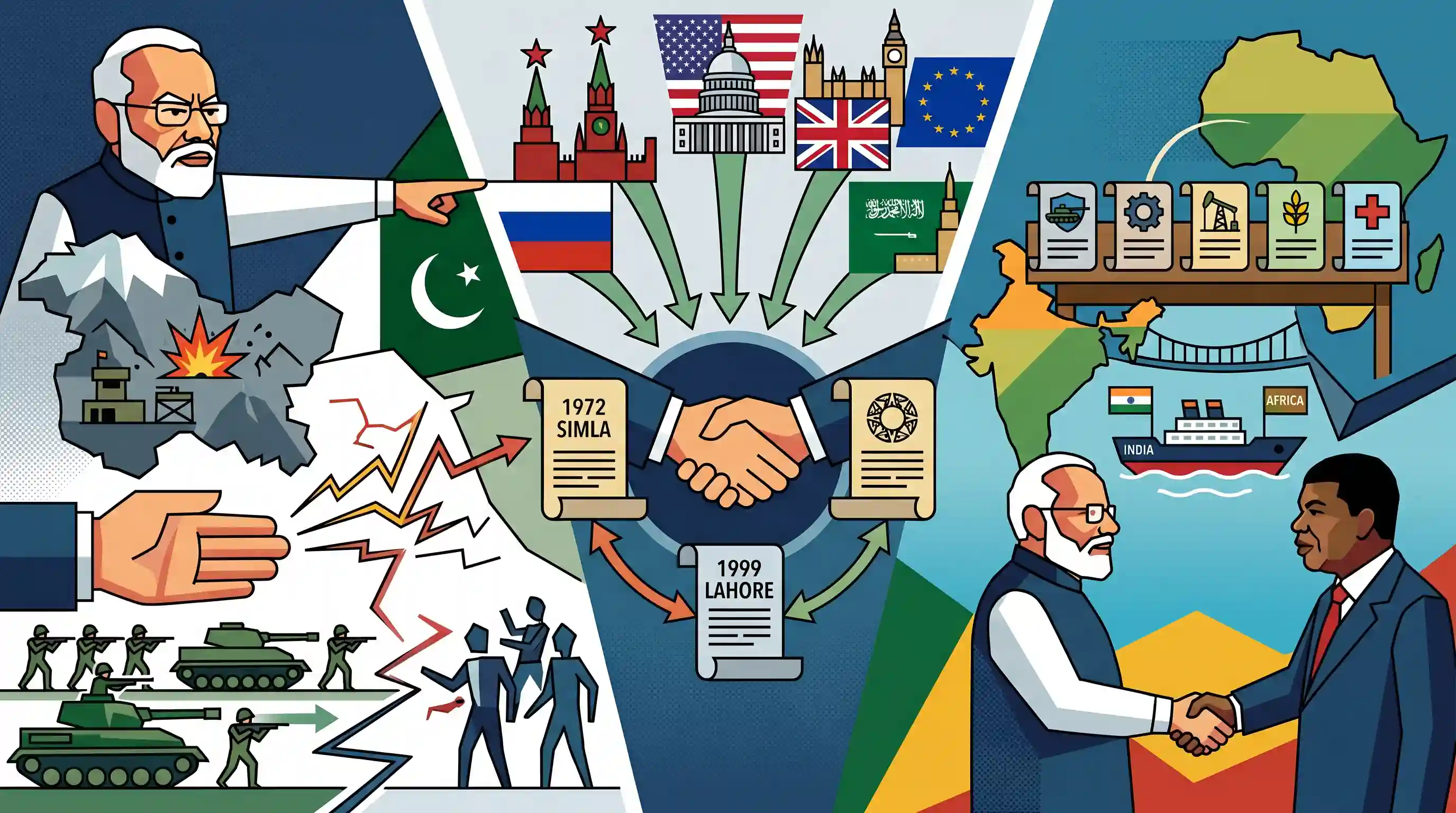
Following the Pahalgam terror attack, Prime Minister Narendra Modi asserted that India would take "firm and decisive action" against the perpetrators, labeling the incident as cross-border terrorism linked to Pakistan and giving the military a "free hand" to respond. Amidst heightening tensions, Russia urged both nations to settle their differences diplomatically based on the historic Simla Agreement and Lahore Declaration, echoing calls for de-escalation from the US, UK, EU, and Saudi Arabia. Concurrently, India strengthened its ties with Africa by signing five agreements, including a defense pact, during the state visit of Angolan President Joao Manuel Goncalves Lourenco.
Key Points
- PM Narendra Modi promised "firm and decisive action" against perpetrators of the Pahalgam terror attack, condemning it as Pakistan-linked cross-border terrorism.
- The Indian government has given the service chiefs a "free hand" to conduct military operations against Pakistan.
- Russian Foreign Minister Sergey Lavrov advocated for resolving the India-Pakistan tensions bilaterally using the 1972 Simla Agreement and the 1999 Lahore Declaration.
- Angolan President and current African Union chair Joao Manuel Goncalves Lourenco visited India, resulting in five bilateral pacts including a defense cooperation agreement.
- The US, UK, EU, and Saudi Arabia have collectively urged de-escalation of tensions in the region.
Important Terms
Simla Agreement

A 1972 bilateral peace treaty between India and Pakistan following the 1971 war. It mandates resolving all disputes, including Kashmir, through peaceful bilateral negotiations without third-party intervention.
UPSC context
GS Paper II: International Relations. It is the cornerstone of India's "bilateralism" policy regarding the Kashmir dispute and regional peace.
Lahore Declaration
A 1999 bilateral agreement between India and Pakistan aimed at peace and stability. It emphasizes nuclear restraint, de-escalation of tensions, and a commitment to the 1972 Simla Agreement.
UPSC context
GS Paper II: International Relations. Tests knowledge of nuclear diplomacy and attempts at normalizing ties despite cross-border tensions.
African Union (AU)
A continental union of 55 African member states. It promotes political and economic integration, peace, and security across the continent, recently becoming a permanent member of the G20.
UPSC context
GS Paper II: International Relations. Crucial for South-South cooperation, India's "Global South" leadership, and UN Security Council reform support.
European Union (EU)
A supranational political and economic union of 27 European member states. It is one of India's largest trading partners and a key partner in technology and climate action.
UPSC context
GS Paper II: International Relations. Focuses on trade (FTA negotiations), maritime security in the Indo-Pacific, and global governance.
Line of Credit (LoC)
A credit mechanism where India provides funds to other countries to purchase Indian goods/services. India recently extended $200 million to Angola for defense procurement.
UPSC context
GS Paper II & III: Foreign Policy/Economy. An instrument of "economic diplomacy" and capacity building in developing nations.
Prelims Trap
The Simla Agreement allows for UN or third-party mediation if bilateral talks fail.
The 1972 Simla Agreement strictly binds India and Pakistan to resolve differences bilaterally, effectively negating third-party (including UN) mediation, a cornerstone of India's stance.
Static Concepts Connected
What are the key mandates of the Simla Agreement and Lahore Declaration?
- Simla Agreement (1972): Converted the 1971 ceasefire line into the Line of Control (LoC) and legally established bilateral dialogue as the exclusive framework for dispute resolution.
- Lahore Declaration (1999): Formally acknowledged the nuclear dimension of South Asian security, committing both nations to mutually agreed Confidence Building Measures (CBMs) to avert accidental conflicts.
How is India's diplomatic engagement with Africa evolving?
- Traditional Approach: Historically centered on developmental assistance, capacity building (ITEC), lines of credit, and soft power initiatives like the Pan-African e-Network.
- Defense Shift: Now actively transitioning into structured security partnerships, joint military exercises (AFINDEX), and defense exports to counter Chinese presence and secure the Indian Ocean Region.
Cross-Topic Patterns
Strategic restraint to proactive deterrence
Granting the military a 'free hand' signifies a doctrinal shift from strategic restraint to proactive punitive operations, commonly tested in Internal Security papers on asymmetric warfare.
African Union and Global South leadership
Signing defense pacts with Angola (current AU chair) aligns with India's broader Global South strategy, capitalizing on the AU's recent induction into the G20.

Expect a 2026 Prelims question mapping India-Pak treaties (Simla/Lahore/Tashkent) or a Mains Q on India's shifting Africa strategy.
Linked PYQs · 4
Linked PYQs · 4
- 2020MainsGS3
Analyze internal security threats and transborder crimes along Myanmar, Bangladesh and Pakistan borders including Line of Control (LoC). Also discuss the role played by various security forces in this regard.
- 2024MainsGS3
India has a long and troubled border with China and Pakistan fraught with contentious issues. Examine the conflicting issues and security challenges along the border. Also give out the development being undertaken in these areas under the Border Area Development Programme (BADP) and Border Infrastructure and Management (BIM) Scheme.
- 2025MainsGS2
India-Africa digital partnership is achieving mutual respect, co-development and long-term institutional partnerships. Elaborate.
- 2021MainsGS2
If the last few decades were of Asia's growth story, the next few are expected to be of Africa's.” In the light of this statement, examine India's influence in Africa in recent years.
